SEO in 2026 feels a lot like showing up to a party where everyone keeps whispering, “Did you hear, SEO is dead”? Meanwhile, SEO is in the corner, alive, caffeinated, and silently driving most of the internet traffic. 😀
Ever since its birth, SEO has faced and survived countless algorithms – keyword stuffing, Panda, Penguin, mobile-first, voice search, AI search engines, and LLMs. Every time there’s an industry update, a new rumor takes over: “This is the end”, “SEO doesn’t matter anymore,” or ChatGPT is eating SEO”.
Spoiler Forever: SEO isn’t dying. It’s just changing outfits to slay even more.
With SEO, there’s no real problem – neither the changing algos or advancements and trends like AI or zero-click searches. It’s the outdated beliefs that refuse to leave the room. SEO myths are extremely harmful as they waste time, drain budgets, and leave founders with the guesswork or wrong decisions. Result? Both their money and brand image are at stake.
In 2026, SEO is not just about blue links. It’s an amalgamation of classic SERPs, local discovery, AI answer panels, voice search, and content that machines summarize before humans even click.
With the SEO industry experiencing the AI shift, it has led to the rise of many confusions, and myths thrive in confusion.
So, let’s clear the fog!
Myth #1 - SEO is Only About Google
Businesses and many SEO “specialists” still believe that SEO is all about Google rankings. This mindset devalues intent and ignores how users actually search today.
The Truth
SEO is now multi-platform and multi-engine.
While Google still matters a lot, it’s no longer the only discovery engine. People now look for information or discover brands through various channels – YouTube, Bing, Apple, Amazon, Reddit, etc. They aren’t limited to Google anymore.
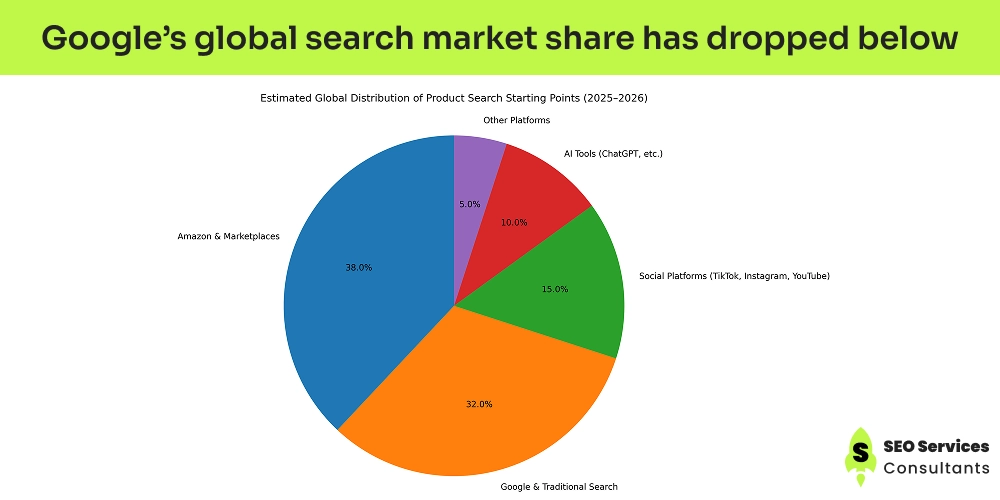
Google’s global search market share has dropped below 88% for the first time in a decade.
Source: StatCounter (2025)
Meanwhile, Bing, DuckDuckGo, Amazon, and AI search tools continue to grow.
Moreover, Search Engine Journal confirms that over 40% of product searches now begin on non-Google platforms.
Tip
Build content that works across platforms. It should be optimized for popular platforms like Google, Bing, YouTube, and AI crawlers, and not just blue links. Also, well-structure your content to make it easy-to-scan, intent-driven, and ready for citation. Using clear headings, concise answers, and rich context can help search engines, social platforms, and AI systems easily understand your content.
Myth #2: Exact Match Domain Names Boost Rankings
It’s still believed that owning a domain like bestcrmsoftware.com gives an automatic ranking benefit. The assumption is that Google “trusts” keyword-heavy domains more, ranks them faster, and considers them more relevant by default.
Due to this belief, teams often prioritize exact-match domains over brand credibility, content quality, or long-term positioning.
The Truth: Branding & Content Matter More Than Keywords in Domains
Exact match domains stopped being a ranking factor years ago. John Mueller of Google has repeatedly confirmed that EMDs do not provide ranking boosts. In fact, low-quality EMD sites are hit harder by quality updates.
Tip
Instead of choosing EMDs, choose a branded domain and invest in topical authority, content quality, and backlinks.
Myth 3: ChatGPT is Eating SEO
This misconception claims that AI tools like ChatGPT are replacing search engines entirely. It is believed that people will stop Googling, click fewer websites, and rely on AI answers. As a result? Search organic traffic will collapse, rankings won’t matter, and traditional SEO efforts will soon become irrelevant or obsolete.
The Truth
Most AI answers are generated from indexed web pages, meaning AI tools are powered by SEO content. If your content doesn’t exist or isn’t crawlable, AI cannot reference or learn from it.
Google itself confirmed that AI overviews pull answers from ranking pages, not random sources.
Tip
SEO feeds AI and is here to stay. Instead of abandoning it, adapt it. Make sure your content is crawlable, structured, and authoritative so AI tools can reference it accurately, giving your website visibility in AI summaries and traditional search results.
Myth 4: Ranking #1 Automatically Gets You Featured in AI Answers
A majority of SEOs assume that an AI tool or an answer panel (such as Google AI Overviews or a ChatGPT-style summary) will automatically extract content from their pages if their site ranks #1 on Google for a keyword.
The misconception is that top-ranking pages are always authoritative to AI, and the position at the top ensures that they are visible in terms of AI results. This has made marketers consider only SERP rank, disregarding AI-specific format, content clarity, and structured responses.
The Truth: AI Prioritizes Structured, Intent-Focused Content
AI panels prioritize clarity, structure, and intent alignment (known as generative engine optimization), not just rank. A popular analysis on AI Overviews found that only ~52% of AI citations come from top-3 rankings.
Tip
Use concise answers, schema, and question-based formatting.
Myth 5: Using “Near Me” Keywords Improves Local Search Rankings
Marketers often add the “near me” phrase directly into their website copy, blog posts, or Google Business profile descriptions, expecting their local rankings to improve. This myth became popular as “near me” searches increased with mobile and voice search. As a result, marketers and brands create keyword-stuffed pages hoping to capture local intent.
The Truth: Google Uses Location Signals, Not Keywords
Google doesn’t focus on the literal phrase “near me” to determine local rankings. Instead, it uses local signals such as the user’s GPS data, search context, IP address, and business proximity.
Google’s local algorithm, by default, understands the “near me” intent, even if these words never appear on your page. Moreover, overusing the phrase can actually hurt readability and trust.
Tip
Create strong, location-specific pages with clear city or neighborhood references, consistent NAP (name, address, phone) details, embedded maps, and locally relevant content that actually informs and helps users. Focus on proximity signals and relevance, and not keyword shortcuts.
Myth 6: AI Citations Are Always Based on Brand Authority
There’s a growing misconception that AI-powered tools only trust and cite large, well-known brands. It’s believed that if you aren’t a household name like Forbes, Nike, or Amazon, or a high-domain enterprise-level company, your content won’t appear in AI answers.
This encourages startups and niche publishers from even trying to optimize for AI visibility, creating the false idea that AI is an exclusive, brand-centric game.
The Truth
AI citation patterns do show a strong presence of brand-controlled success. But this doesn’t mean smaller, specialized sites are completely ignored.
The analysis clearly reveals that AI heavily favors content quality, structure, and reliability, not just brand size. The reason that big brands win more often is that they publish cleaner, better-maintained, relevant content. This also means that smaller sites with excellent informational clarity can also show up.
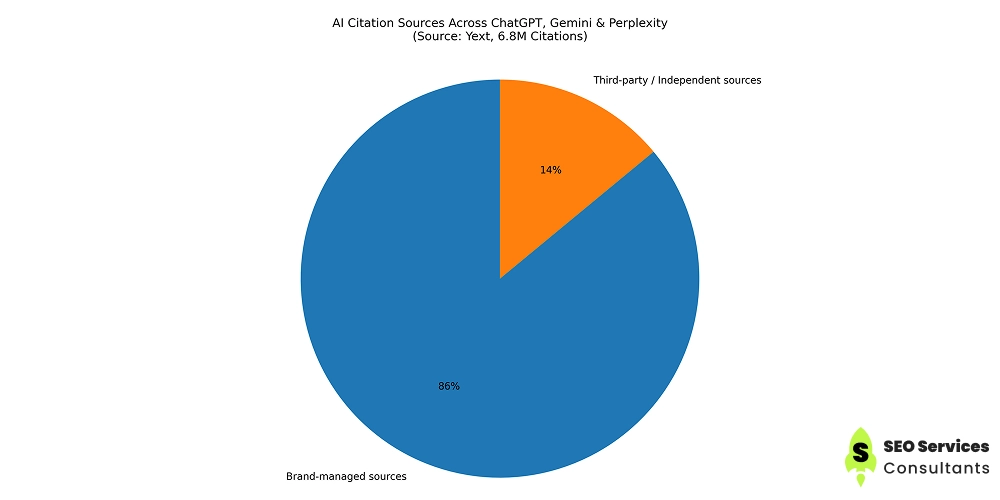
A 2025 Yext analysis of 6.8 million citations across Gemini, ChatGPT, and Perplexity found that 86% of cited sources were from brand-managed assets like websites, listings, and structured data.
Tip
Create structured, crawlable content that optimizes your first-party assets with clear facts, FAQs, and topical breakdowns. Also, earn mentions on listings, industry directories, or partner sites, as AI models lean heavily on structured data they can trust.
Myth 7: Google Penalizes All AI-Generated Content ‘
This myth is a major debatable topic currently. Any content created with the help of AI software, such as ChatGPT, Bard, or Claude, will be automatically penalized by Google. Many creators assume that Google has developed a special algorithm that identifies and demotes AI-generated text on the assumption that AI content is of poor quality, spammy, or manipulative by nature.
Here’s what people are saying (real discussions):
Several experiments shared by users show drops in traffic, strengthening the confusion about whether AI-generated content is acceptable or not.
The Truth: Google Penalizes Low-Quality Content - Not AI Usage
Google has repeatedly clarified that it does not penalize content simply because it was generated or assisted by AI.
Google explicitly states: “Using automation—including AI—to generate content with the primary purpose of manipulating ranking in search results is a violation of our spam policies.” They further clarify, “Our focus on the quality of content, rather than how content is produced, is a useful guide that has helped us deliver reliable, high-quality results to users for years. It’s important to recognize that not all use of automation, including AI generation, is spam.”
However, it does state that it uses algorithmic demotions or manual intervention to penalize low-quality, unhelpful, or manipulative content, no matter how it was generated. It punishes things like spammy mass content, auto-generated pages without adding value, or content that is created to be ranked instead of assisting users.
A 2024 SEMrush analysis of 20,000 pages reported a negligible ranking gap between human-written and AI-written content when quality standards were met.
In an official statement on X, Google Search Liaison, Danny Sullivan, clarified: “Content created primarily for search engine rankings, however it is produced, is against our guidance. If content is helpful & created for people first, that’s what matters.”
So, if your AI-written content experienced a decline in ranking or traffic, it is not AI to blame, but all the basics that have always been important: relevance, intent match, quality, and trust.
Tip
A good practice is to use AI as a drafting tool, and not a publishing shortcut. Always revise, verify facts, and add real insight. Adhere to the EEAT (Experience, Expertise, Authority, Trustworthiness) principles and incorporate human experience to remain on the good side of Google.
Myth 8: Zero-Click Search Has Killed SEO
Let’s first understand what a zero-click search is. These days, users find their answers to their search queries in the AI overview, featured snippet, or “People Also Ask” section. So, they don’t go beyond the search results page.
Zero-click searches mean users get their answers directly from search engine results pages without clicking through to any website.
This has led to a belief that because users often get answers directly on Google, SEO no longer delivers value.
If users don’t click on website links, there’s no logic working for rankings, content creation, and optimization. All these are a waste of time and budget.
The Truth: SEO Has Shifted From Clicks To Visibility & Trust
Zero-click search hasn’t killed SEO, but it has changed how SEO delivers value!
Repeated visibility in AI results builds brand familiarity, perceived authority, and trust. This means, AI hasn’t killed traditional SEO; it is transforming search for a better user experience and brand visibility.
Tip
In 2026, when zero-click searches are increasing, marketers must shift their focus from clicks to visibility. They must design optimization strategies for authority-driven content that AI trusts. Clear explanations, consistent subject expertise, and strong EEAT signals are the key to search visibility.
And when users repeatedly see you in AI search results, trusts build over time, driving more brand searches and higher-intent visits later.
Don’t Let Myths Become A Barrier in Your Digital Growth - Rely on Experts!
SEO in 2026 and beyond is neither broken, dying, nor losing relevance. It’s simply evolving faster than ever.
What truly holds back brands isn’t the algorithms or trends, but clinging to outdated assumptions and half-baked truths. If you aren’t prepared well or don’t have strong foundations, algorithms will feel complex and unpredictable at times.
Google and other reliable platforms consistently share guidelines, and independent studies continue to test what works and what doesn’t. Plus, your own data remains the most reliable signal of all. By remaining skeptical, checking the facts using reliable sources, and making decisions based on performance, and not panic, SEO is much more predictable and effective.
This is where having the right expertise matters. At SEO Services Consultant, we help brands cut through SEO noise, adapt to AI-driven search, and build strategies rooted in data, not myths.