Do you have a subdomain and want consistent growth across both your main domain and subdomain? If yes, this blog will point you in the right direction.
Search engine optimization plays a critical role in building a strong digital presence. Many businesses assume that optimizing only the main domain is enough to stay ahead of competitors. That’s a common mistake. Search engines treat a subdomain as a separate website. This means it requires its own SEO strategy, rather than relying on the authority of the main domain.
Still have questions or want a clearer understanding of subdomain SEO?
In this blog, we’ll explain what subdomain SEO is and how it affects your search performance. We’ll also explore whether creating a subdomain is good or bad for SEO. To avoid confusion, we’ll break down the difference between subdomains and subdirectories – two terms that are often misunderstood.
What Is a Subdomain?
Simply put, a subdomain is a part of your main website’s URL. When a prefix is added before the primary domain, it becomes a subdomain, also known as a child domain.
For example, imagine a website called www.services.com, where the core service-related content lives. If you want to create a separate section with a different purpose, audience, or content focus, such as a blog, you can use a subdomain like www.blog.services.com.
A subdomain is commonly used to organize content that serves a specific goal or audience. While it stays connected to the primary website, it can function almost like a standalone site, with its own unique structure and strategy. Sometimes, use a different platform if needed.
Generally, Subdomains are widely used for blogs, regional or language-specific websites, help and support centers, learning portals, and e-commerce stores.
They are especially useful when a section of the website requires a different design, functionality, or content strategy. By using subdomains, businesses can maintain a well-organized website while delivering a focused user experience.
Is a subdomain and subdirectery same?
No. Both are different. Someone with a strong understanding of SEO can clearly identify the difference between the two, but in reality, that percentage is quite low. These terms are often misunderstood, even though they are completely different.
As mentioned earlier, a subdomain works as a separate entity or branch, whereas a subdirectory is simply a folder within the main domain. A common example of a subdirectory is example.com/services or example.com/blog.
Aspect |
Subdomain |
Subdirectory |
|---|---|---|
| URL Structure | blog.example.com | example.com/blog |
| SEO Authority | Separate | Shared |
| Ranking Effort | Higher | Lower |
| Best For | Distinct content or functions | Related content |
All in all, Subdirectories are usually better for SEO when the content is closely related. Subdomains work best for clearly separate purposes.
How Search Engines Treat Subdomains
Whether your subdomain is connected to the root website, but still Search engines still treat subdomains as separate properties. Your subdomain is indexed and evaluated independently. This means it does not automatically receive the full SEO benefits of the primary domain.
As a result, subdomains’ SEO require their own strategy. In his process, On-page optimization, technical setup, and content quality must be handled individually. While some brand authority may carry over, strong rankings are not guaranteed without consistent optimization efforts.
Authority transfer between the main domain and a subdomain is limited. Search engines rely heavily on signals such as backlinks, user engagement, and content relevance. A subdomain with weak content or poor link support will struggle to rank, regardless of how well the main website performs.
Content quality and backlinks play a crucial role in subdomain performance. Each subdomain must publish valuable, relevant content and build its own link profile to gain trust and visibility in search results.
If a subdomain is poorly structured or lightly optimized, it can underperform significantly. In some cases, it may receive little to no organic traffic, even when the main domain ranks strongly. This is why proper planning and ongoing SEO efforts are essential for subdomain success.
When Subdomain SEO Makes Sense
Subdomains are effective in specific scenarios:
- International or regional targeting
- Large content sections with different audiences
- Separate platforms (help centers, SaaS dashboards)
- Technical limitations or CMS constraints
If the content has a different goal, user intent, or structure, a subdomain can be justified.
Best Practices for Subdomain SEO
Ranking your subdomain like your main domain requires more attention and a clear strategy. Below, we’ve mentioned useful and practical practices that help improve your subdomain rankings. Follow these steps and monitor the results regularly.
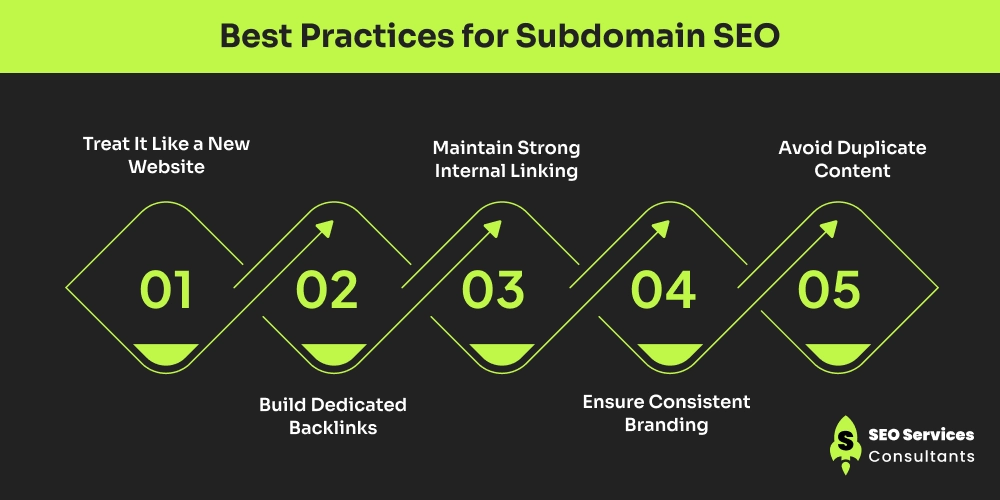
1. Treat It Like a New Website
First of all, your subdomain has a different URL from your main domain. Because of this, it should be treated like a separate website. It requires its own on-page SEO, technical SEO, and high-quality content. These factors influence search engines directly and play an important role in ranking the subdomain for relevant queries.
2. Build Dedicated Backlinks
Subdomains need their own backlink profile to build authority. Backlinks pointing only to the main domain do not automatically strengthen the subdomain. To improve rankings, you should earn relevant and high-quality backlinks specifically for the subdomain. These links help search engines understand the credibility and relevance of the subdomain, which directly impacts its ability to rank.
3. Maintain Strong Internal Linking
Internal linking plays an important role in subdomain SEO. Strategic links between the main domain and the subdomain help users navigate easily and also guide search engines. Proper internal linking allows link equity to flow between domains and improves crawlability, which supports better indexing and ranking performance.
4. Ensure Consistent Branding
Brand consistency across your main domain and subdomain is essential. Using the same brand tone, design elements, and messaging builds trust with users. When visitors recognize your brand, they are more likely to stay longer and engage with your content. This positive user behavior indirectly supports better SEO performance.
5. Avoid Duplicate Content
Each subdomain should provide unique and valuable content. Reusing or duplicating content from the main domain can confuse search engines and harm rankings. If you notice duplicate passages while writing, using a plagiarism remover can help refine the content and maintain originality. Unique content helps search engines clearly understand the purpose of the subdomain and improves its chances of ranking for targeted keywords.
Common Subdomain SEO Mistakes
- Assuming automatic authority transfer
- Thin or low-quality content
- Poor internal linking
- No backlink strategy
- Using subdomains without a clear purpose
These mistakes often lead to indexing issues and weak rankings.
Are Subdomains bad for SEO?
No, subdomains are not bad for SEO when used correctly. Search engines consider subdomains as separate domains, so they require their own SEO strategy, content, and backlinks. If managed poorly, a subdomain can be difficult to rank.
However, when subdomains are used with a clear purpose, such as targeting specific regions, services, or content types, they can strengthen your overall search presence. The key is proper optimization, consistent branding, and avoiding duplicate content. Subdomains are not an SEO shortcut, but they are not a disadvantage either. Their performance depends entirely on how strategically they are implemented.
Final Thoughts!
Subdomain SEO is powerful when used correctly. It offers flexibility and scalability, but it demands a clear strategy and consistent optimization. If your content serves a distinct purpose, a subdomain can work. If not, a subdirectory is often the smarter SEO choice.