Offering SEO services but don’t have an in-house team, and don’t know what to do next?
More than 90% of online experiences start with a search engine, and businesses that appear on the first page get the majority of clicks. Because of this, many agencies want to offer SEO services but often struggle when they don’t have a dedicated team.
Instead of hiring and investing your valuable resources in recruitment and training, you can make a decision that saves both money and time.
Here, as an agency, you have two options: one is outsourcing SEO services, and the second one is white-label SEO. These two choices depend on your requirements.
Obviously, many of you are confused about which one is ideal for you. So this blog is here to clarify each term, so you can make the decision freely and with a clear mind.
Let’s get started!
What is White Label SEO?
White-label SEO is a completely outsourced model. In this model, a third-party provider performs SEO tasks under your brand name. For more clarity, it is like you onboard a client and promise SEO services, but you don’t have a dedicated SEO, design, or development team.
So you contact an SEO agency that actually works on the project.
In this case, they handle everything, from auditing and keyword research to content creation and optimization. But when they deliver all this work, the client thinks it is done by your agency.
With this setup, you can save on hiring and training investment and directly work with a professional team that already knows the process and how to deliver results. Through his model, agencies expand their range of services without the overhead of building an in-house team.
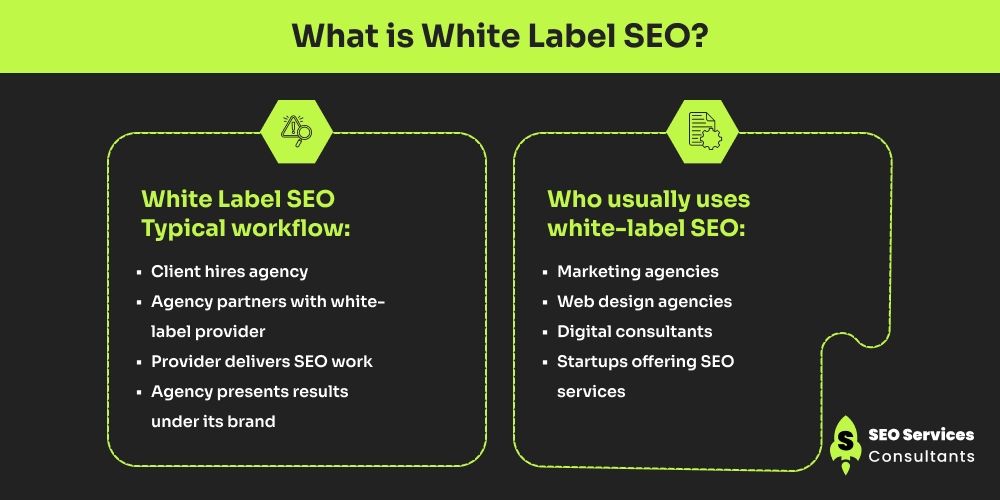
White Label SEO Typical workflow:
- Client hires agency
- Agency partners with white-label provider
- Provider delivers SEO work
- Agency presents results under its brand
Who usually uses white-label SEO:
- Marketing agencies
- Web design agencies
- Digital consultants
- Startups offering SEO services
What is Outsourcing SEO?
Outsourcing SEO is when agency hire an third party SEO service or team to complete the specific SEO task. Again, this work is delivered to the clients and comes under your brand name without revealing the actual agency name.
Simply put, you get an SEO project from the clients, but you have a shortage of team who create backlinks or content. In this case, instead of building the in house team, you outsource the work to an SEO specialist, freelancer, or another SEO company that has experience in this area.
With this approach, agencies reduce workload, save time, and get support from experts when required, without going through a long hiring process. It is more flexible, especially for agencies that handle different types of SEO projects for multiple clients.
Include common outsourcing options:
- Freelancers
- Offshore SEO teams
- SEO agencies
- Specialized SEO experts
Explain typical tasks outsourced:
- Keyword research
- Technical SEO
- Link building
- Content optimization
- SEO audits
Key Differences Between White Label SEO and Outsourced SEO
To understand it better, here we are going to compare both models so you can see the differences more clearly. This will help you understand the concept more deeply and make the right decision.
Factor |
White Label SEO |
Outsourcing SEO |
|---|---|---|
| Brand Ownership | Your brand is presented to the client. All work appears under your agency name. | An external brand is often visible, depending on the arrangement. |
| Client Relationship | The agency manages all client communication and maintains the relationship. | It may involve direct interaction between the client and the external provider. |
| Scalability | Designed for scaling SEO services as your agency grows. | Depends on the capacity of the freelancer or external team. |
| Control | Follows a more structured and defined process. | Control can vary widely based on who you hire. |
| Consistency | White-label providers usually follow a fixed workflow and standard process. | Quality and process depend on the provider you choose. |
| Reporting | Usually includes branded reports that you can share with clients. | May not always include reports that are ready to send to clients. |
Pros and Cons of White Label SEO
Without investing in a full-time in-house team, white label SEO is a popular option for businesses of all sizes. Before making a decision, it is essential to weigh the pros and cons of white label SEO. This will help you pick the right service.
Pros
- Easy to scale services
- Increased Revenue
- Maintain brand authority
- No need to hire a full SEO team
- Improve Efficiency
- Reduce Costs
- Access to specialized skills
- Structured systems and processes
- Faster service delivery
Cons
- Less control over execution
- Dependence on provider quality
- Sometime communication issues
- Brand Dilution
- Contractual Issues
- May cost more than freelancers
Pros and Cons of Outsourcing SEO
Outsourcing SEO services is also an ideal option. However, when deciding what is right for your business, it is important to analyze all scenarios so it does not cost too much. Here, we mention the pros and cons to help you make a clear decision.
Pros
- Lower cost options available
- Flexible hiring
- Access to specialized experts
- Good for specific SEO tasks
- Improve your team efficiency
Cons
- Quality inconsistency
- Communication issues
- Harder to maintain brand identity
- Security risks
Cost Comparison: White Label SEO vs Outsourcing
Cost is one of the dominant factors when agencies choose between white-label SEO and outsourcing SEO. At first, both may look similar, but their pricing structures and long-term expenses can be different.
First, let’s understand the common SEO pricing models used in the industry:
Monthly Packages |
Pre-Project Pricing |
Hourly Rates |
|---|---|---|
| Agencies pay a fixed monthly fee for ongoing online SEO services. | Used for specific tasks like SEO audits, website optimization, or keyword research. | Mostly used when working with freelancers or independent SEO consultants. |
| This usually includes optimization, reporting, and continuous performance improvements. |
Now, if we talk about white-label SEO, the pricing is usually more structured. Most providers offer fixed monthly plans based on the services included and the number of clients you manage. This makes budgeting easier because you already know how much you will spend each month. It also includes a team, process, and reporting system.
On the other hand, outsourcing SEO pricing can vary a lot. Different freelancers or agencies charge different rates. Sometimes it looks cheaper in the beginning, but the total cost may increase depending on the work scope, revisions, or additional tasks.
There are also some hidden costs that agencies often overlook. These include time spent on project management, communication with external teams, follow-ups, and revisions.
In the long run, white-label SEO is usually more cost-effective for agencies that want to scale their SEO services. Outsourcing works better when you only need help with specific SEO tasks or short-term projects.
Cost Factor |
Costs of White Label SEO |
Costs of Outsourcing SEO |
|---|---|---|
| Overview | The costs of white-label SEO vary depending on the provider, scope of work, and expertise level. | The costs of outsourcing SEO depend on the provider, project complexity, and required expertise. |
| Setup Fees | $500 – $2,000 | $0 – $1,000 |
| Monthly Retainer Fees | $1,000 – $5,000 | $500 – $2,000 |
| Project-Based Fees | $2,000 – $10,000 | $1,000 – $5,000 |
Which Model is Best for Your Business?
The right choice depends on how your agency works, your growth plan, and the type of clients you handle. Both models solve different problems, so it’s better to look at practical scenarios before deciding.
White-label SEO is usually a better fit when:
- Agencies want to start offering SEO services quickly without building an in-house team.
- The business is planning to scale and handle more SEO clients in the future.
- The focus is on building strong branding and maintaining long-term client relationships.
- The agency wants a structured process and consistent service delivery.
In these situations, white-label SEO helps agencies grow faster while keeping their brand in front of the client.
Outsourcing SEO works better in cases like:
- Small businesses that do not need full-scale SEO management.
- Agencies that are still testing SEO services before making a long-term investment.
- Companies that only need help with specific SEO tasks like audits, content optimization, or link building.
- Businesses that want flexible hiring depending on project needs.
Another important part of the decision is evaluating a few key factors inside your business:
- Things you should consider before choosing a model:
- Your available budget for SEO services.
- The team size you currently have.
- How many clients do you manage or expect to handle?
- Your long-term business goals and growth plans.
Still Not Sure? Consult With SEO Service Consultants
If you are a business owner planning to outsource SEO but unsure which model fits your needs or what it may cost, speaking with experienced consultants can help. A professional consultation clarifies the right approach and helps you use your time and resources more efficiently.
As a recognized SEO agency, we provide practical guidance based on your business goals, scale, and service requirements. Our team works with both white-label SEO and outsourced SEO models, helping you choose the option that aligns best with your operations and growth plans.
We also operate behind the scenes when needed, allowing you to present the work under your brand while maintaining full client ownership.
Get in touch today to find the right SEO partnership at a cost-effective package that supports long-term growth and strengthens your relationship with clients.