SEO is no longer about rankings on pages; rather, it’s about owning the answers, influencing the decisions, and being visible everywhere your audience searches. 2026 welcomes the era of answer engine optimization (AEO), AI-driven search experiences, and search-everywhere marketing. Based on recent industrial analysis, 50% of searches now trigger AI-generated overviews, and 60% of web pages fail basic performance standards. And due to this, 67% of content fails to convey search intent. And this is not an SEO problem; this depicts an outdated strategy.
This blog is divided into two segments. The first one will help you learn why most SEO campaigns fail, even when participating in SEO practices. And with the second segment, you will learn how to thrive in SEO campaigns despite the challenges they face. It will include strategies and experience smart agencies follow to stand out across SERPs.
Part 1: Why Most SEO Campaigns Fail in 2026?
In 2026, you will be consistently witnessing your SEO campaigns getting down and failing in the realm. Then this SEO failure is nothing about a lack of effort; rather, it is caused by misalignment with how the search engine has shifted its workings.
Search engines these days have evolved to intelligent answer systems, powered and backed by AI, behavioral data, and trust elements. Still, there are many businesses that operate following the 2017 mindset. And the result? They might be visible but not relevant. They might be ranking but not converting. And they are surely investing but not growing? Do you want the same for yourself? Definitely not. So let’s break down the real reasons that might be causing significant challenges in your way.
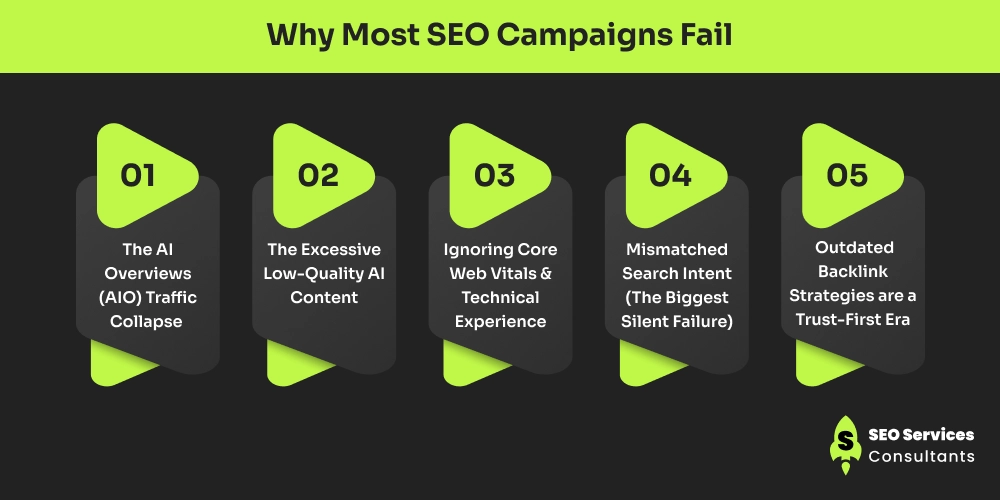
1: The AI Overviews (AIO) Traffic Collapse
If counted among all, the most disruptive shift that has been seen in modern SEO is the rise of AI-generated search results. Search engines these days synthesize the information from multiple sources, deliver direct answers, and reduce the need for users to visit websites. This shift has changed the fundamentals in terms of rankings and value.
Most businesses get it wrong when they optimize to rank on page 1, increasing their click-through rates and driving traffic to blog pages. But in reality, they need to optimize for answer-based queries, because users are getting answers directly on the SERPs and making a decision without even clicking. Brands are failing with their SEO campaigns because they are trying to become the source behind the answer rather than just putting effort into becoming another link below the AI summary.
Due to this, organic traffic is declining despite stable rankings, visibility has reduced in terms of high-intent searches, and authority has been lost to competitors who structure content better. In 2026, if your content is not well structured for AI consumption, you are invisible, even if it ranks somewhere.
2: The Excessive Low-Quality AI Content
With the presence of AI, yes, the content creation has democratized, but somewhere it has also devalued the average-looking content. Based on today’s search landscape, content saturation has been created with rewritten articles, generic yet similar guides, and content creation without real-world experiences. And from here, brands started confusing content volume with content value. They produce 50+ blogs, but none of them has depth, originality, or insight. And the outcome looks like a failure.
Search engines evaluate first-hand experience, depth of market knowledge, authenticity of insights, and real-world usefulness. That content lacks such signals, generally fails to rank higher, fails to engage, and is usually filtered out from helpful content systems.
When you look at this in reality, it creates deep impressions, traffic spikes without any retention, and pages that never move beyond page 2 and page 3. In 2026, content is not more about being present; it’s about being worth consuming.
3: Ignoring Core Web Vitals & Technical Experience
Modern SEO is undoubtedly aligned to deliver user experience engineering. Search engines measure what kind of response users are sharing while interacting with the site. Does it load instantly? Is it easy to navigate? Does it work perfectly even on mobile? Most campaigns go wrong because of technical SEO, because it is not about a one-time setup or a low-priority backend task. Technical performance directly impacts the business rankings, user engagement, and conversion rates.
4: Mismatched Search Intent (The Biggest Silent Failure)
Search intent sets the true foundation of modern SEO, and still, many people ignore this. Every search has a purpose here, where users look for answers to their queries, compare options, make purchases, and find specific brands. Another reason why campaigns fail is that they target keywords based on their search volume, difficulty, and competition. Understand the difference with the help of this example:
Users query search for ‘best project management software,’ and they get information or blog guides about comparisons of pricing, pros and cons, and use cases, which are totally off from what they are seeking.
And due to users leaving instantly, the engagement drops, and rankings start declining over time.
5: Outdated Backlink Strategies are a Trust-First Era
Backlinks are still powerful, but their role has evolved. Earlier, more links were considered higher rankings, but in 2026, better links are preferred as a stronger trust signal. And you know where campaigns fail: they rely on cheap backlink packages, irrelevant guest posts, and automated link-building tactics.
Search engines evaluate the content’s contextual relevance, source authority, and brand association. Whereas low-quality links add no value, they can harm the business’s credibility and trigger spam detection.
Part 2: How Smart Agencies Turn SEO Into a Growth Engine
If you are looking for a way to differentiate between failing campaigns and successful ones, then it is not about effort; it is all about strategy evolution. Smart agencies in 2026 don’t blindly do SEO. They develop a search ecosystem that drives revenue, authority, and long-term gain.
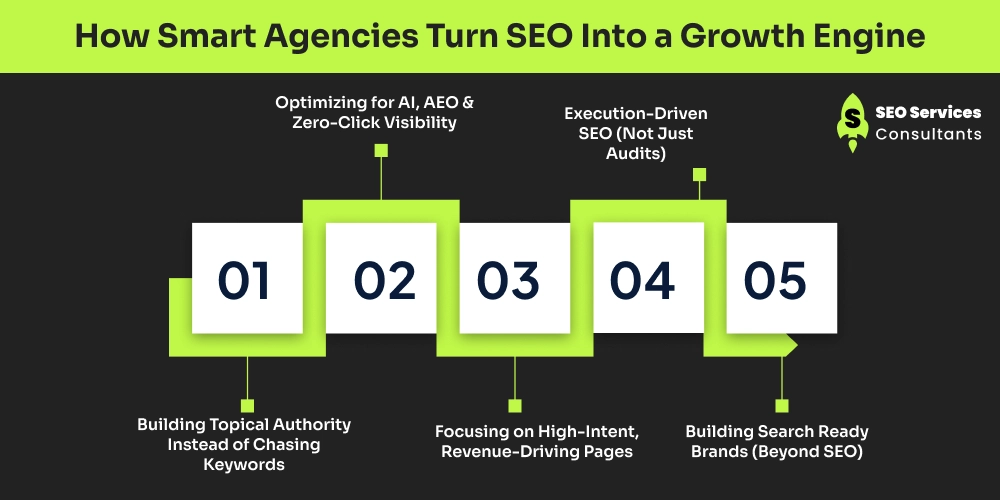
1: Building Topical Authority Instead of Chasing Keywords
Modern SEO is not just about ranking for a search term; rather, it’s about owning a topic. Smart agencies believe in creating pillar pages that hold core information, cluster content supporting the subtopics, and strong internal linking for structuring. This helps the search engine to understand brand authority in its space. And it works to improve search rankings across multiple keywords, builds long-term visibility,y and increases user trust.
The real difference comes when you replace your habit of writing isolated blogs.
2: Optimizing for AI, AEO & Zero-Click Visibility
Brands that aim to win over AI-driven search results adapt to it. Her,e agencies focus on structuring their content for AI readability, providing clear yet direct answers, using schema markup, and organizing the whole content logically. Here, the goal is to get features for AI-generated summaries, featured snippets, and people-also-ask sections. The outcome businesses get is increased visibility even without any clicks, higher brand recall, and authority positioning in search. In 2026, visibility matters more over traffic because visibility drives trust and trust drives conversions.
3: Focusing on High-Intent, Revenue-Driving Pages
Not all pages work equally; smart agencies identify pages that generate business. Here, we aim to analyse performance data, identify high-intent keywords, and improve existing pages instead of creating new ones. To achieve the progress, we aim to rank on page 2, close to conversion, and high in commercial intent. The result needs Faster SEO wins, higher ROI, and more conversions without scaling content production.
4: Execution-Driven SEO (Not Just Audits)
Conventional means of SEO audits used to take a longer time, had complexities, and were rarely implemented. But modern SEO focuses on action over any analysis. Smart agencies generally prioritize high-impact fixes, implement their strategies earliest, and continuously iterate to achieve rankings and progress in 2026.
5: Building Search Ready Brands (Beyond SEO)
Search engines now rank brands, not just pages. If your brand is mentioned across web pages and trusted by users who recognize your brand in your niche. You gain higher rankings, faster indexing, and greater search visibility. Agencies build this trust by running digital PR campaigns, thought leadership content, industry mentions, and strategic collaborations. Even unlinked mentions contribute to business authority, trust, and brand signals. In 2026, branding and SEO are no longer different identities; they are the same for strategic execution.
Conclusion
SEO in 2026 is no longer optional; it acts as a foundational growth for a secure and lasting online presence. Most SEO campaigns fail not because SEO doesn’t work, but because they are built differently for a version of the internet that no longer exists. And in 2026, search will become the primary interface between the brand and its target audience.
Every search query today represents a problem that needs to be solved, a decision that is supposed to be made, and a moment where trust is either developed or lost. The real shift that has come is where SEO has moved from ranking pages to owning the conversions, driving traffic to driving decisions, gaming algorithms to earning authority. As modern search systems don’t really reward in terms of adding volume, and shortcuts, rather they reward in terms of depth, credibility, and real usefulness.
Due to the rise in AI-generated answers and zero-click searches, audiences are no longer visiting websites. They are seeing brands in AI summaries, comparing across multiple platforms, and forming opinions before they ever click.
Success in SEO 2026 won’t come from doing more; it will come from doing the right things. Having an understanding of exactly what your audience is searching for and why, creating content that genuinely helps, not just the ranking, and delivering a seamless yet fast and intuitive user experience. If there is one last thing to take away, SEO is no longer about being found; it’s about being chosen. And being chosen happens when your content answers better, the brand feels more trustworthy, and you provide an experience smoother than the rest.