
Performance-based SEO pricing is a results-driven model where payment is tied to outcomes. It follows the “pay only when you see results” concept, which seems compelling to a skeptical business owner because of its lower upfront risk and clear accountability.
However, search engine optimization is far more complex than simply achieving rankings and generating clicks. It is a long-term investment that requires consistent efforts to generate measurable results and sustainable organic growth. While the performance-based model looks lucrative and promises measurable outcomes, it is still one of the most debated SEO pricing models. So the central question becomes, does it really deliver, or are there hidden risks that outweigh the benefits?
In this blog, we will break down the reality of performance-based SEO pricing, its benefits, hidden risks, challenges, and whether it’s the right choice for your business or not.
Key Takeaways
- Performance-based SEO pricing is a results-driven model where payment is based on achieving specific goals.
- The key metrics considered for payment include keyword rankings, traffic growth, leads, and conversions.
- The model may sound appealing on paper, but it is complex in practice. The focus is heavily on short-term metrics rather than long-term growth.
- No ethical agency will guarantee the #1 position, as ranking depends on multiple factors such as industry competition, keyword difficulty, and domain authority. The ever-evolving Google algorithm also impacts the ranking.
- Performance-based SEO may work well for local businesses, short-term campaigns, or testing SEO with clearly defined KPIs and transparent reporting.
- The biggest risk with performance-based SEO is the use of black-hat SEO tactics for achieving short-term rank gains. The whole focus is on vanity metrics such as rankings, while long-term optimization is ignored.
- There are many alternatives to the performance-based SEO model, such as monthly retainer, a hybrid model, an outcome-driven contract, project-based SEO, hourly consulting, and deliverable-based pricing.
- Among these, the hybrid model has the closest pricing structure to performance-based SEO with a fixed base fee and variable bonus.
- Businesses should prioritize transparency, ethical SEO practices, and long-term ROI over guaranteed rankings or quick wins.
What Is Performance‑Based SEO Pricing?
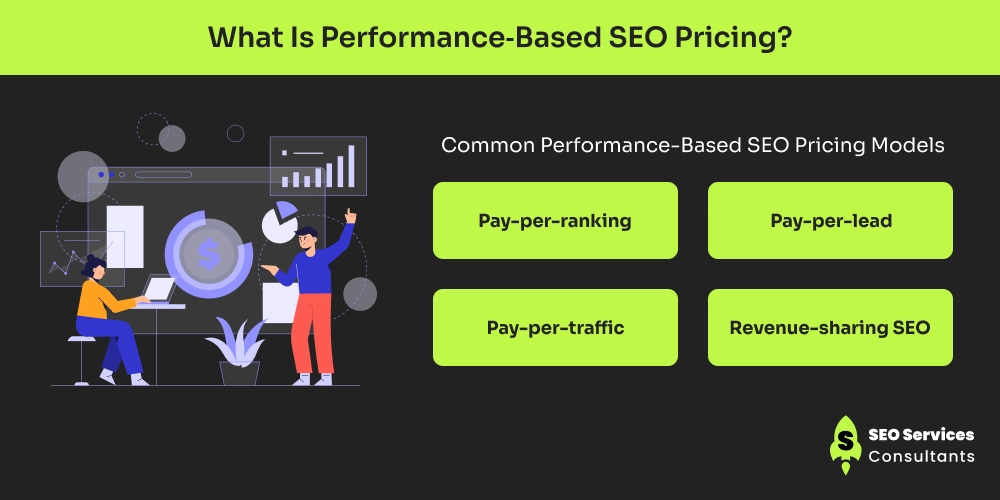
Performance-based SEO is a pricing model where the business pays agencies on the basis of specific outcomes rather than any flat or monthly fee. The performance metrics commonly covered are keyword rankings, website traffic, leads, and conversions.
Common Performance-Based SEO Pricing Models
- Pay-per-ranking: Fees are charged when agreed-upon keywords reach a certain position on search engines, such as reaching the top 10 of search results.
- Pay-per-lead: Payment is tied to the number of leads generated through the SEO campaign.
- Pay-per-traffic: Payment is based on an increase in website traffic or achievement of predefined traffic milestones.
- Revenue-sharing SEO: Agencies take a share of revenue generated from SEO efforts.
Does Performance‑Based SEO Pricing Work?
Performance‑based SEO sounds appealing as you only pay when results show up. On paper, this model looks attractive with a low-risk, result-oriented payment model. But real effectiveness is also subject to the definition of “performance metric,” which can be vague in some cases. Also, the focus is completely on short-term achievement, and the model completely lacks focus on long-term growth. Does this model actually deliver what businesses expect? Let’s break down the reality.
Why Businesses Find Performance-Based SEO Pricing Attractive
The “pay when results show up” feature primarily attracts businesses toward this model, as they find it safer in comparison to other retainer models.
- Lower Upfront Risk: Businesses avoid large retainers or big commitments before seeing measurable results. This model appeals to them as they find it financially safe, especially those companies doing SEO for the first time.
- Clear Accountability: Since payment is tied to results, it creates pressure on agencies to deliver measurable improvements, and natural accountability is maintained.
- Faster Execution: Performance incentives may push agencies to move faster. Agencies have a strong motivation to prioritize your campaign and deliver quick results.
- KPI-Focused SEO: Clear targets make campaign evaluation easier. The outcome is fixed on numbers, and it is easier to track and determine ROI.
Note: Looking for SEO package pricing? Check out our blog: International SEO Pricing: USA vs UK vs India Cost Comparison.
What Are the Challenges of Performance‑Based SEO Pricing
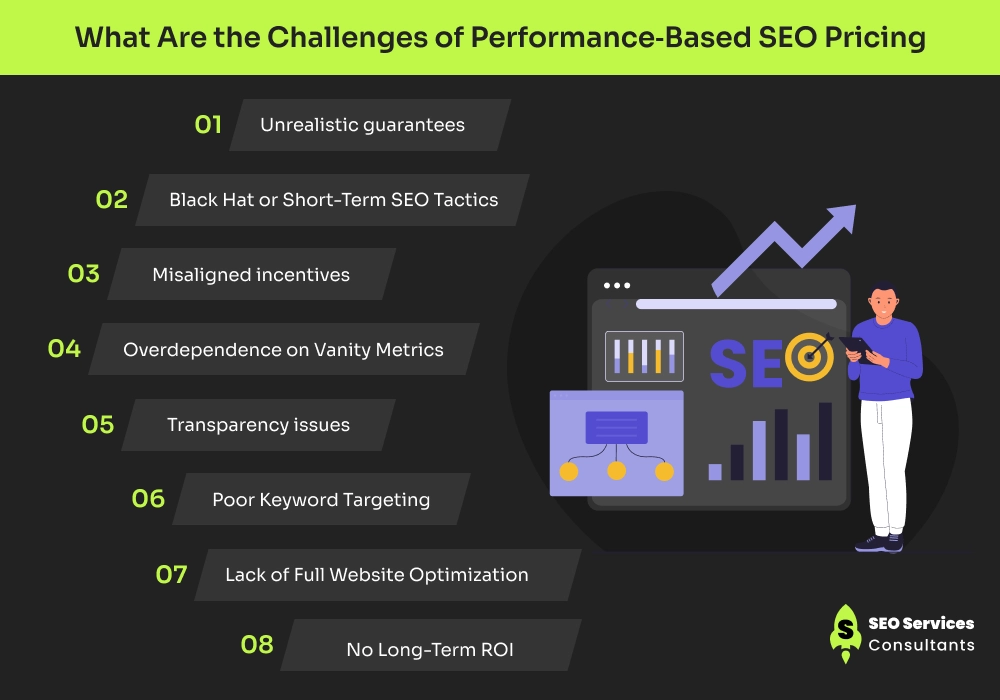
While performance-based SEO pricing sounds risk‑free, it comes with pitfalls. If overlooked and not handled carefully, it can negatively affect long-term growth.
1: Unrealistic guarantees
- Some agencies may promise #1 rankings or overnight traffic spikes.
- Truth is, SEO is a long-term process, not an overnight fix. Several factors affect ranking, such as domain authority, technical health of your website, and content quality. The Google search algorithms are also constantly changing.
- No ethical SEO agency can guarantee #1 rankings as the search engines are consistently evolving.
2: Black Hat or Short-Term SEO Tactics
- To hit quick targets, some providers rely on black‑hat methods or low‑value keywords that don’t drive meaningful business growth.
- They may target easy-to-rank keywords with low search volume or little buying intent.
- They might build low-quality backlinks that attract Google penalties.
- Their entire focus is on short-term ranking spikes that eventually disappear after a few months due to a lack of sustainability.
3: Misaligned incentives
- Payment is tied to only rankings or clicks. There is no focus on major outcomes like conversions, revenue, and customer lifetime value.
- Rankings and traffic may improve without increasing revenue. But you never attracted a qualified lead, and there will be no meaningful revenue generation.
4: Overdependence on Vanity Metrics
- Success is often defined by vanity KPIs (like traffic volume), and holistic outcomes such as qualified leads or ROI are generally ignored.
- Traffic alone can’t ensure qualified leads or sales. For example, the SEO brought 10,000 visitors to your website, but only 500 of them actually needed your products; the other visitors don’t provide you with any return.
5: Transparency issues
- Vague contracts and unclear definitions of “performance” can leave businesses paying for results that don’t move the needle.
- For example, you might end up paying for keywords with zero searches that will never help you with revenue.
6: Poor Keyword Targeting
- Agencies may target low-competition keywords with little business value.
- The sole focus of the campaign is to gather traffic irrespective of returns.
7: Lack of Full Website Optimization
- As the focus remains on quick wins, technical SEO, enhanced user experience, and conversion optimization may be ignored.
- These are critical areas that need to be optimized for real, sustainable SEO wins.
8: No Long-Term ROI
- Since the campaign is completely based on the accomplishment of certain performance parameters, there is a lack of long-term growth or ROI.
- For sustainable SEO growth, optimization from each sector, such as off-page, on-page, technical, and content, is required.
What “Performance” Usually Means in SEO
Most agencies define performance with easy-to-track metrics. But these metrics don’t always reflect actual revenue or ROI. Below are the common performance metrics:
Common Performance Metric |
What It Measures |
The Problem |
|---|---|---|
| Keyword Rankings | Position in Google search results | Rankings don't equate to conversions; Page 1 for the wrong keyword is worthless. |
| Organic Traffic Growth | Number of visitors from search | Traffic without buyer intent is just wasted clicks. |
| Lead Counts | Form submissions, calls, and sign-ups | Low-quality leads that never convert to revenue. |
| Click-Through Rates (CTR) | Percentage of impressions that become clicks | High CTR doesn't guarantee sales or engagement. |
Businesses need to understand that these metrics are measuring activities, not the real business outcomes. If you have low revenue growth despite huge organic traffic and good ranking, you are not leading towards growth, and you need to upgrade your strategy.
Performance-based SEO packages may look attractive at first, but there are hidden challenges that may outweigh its benefits. For a secure execution, clearly defined KPIs are required that provide measurable business outcomes.
Performance-Based SEO: Expectation vs. Reality
Performance-based SEO may reduce risk on paper, but in reality, it is much more complex.
Expectation |
Reality |
|---|---|
| “We only pay when we get results.” | Results are often tied to rankings or traffic, not actual revenue growth. |
| Higher rankings will automatically increase sales. | Rankings without buyer intent may bring traffic, but few conversions. |
| SEO agencies can guarantee #1 rankings. | No ethical agency can guarantee rankings because search algorithms constantly change. |
| Performance SEO reduces business risk. | Poor SEO tactics can create long-term penalties and recovery costs. |
| Agencies will stay fully accountable. | Some agencies focus on easy-to-rank keywords just to hit targets quickly. |
| Faster results mean better SEO. | Sustainable SEO usually requires a long-term strategy and optimization. |
| More traffic means SEO success. | Traffic alone is a vanity metric if it does not generate qualified leads or revenue. |
| Performance metrics are always transparent. | Vague contracts and unclear KPIs often create reporting confusion. |
When Performance‑Based SEO Can Work
Although performance-based SEO is not universally effective, it can be suitable in some specific scenarios, subject to certain conditions.
Best-Fit Scenarios for Performance-Based SEO
- Local SEO campaigns: While targeting a specific geographical area for measurable outcomes.
- Short-term campaigns: Projects with defined goals and timelines.
- Product launches: New product launch campaigns with a sole focus on visibility.
- Businesses with strong conversion tracking: Businesses that can accurately measure ROI and sales.
Requirements for Successful Performance-Based SEO
- Clearly defined KPIs: Metrics should be clearly linked to measurable outcomes like leads and conversions rather than just traffic volume.
- Transparent reporting: Clear reporting and deliverables with full visibility about how they are measured.
- Ethical SEO practices: Agencies should follow sustainable SEO practices or white hat SEO techniques to ensure there are no Google penalties.
- Strong agency-client trust: Open communication and realistic expectations, aligned with the client’s growth goal.
Situations Where Performance-Based SEO Often Fails
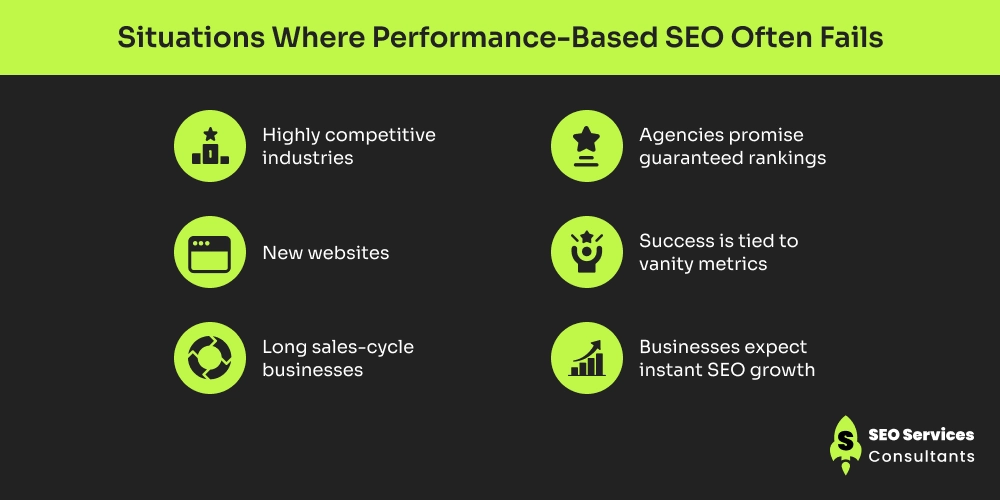
- Highly competitive industries: Niches such as Legal, SaaS, finance, and ecommerce often require long-term investment for real SEO growth.
- New websites: New websites require time to build domain authority, trust, and search visibility.
- Long sales-cycle businesses: Large businesses with long sales cycles can be misled by short-term KPIs.
- Agencies promise guaranteed rankings: It is an unethical practice, as ranking depends on multiple factors and no agency can control it.
- Success is tied to vanity metrics: The real growth metrics are different than just focusing on traffic.
- Businesses expect instant SEO growth: SEO is a long-term process; it can’t be built instantly.
Common Questions About SEO Pricing in USA, UK & India
What Are Alternatives to Performance‑Based SEO?
Performance-based SEO may feel too risky or misaligned for businesses seeking transparency, predictability, and long-term growth. Alternatives like monthly retainers, hybrid pricing, outcome‑driven contracts, and project‑based SEO can offer more transparency and predictability while still keeping results front and center. Understanding these structures can help you choose a pricing model more aligned with your business’s long-term goals and scalability. Here are the best alternatives to the performance-based SEO pricing model:
Alternative |
How It Works |
Best For |
|---|---|---|
| Monthly Retainer | Fixed fee with defined monthly deliverables | Businesses wanting ongoing SEO with predictable costs |
| Hybrid Model | Base fee plus performance bonus tied to agreed KPIs | Balancing risk and incentive |
| Outcome-Driven Contract | Tied to leads/conversions (not rankings) | Revenue-focused businesses |
| Project-Based SEO | One-time scope (audit, technical fix) | Specific needs, not ongoing |
| Hourly Consulting | Pay per hour for expert advice or specific tasks | One-off needs or supplementing an in-house team |
| Deliverable-Based Pricing | Pay per output (per blog post, backlink, or page optimized) | Businesses looking for full transparency on what they're paying for |
Conclusion: Does It Really Work?
Performance-based SEO pricing looks attractive with the idea of paying only when you see results, whether that’s higher rankings, more traffic, or increased leads. This sounds great on paper, but things change in practice.
In practice, it is riskier and more complex than it appears. It requires clearly defined KPIs, ethical SEO practices, and trust for long-term success. Otherwise, the focus would only be on short-term achievements with very few measurable outcomes. It will not move your business forward, and you would rather risk it, making it devoid of long-term success.
Frequently Asked Questions About Performance-based SEO Pricing
What is performance-based SEO pricing?
Performance-based SEO pricing is a model where you pay only when specific outcomes are achieved. It is a result-driven model where payment is tied to the performance of agreed-upon metrics such as keyword rankings, organic traffic growth, or leads. Payment is made after the achievement of specified goals.
Does performance-based SEO really work?
It may work well with short-term campaigns, local SEO, or businesses testing SEO with clearly defined KPIs and transparent reporting. However, it is not ideal for a long-term strategy as its entire focus is on short-term quick wins.
What are the biggest risks of performance-based SEO?
The major risks of a performance-based SEO pricing model include agencies using black-hat tactics that may attract Google penalties for a short-term win, focusing on vanity metrics like rankings instead of revenue, poor keyword selection, and a lack of long-term site optimization. There can also be a dispute at the time of payment due to vaguely defined metrics.
Can an SEO agency guarantee #1 rankings?
No. No ethical agency will guarantee #1 rankings. A seasoned SEO agency understands that the Google algorithm is constantly changing and ranking is influenced by many other factors, such as the product category, keyword competition, and domain authority.
How much does performance-based SEO typically cost?
The cost of performance-based SEO varies widely according to the chosen parameter. It can be charged for keyword ranking, revenue, and leads. Agencies may charge you $150 per keyword for ranking, $20 to $200 per lead in the lead generation model, and 5 to 20% of your revenue in the revenue generation model.
Which is the best alternative to a performance-based SEO pricing model?
There are many alternatives available for a performance-based SEO pricing model, such as a monthly retainer, a hybrid model, an outcome-driven contract, project-based SEO, hourly consulting, and deliverable-based pricing. Among these, the hybrid model can be the best option as you have to pay a small fixed fee and, additionally, a performance bonus. It provides stability while keeping agencies motivated for good results. You can choose the right model on the basis of your business requirements and needs.
What KPIs are commonly used in performance-based SEO?
Common use KPIs in performance-based marketing include:
- Keyword rankings (top 3/top 10)
- Organic traffic growth
- Number of qualified leads
- Conversion rate improvement
- Revenue generated from organic search