Link building remains one of the biggest drivers of SEO success, but at the same time, it is one of the trickiest investments. One bad link decision can waste budget, weaken the trust signal, or even invite a Google penalty that negatively affects your rankings. Businesses can find link building services ranging from $50 to $5,000 or more per link. This huge gap in pricing confuses business owners. While the cheap ones may look appealing, choosing the wrong strategy can hurt your online visibility.
In 2026, Google’s spam detection systems are far more advanced than they used to be. They can detect manipulative link schemes. Search engines now have a greater focus on the greater emphasis on the E-E-A-T (Experience, Expertise, Authoritativeness, and Trustworthiness) framework, and they prioritize natural, relevant, and editorially earned links. This makes understanding the difference between safe and risky link building more crucial than ever. A single low-quality package may reverse months of your work on SEO.
In the guide, we’ll help you understand factors affecting link-building costs, compare safe and risky link building to give a realistic picture, and explain how you can choose a cost-effective strategy.
Let’s get started!
Key Takeaways
- Link building costs in 2026 vary widely, with safe, high-quality backlinks typically ranging from $300 to $1,000 per link, while risky, low-quality backlinks may cost around $50 to $250 per link.
- A safe white approach requires higher upfront costs as it includes manual outreach, digital PR, original research, and high-quality guest posting that help strengthen brand authority and support sustainable rankings.
- In contrast, risky link building relies on black hat strategies such as automated backlinks sourced from link farms or PBNs that may attract a Google penalty or lead to hurt rankings in the long run.
- The cost of link building services depends on several factors such as website authority, quality of links, industry competition, outreach method, and content requirements.
- A high-quality link building service generally includes research, outreach, content creation, relationship building, and ongoing quality checks.
- While choosing a cost-effective link building service, opt for the best mix of quality, relevance, transparency, and long-term SEO value.
What do link building costs in 2026?
Link building cost is highly variable. There are several factors that decide the cost, such as the quality of the link, the authority of the site, the industry, and the content creation involved. Professional backlinking services that strictly follow Google guidelines are generally more expensive than low-quality options.
The table below provides a general overview of the average cost of link building services in 2026.
Service |
Average Cost (2026) |
Notes / Details |
|---|---|---|
| Per Backlink | $300 – $1,000+ Premium: $1,500 – $5,000+ |
Quality editorial links average ~$509. Low-end safe: $200–$400. High-authority: $700–$1,500+. Risky/cheap: $50–$250. |
| Monthly Packages / Retainers | $3,000 – $12,000+ per month |
Starter: $2,500–$5,000 (5–10 links). Growth: $5,000–$8,000. Enterprise/Premium: $10,000–$25,000+. |
| Guest Posts | $300 – $1,000 |
Standard/mid-tier: $220–$600. High-quality (strong DR/traffic): $600–$2,000+. Top-tier: $3,000–$6,000. |
| Digital PR |
$750 – $1,500+ per link $5,000 – $30,000+ per campaign |
Earned media links average ~$750. Full campaigns often cost $5k–$15k/month or per project. |
| Enterprise Campaigns | $10,000 – $40,000+ per month |
Large-scale, multi-channel (PR + outreach + content). Custom strategy for competitive niches. |
Average Per-Link Pricing Ranges
- Risky / Low-Quality: $50 – $250 (often spammy or low-value sites)
- Safe Mid-Tier: $300 – $700 (good relevance and authority)
- Premium Safe: $1,000 – $5,000+ (high DR, strong traffic, competitive niches)
Monthly Retainer Pricing
- Businesses looking for a long-term investment can opt for a monthly retainer pricing model.
- In this model, agencies or freelancers charge a monthly fee rather than per-link fees, which includes services such as outreach, content creation, and link acquisition.
- Starter plans usually offer 5-10 quality links per month.
How Much Should You Spend on Link Building per month in 2026?
The right link building budget depends on the size of your business, industry competition, and growth goals. A small or local business targeting a specific city often requires a smaller budget in comparison to a national brand competing in industries like finance or legal.
The key is not simply spending maximum but spending as per your business needs and requirements. The table below provides an estimated monthly budget based on the size of your business and growth objectives.
Business Type |
Suggested Monthly Budget |
Suitable For |
|---|---|---|
| Local businesses | $500–$1,500 | Building local visibility and rankings |
| Small businesses | $1,500–$3,000 | Steady organic growth in moderately competitive markets |
| Mid-sized businesses | $3,000–$7,000 | Scaling SEO in competitive industries |
| Enterprise brands | $7,000–$20,000+ | National or global campaigns with aggressive growth goals |
Project-Based and Package-Based Pricing
- In this model, providers sell fixed plans like a 10-guest post package or a one-time digital PR package.
- Digital PR campaigns are usually expensive as they involve journalist outreach and earned media coverage.
- These models help in predictable planning, as it is very clear what deliverables you will be receiving.
Apart from the type of services, the quality of links you are getting plays a greater role in deciding the cost of the services. It is necessary to understand the difference between safe and risky link building strategies so you can make a decisive investment decision.
Safe vs. Risky Link Building: Pricing, Quality & Value
The biggest difference between safe and risky link building isn’t just the price. It’s rather the quality of the website involved, the amount of manual work required, and the long-term search engine optimization benefits those links will bring. While safe link building focuses on earning editorially placed, relevant backlinks through ethical strategies, risky link building prioritizes quantity and speed over quality. The focus shifts from sustainable growth and ranking to manipulative tactics designed to influence search rankings quickly. Although the risky link building methods may look lucrative, they expose your website to algorithmic devaluation and manual penalties that require costly recovery work.
Here’s a quick comparison table of safe vs. risky link building strategies for reference:
Aspect |
Safe (White-Hat) |
Risky (Gray/Black-Hat) |
|---|---|---|
| Average Cost/Link | $300–$1,000+ | $50–$250 |
| Time to Results | 3–12 months | Immediate but unstable |
| Risk Level | Low | High (penalties) |
| Long-term ROI | High & compounding | Low/Negative |
| Best For | Sustainable growth | Quick (risky) boosts |
What Qualifies as a Safe Link
- Genuine editorial links earned through outreach or PR.
- Links that come from relevant, trustworthy websites and add value to the host page.
- Content that aligns with Google’s E-E-A-T guidelines.
- Links with transparent placement practices and clear reporting.
What Makes a Link Risky
- Links that are purchased in bulk without editorial standards.
- Links purchased from link farms, low-quality directories, bulk guest post networks, or automated outreach schemes.
- Links without any topical relevance and traffic value.
How pricing reflects quality
Higher prices usually reflect manual outreach efforts, quality content creation, and matching editorial standards. Here’s a quick breakdown for your reference:
Pricing Band |
Typical Cost |
What You Can Expect |
|---|---|---|
| Low Cost | Under $250 per link | Bulk links, spammy guest posts, PBNs, directories, automated tactics. High risk, low value. |
| Mid-Range | $300–$800 per link | Manual outreach, niche-relevant guest posts, editorial placements. Balanced cost, sustainable growth. |
| Premium | $800–$5,000+ per link | High-authority publications, digital PR, data-driven campaigns, trusted industry sites. Strong ROI, brand authority. |
Safe Link Building: Strategies & Pricing
Safe or white-hat link building strategies are focused on sustainable and Google-compliant methods that help strengthen your website’s authority over time. It is best for brands seeking long-term growth and less risk. Safe links usually cost more, but the cost is justified by higher returns.
Core Safe (White-Hat) Strategies
- Digital PR and HARO/journalist outreach.
- Original research, data studies, and linkable assets.
- High-quality guest posting and niche edits/link insertions on relevant sites.
- Resource page and broken link building.
- Expert roundups and collaborations.
Pricing Breakdown (2026 averages)
- Per link: $300 – $1,500+ (premium DR 50–85+ links generally cost significantly more)
- Monthly retainers/agencies: $3,000 – $12,000+
- In-house/freelancer estimates: Often $2,000 – $6,000/month effective cost, depending on team size.
Examples by Tier:
- Low/Mid Quality (DR 30–60, relevant): $200 – $600
- High Quality (DR 60+, strong traffic): $700 – $1,500+
- Premium (Top-tier publications & Digital PR): $2,000+
Pros: Long-term rankings, brand authority, low penalty risk, and compounding SEO benefits.
Cons: Higher upfront cost and slower results. Results are usually noticeable in 3–12 months.
Risky Link Building: Tactics & Hidden Costs
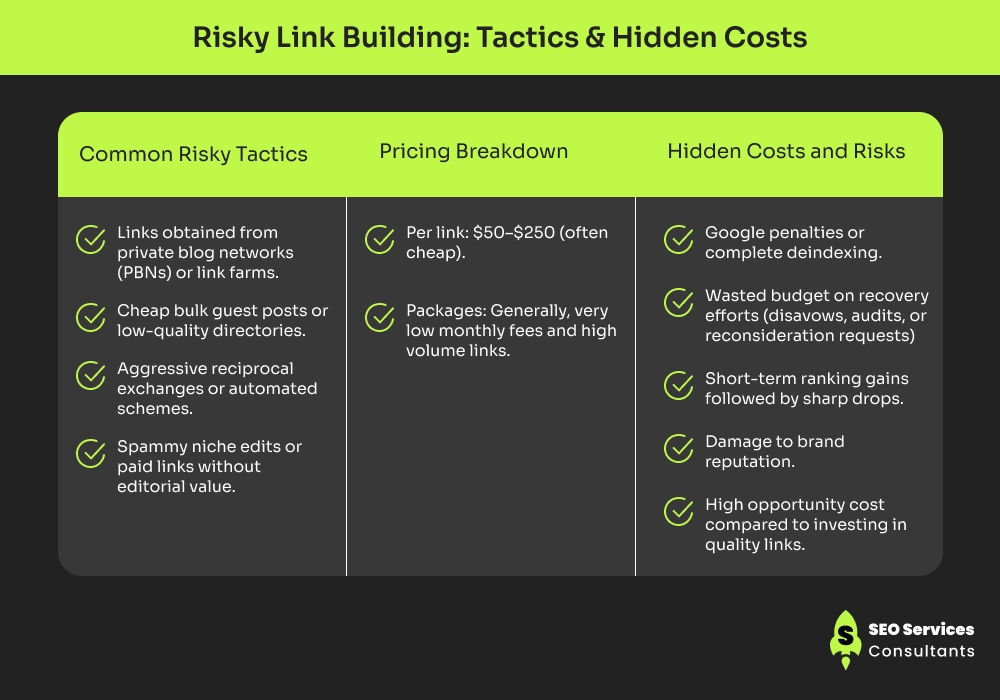
Risky links may look attractive: the cost is low, the results are appealing, and they come quickly. But those gains are usually unstable and short-lived. The real cost is visible later in ranking drops, clean-up work, and loss of trust signals by search engines.
Common Risky Tactics
- Links obtained from private blog networks (PBNs) or link farms.
- Cheap bulk guest posts or low-quality directories.
- Aggressive reciprocal exchanges or automated schemes.
- Spammy niche edits or paid links without editorial value.
Pricing Breakdown
- Per link: $50–$250 (often cheap).
- Packages: Generally, very low monthly fees and high volume links.
Hidden Costs and Risks
- Google penalties or complete deindexing.
- Wasted budget on recovery efforts (disavows, audits, or reconsideration requests)
- Short-term ranking gains followed by sharp drops.
- Damage to brand reputation.
- High opportunity cost compared to investing in quality links.
Does Higher Cost Mean Better Links?
If the cost comes with quality and safety, it is worth the price. Manual outreach, reputable publishers, strong content, and carefully managed outreach campaigns are often expensive. However, higher prices don’t automatically mean high-quality services. Some agencies may overcharge while relying on inflated metrics and recycle the same publisher list.
When expensive services are worth it
- Provider is delivering links belonging to competitive niches (finance, legal, health, SaaS).
- Links are coming from high-authority, relevant websites.
- Provider creates content that demonstrates strong E-E-A-T signals.
- When the provider offers transparency, reporting, and white-hat guarantees.
Overcharging happens when
- Providers sell low-quality guest posts at a higher cost.
- There is a lack of transparency and overpromising offers, like too many links at a low cost per month
- Costs are not related to measurable outcomes like ranking, authority, or traffic.
What Determines the Cost of Link-Building Services?
The cost of link building services varies a lot from provider to provider. Pricing ranges from a few hundred dollars for one link to thousands for a single placement. Prices vary based on the quality of links, efforts involved, and the resources needed to secure them. Knowing what’s included in link building services and which factors affect pricing is crucial to help you evaluate quotes, set realistic budgets, and avoid low-quality services that can harm your website.
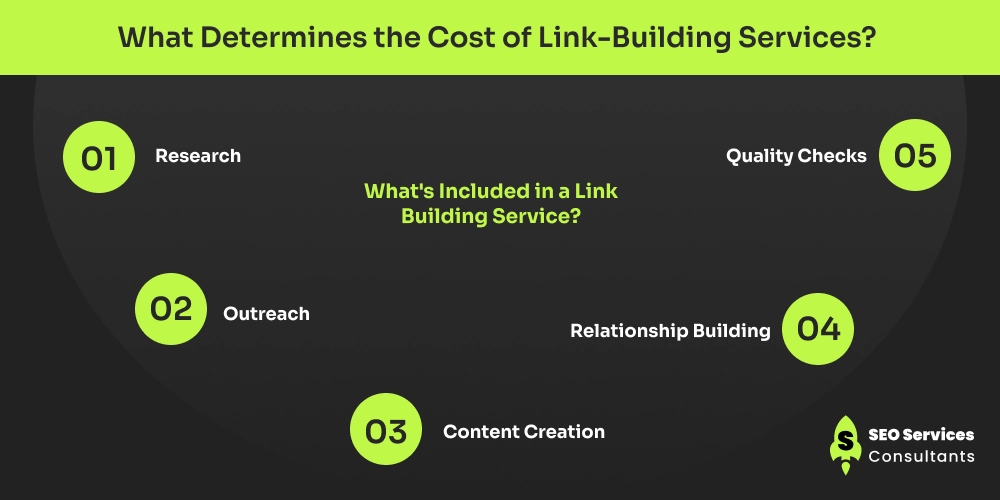
What's Included in a Link Building Service?
A professional link building service includes several components such as research, outreach, and content creation. Generally, the more comprehensive services included in your package, the higher the cost.
- Research: Finding relevant websites that match your niche, audience, and quality standards.
- Outreach: Personally contacting website owners, editors, and journalists. This often includes multiple follow-ups.
- Content Creation: Writing and optimizing high-quality articles, guest posts, or content that the publisher is willing to feature and naturally earns and supports backlinks.
- Relationship Building: Developing long-term relationships with trusted publishers for future collaborations and better placement opportunities.
- Quality Checks: Verifying that links remain live and align with campaign goals with regular monitoring.
What Factors Affect Link Building Pricing?
While average pricing can provide a rough budget estimate, it is important to understand which factors affect pricing to get a realistic cost.
Factor |
Impact on Cost |
|---|---|
| Website Authority | Higher DR/DA sites usually cost more. |
| Industry Competition | Competitive niches (finance, SaaS, legal) demand premium pricing. |
| Link Quality | Relevant sites cost more than random placements. |
| Geographic Targeting | U.S./EU links are more expensive than offshore or local placements. |
| Content Requirements | Custom-written content adds to the total cost. |
| Manual vs Automated Outreach | Manual outreach increases costs but is generally the safer and more sustainable approach. |
- Website Authority: Higher authority sites usually cost more. A backlink from a DR 70 website can cost three to five times more than a backlink from a DR 40 website.
- Industry Competition: Competitive niches such as finance, legal, SaaS, and healthcare are usually expensive due to high demand and strict editorial standards.
- Link Quality: Relevant, niche-specific backlinks from trusted websites are more valuable and expensive than generic ones.
- Geographic Targeting: Backlinks from U.S. websites often cost more than local markets due to their high value.
- Content Requirements: The more specific your content requirements, the higher the cost. You may pay nearly 30 to 60% more for custom-written articles, original research, or data-driven content.
- Manual vs Automated Outreach: Personalized human outreach generally costs more as it needs time, expertise, and effort, but is safer.
How to Choose a Cost-Effective Link Building Service?
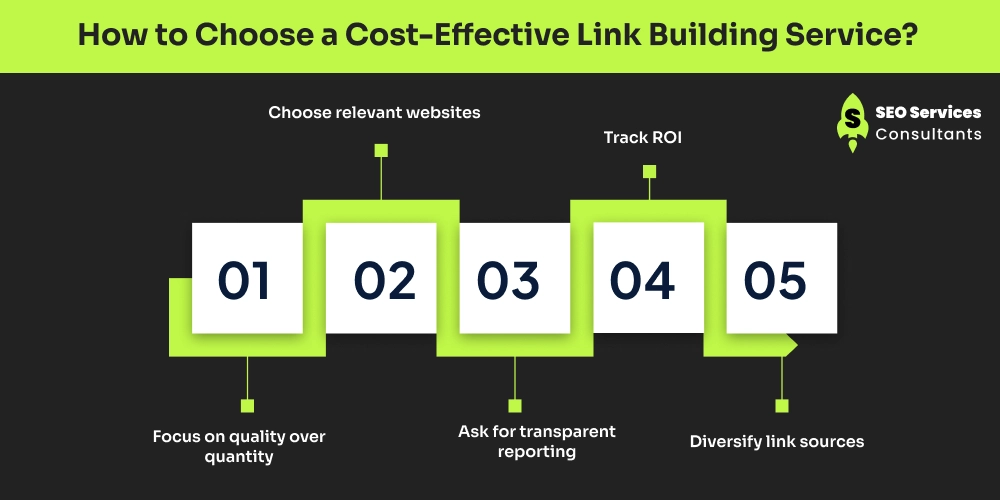
A cost-effective link building solution is not always the cheapest one. Neither does an expensive service always assure high quality. The right option is the one that gives you the best mix of quality, relevance, transparency, and long-term SEO value. The focus should be on earning high-quality links rather than just adding low-value backlinks without any relevance. Here’s what to look for and what to avoid:
Best Practices
- Focus on quality over quantity: Opt for a few backlinks from relevant sites with high DR instead of hundreds of backlinks with low-quality or from unrelated websites.
- Choose relevant websites: Backlinks should come from a website closely related to your niche, industry, products, or services.
- Ask for transparent reporting: Look for a detailed report showing live links, referring domains, anchor text, and performance metrics.
- Track ROI: Measure whether the links are helping with ranking, traffic, leads, or conversion. The success of the campaign shouldn’t only be judged by the number of backlinks.
- Diversify link sources: A healthy backlink profile should include a mix of guest posts, digital PR, resource links, and niche edits.
Red Flags to Avoid
- Extremely cheap packages: Offers under $100 can be risky or low-grade backlinks.
- Guaranteed rankings: Google's algorithm continues to evolve. No legitimate agency would guarantee specific ranking positions.
- PBNs and link farms: These schemes are usually designed to manipulate search rankings and don’t provide any value to the user. These links may attract a high risk of penalties.
- No website transparency: If your provider refuses to share sample placements or disclose the types of websites they work with, it might be a red flag.
- Automated bulk backlinks: Heavy reliance on automation often leads to spammy results and penalties.
Conclusion
Link building is one of the valuable long-term SEO investments, but there is no fixed investment rule. Link building cost varies significantly, ranging from $50 to $5,000 or more for premium placement. The cost depends on various factors such as website authority, industry competition, link quality, and content requirements.
Safe or white-hat link building services usually cost more as they include manual outreach, content creation, and editorially earned placements on relevant sites. Risky link building methods appear attractive at first glance due to fast results and low cost, but they often come with the hidden cost of ranking drops, Google penalties, and expensive recovery efforts. Google uses multiple algorithms and systems, and it rewards relevancy, authenticity, and transparency. If you are planning a link-building campaign, start by reviewing your backlink profile and opt for a few high-quality backlinks from relevant websites with high DR.
Frequently Asked Questions
How much does link building cost in 2026?
The cost of link building depends on several factors, like the quality of the backlink and link building strategy used. In general, safe, high-quality white-hat link building services cost ranges from $300 to $1,000 per link. Premium, high-quality placements on high-authority websites may cost $1,500 to $5,000 or more. Monthly link-building campaigns often range from
$3,000 to $12,000 per month depending on the size of your business and industry competition.
What is the average cost per backlink in 2026?
Most high-quality white-hat backlinks typically cost between $300 and $1,000+. Cheap backlink services are also available. These risky links start from $50, but they generally come with hidden costs.
What is the safest type of link building in 2026?
Digital PR, original research or data-driven content, and high-quality editorial guest posts on relevant sites are usually the safest and most effective approaches for backlinking.
What is the difference between safe and risky link building?
Safe link building uses relevant websites, manual outreach, and editorial standards to earn links that support long-term SEO. On the other hand, risky link building strategies rely on shortcuts like PBNs, bulk guest posts, or spammy placements that may be cheap and provide quick results but often hurt rankings later and may attract Google penalties.
Are cheap backlinks worth buying?
Cheap backlinks package that offers backlinks in bulk often rely on low-quality websites, link farms, or automated methods. They may put your website at risk of heavy penalties and hurt your ranking in the long term. It is generally better to invest in healthy, high-value backlinks coming from a relevant website with good authority.
What affects the price of link-building services?
The price of link-building services is affected by various factors such as website authority, niche competition, link quality, geographic targeting, content requirements, and whether outreach is manual or automated. Stronger, more relevant links usually cost more because they demand more time and effort to earn.