Most businesses with a healthy backlink profile start seeing measurable growth within 3 to 6 months. Whereas, Startups often take 6 to 13 months to see consistent results, sometimes even longer, depending on competition and website readiness.
In the modern digital world, SEO is a FUNDAMENTAL. It helps to earn visibility, drive traffic, and generate steady leads. If you’ve already invested in SEO, you’re ahead of many competitors, but remember, over 200 factors influence your final results. Many businesses still ask questions like:
Why can’t I see results yet?
How long does SEO take to work?
…are extremely common.
This blog gives you clear, honest answers that most agencies skip. Let’s break it down and see how long SEO really takes for your business.
What Impacts Your SEO Results
- Your Reputation
- Authority Score
- Frequency of Your SEO Efforts / How Consistently You Invest in SEO
- Business Size
- Your Competition
- Content Quality
- Spam Score
Let’s explore each point to see how it impacts your SEO results.
How long does SEO take?
In most cases, you start seeing improvements within 3 to 6 months when you follow a consistent SEO process. During this time, you may notice things like:
- Growth in organic traffic
- Better keyword rankings
- More calls, inquiries, or sales from search
But not everyone sees early improvements. Some businesses don’t notice much for the first 6 months and start seeing real results between 6 to 12 months. This is more common in competitive industries or when you’re going against well-established websites. Why does this happen? Here’s a simple way to understand it.
Put yourself in the customer’s shoes. You want to buy a pair of shoes. One store is well-known, has good products, good pricing, and has been around for years. The other store is brand new. Which one do you walk into? Of course, the first one. That’s how people think. We trust what we already know.
This same thing happens with websites. If your site is new and your competitors have been around for years, Google sees them the same way you see that old, trusted store.
Reputation can’t be built overnight. But it does get built with the right strategy, consistency, and regular updates. Stay at it, keep improving, and the results follow.
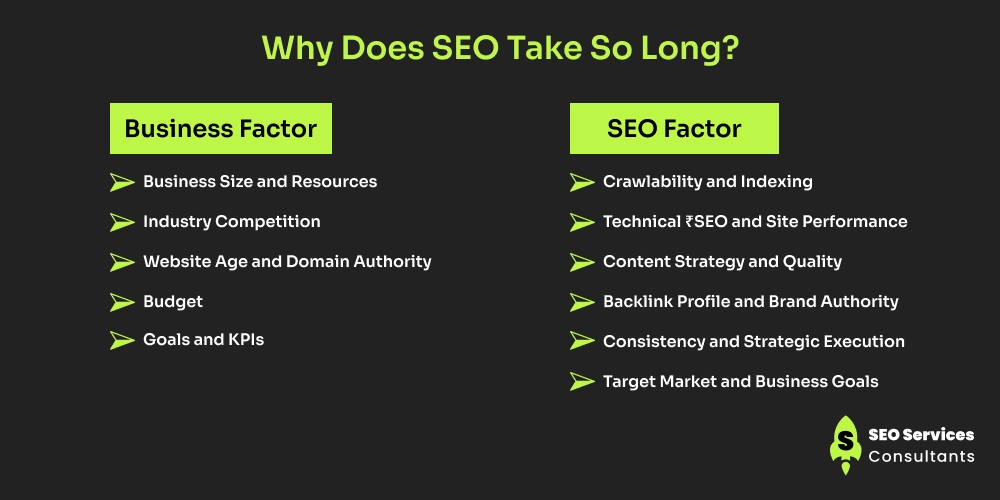
Why Does SEO Take So Long?
SEO mainly depends on two things: the business itself and the SEO work behind it.
Business Factor: your SEO strategy, market, and competition
SEO Factor: how search engines work and how their algorithms react
Every business wants fast growth, but SEO doesn’t behave like paid ads. It doesn’t give overnight results. It’s a process of slowly building trust, relevance, and authority. Google checks hundreds of signals before picking which page should rank.
Business Factors
1. Business Size and Resources
The size of your business affects how fast you can push SEO results. Big companies usually have a large and complicated website, so ranking can be tough, but they also have bigger budgets. With more budget, they hire better teams, buy tools, publish content faster, and naturally get results quicker.
Small businesses work more slowly because of limited time, budget, and output. That’s why their progress takes more time.
Example:
A national eCommerce brand might publish ten articles, update product pages, and run link-building every month. A small bakery might publish one blog in 3 months. Google sees the difference in activity, so the bigger brand moves faster.
2. Industry Competition
Some industries are so crowded that even moving from page 5 to page 3 takes months. Finance, legal, and healthcare these fields that have strong players that have been ranking forever.
But if your niche is small, like “eco-friendly pet grooming in Las Vegas,” you can get visibility quicker because fewer people are competing for those terms.
3. Website Age and Domain Authority
Older websites already have trust built over time. They have content history, backlinks, and user activity.
New websites, even if they look great, start from zero. No backlinks, no authority, no signals. That’s why it takes months of publishing and link-building before Google even starts trusting them.
4. Budget
Budget controls speed.
SEO isn’t one thing; it’s a mix of content, technical fixes, link building, audits, etc.
A company spending $5,000/month moves fast because it can run multiple tasks together. A business spending $500 has to do things step by step. That naturally slows things down.
Even with a high budget, what really counts is consistency. If you drop SEO for months, you lose momentum.
5. Goals and KPIs
Your goals also decide your timeline. Ranking for a few local keywords is faster than targeting national or highly competitive terms.
If you track small KPIs, like impressions, CTR, and keyword movement, you’ll see early progress. If you only look for instant leads, it always feels slow.
Example:
A boutique hotel might start with “best staycation in Austin.” Once that ranks, the next target may be bigger travel terms and guest blogs. Each stage builds on the previous one.
SEO Factors
1. Crawlability and Indexing
Before a page can appear in search results, Google’s bots must discover, crawl, and index it. This process works like a librarian cataloging new books; if your website is poorly structured or hard to navigate, it takes longer for search engines to “shelve” your content.
For instance, a new website with 100 pages might take several weeks to be fully indexed, especially if it lacks internal links or a proper sitemap. Old or redesigned websites face similar challenges when URLs change, leading to delays in re-indexing.
To speed things up, clear site architecture, updated XML sitemaps, and functional internal links help search engines understand your content quickly and accurately.
2. Technical SEO and Site Performance
Search engines reward websites that load fast, run securely (HTTPS), and perform well across devices. There is no matter how great your products are, if the entrance is blocked or the lights flicker, customers will leave.
Even small delays matter: Google studies show that a one-second delay in page load can reduce conversions by 20%. Technical problems such as broken links, crawl errors, or poor mobile usability can slow down indexing and delay visibility.
Websites that undergo regular audits, optimize for Core Web Vitals, and maintain clean coding structures tend to rank faster and retain visitors longer.
3. Content Strategy and Quality
SEO-friendly content isn’t about posting daily; it’s about posting the right content consistently. Google looks for expertise, accuracy, and relevance. When users spend more time reading your articles or engaging with your pages, it signals trustworthiness.
The Businesses that invest in in-depth content updates often see steady ranking gains within 3 to 6 months. Also, outdated or thin content makes Google reassess your credibility, which can delay rankings. In the end, consistent, high-quality publishing accelerates trust and recognition.
4. Backlink Profile and Brand Authority
Backlinks are like professional references for your website. Each link from a reputable site tells Google, “This source is reliable.” But earning these links takes time; it’s a relationship-building process.
For instance, a local business might gain links through press releases, community sponsorships, or collaborations. In contrast, a national brand earns links through major publications and partnerships. The difference? Scale and effort.
Most websites start seeing measurable link-driven improvements only after 3–9 months of consistent outreach and brand-building efforts. Quality always outweighs quantity; a few credible links can outperform dozens of weak ones.
5. Consistency and Strategic Execution
SEO success comes from persistence. Businesses that treat SEO as a long-term investment see compound results. Every content update, site audit, or keyword refinement adds up, much like regular workouts that gradually build strength.
When activity stops – no new content, no updates, no analysis, progress stalls. On the other hand, steady action, even small weekly improvements, keeps momentum strong and rankings stable.
Brands that review data monthly, refine strategies quarterly, and publish consistently are far more likely to sustain growth and adapt to algorithm changes smoothly.
6. Target Market and Business Goals
The time it takes to see SEO results also depends on your market reach. Local campaigns, like promoting a Las Vegas restaurant or salon, often show results faster because the competition is limited and the keyword scope is narrow.
National or international SEO campaigns take longer, as they target broader audiences and compete with established domains.
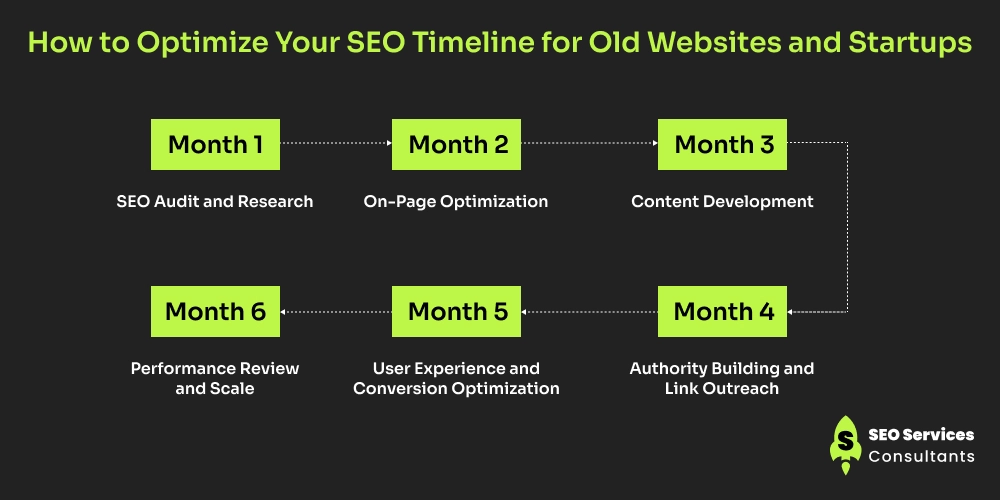
How to Optimize Your SEO Timeline for Old Websites and Startups
SEO is a gradual process. If you are wondering why SEO takes time to show results, this section gives you a clear look at the timeline. Here is the breakdown for both old and new websites. The process is slightly different because older sites already have some level of optimization, while new sites are still fresh and building everything from the ground up.
Below is a realistic SEO roadmap (Month 1 to Month 6) showing what to prioritize and how each stage supports your overall growth.
Month 1: SEO Audit and Research
In the initial 30 days, auditing and research help to find the gaps and opportunities that can set your business apart from competitors.
For Old Websites:
Run a full technical audit (site speed, broken links, redirects, indexing issues).
Analyzing existing keywords and content performance.
Identify pages with high impressions but low clicks for optimization.
Evaluate backlink profile and disavow spammy links.
For Startups:
Perform competitor and keyword research to identify target search terms.
Build a site structure with clear navigation and keyword-focused pages.
Set up Google Analytics, Search Console, and tracking systems.
Month 2: On-Page Optimization
In the second month, the focus is on fixing issues and optimizing your web pages to improve visibility and rankings.
For Old Websites:
Update meta titles, descriptions, and headers with target keywords.
Refresh outdated content and improve readability.
Add internal links between relevant pages.
For Startups:
Publish optimized landing pages and service pages.
Ensure all content is SEO-friendly (URL structure, schema markup, image alt tags).
Month 3: Content Development
The third month focuses on building the right content to increase brand awareness and engage your audience.
For Old Websites:
Create new blog posts targeting untapped keywords.
Add long-form guides or local content to increase topical authority.
For Startups:
Start a content calendar with 2–4 blogs per month.
Focus on awareness-stage content (how-tos, industry insights).
Goal: Build topical depth and attract organic visitors.
Month 4: Authority Building and Link Outreach
In Month 4, the goal is to strengthen your credibility by earning quality backlinks and growing your brand visibility.
For Old Websites:
Reclaim lost backlinks and reach out for quality guest posting.
Promote high-value pages through PR or partnerships.
For Startups:
Begin link-building outreach with niche directories and guest articles.
List your business on Google Business Profile and local citations.
Goal: Strengthen domain authority and brand credibility.
Month 5: User Experience and Conversion Optimization
This month focuses on improving UX elements that directly affect engagement and conversions.
For Old Websites:
Improve page load time, mobile experience, and navigation.
Update CTAs and lead forms to increase conversion rate.
For Startups:
Test landing page performance using heatmaps and A/B testing.
Add customer reviews and trust signals.
Goal: Turn traffic into leads and boost engagement metrics.
Month 6: Performance Review and Scale
Month 6 is all about measuring results, fixing gaps, and scaling what works.
For Both:
Measure progress in rankings, organic traffic, and leads.
Double down on content that performs well.
Refresh underperforming pages and scale link-building.
Plan the next 6-month cycle with advanced strategies (content clusters, video SEO, etc.).
Expected Results Timeline
Stage Old Websites Startups
- Initial Visibility
- Keyword Ranking Growth
- Significant ROI & Traffic
- 2–3 months
- 3–5 months
- 6–9 months
- 3–4 months
- 4–6 months
- 8–12 months
Is there any chance of getting faster results with SEO?
Rome wasn’t built in a day. Let’s be honest – impressive results take time. Getting fast results usually means using unethical practices like black-hat SEO, which may give quick wins at first, but eventually lead to Google penalties or major ranking drops. If you want a strong, long-term presence, white-hat SEO requires patience and trust.
Make sure you invest time in building your online reputation by publishing helpful content that genuinely serves users and their needs. Also, allocate a proper marketing budget and work with a result-driven SEO agency. When you do that, you increase your chances of seeing faster, sustainable results.
Ready to take your business to the top searches? Partner With SEO Services Consultants
Are you struggling to rank your website even after partnering with different agencies and still not getting desirable results? SEO Services Consultant is your solution.
We offer SEO services that deliver results. We’ve worked with 500+ companies across different sectors. When they joined us, their revenue was in 6 figures; now, many have tripled their revenue.
We have 200+ SEO experts who work closely on your project, fixing issues and improving the small elements that contribute to SEO success.
If you want to see real results, book your free website audit or schedule an appointment. Our experts will reach out shortly.