When it comes to boosting brand visibility and driving traffic from every channel, PPC and SEO can transform your growth. How? SEO focuses on optimizing website elements and improving domain authority through ethical practices. PPC, on the other hand, drives instant traffic by running ads on Google and Meta.
Both are effective on their own, but if you want exceptional results, your approach must go beyond what your competitors are doing. Want to know how? Read this blog and discover how combining PPC and SEO can double your business growth.
Here’s a quick look at what you’ll learn.
How SEO is Different from PPC?
How PPC and SEO Work Together for Better Results?
What Benefits Do You Gain When SEO and PPC Work Together?
Drive Higher ROI with PPC and SEO Working Together – Powered by SEO Services Consultants
How SEO is Different from PPC?
SEO is known for ranking the website on search engines, while PPC offers the results only as long as you pay for them. For a better understanding, we will explain these terms individually.
SEO is the process that boosts your website ranking organically on search engines like Google, Bing, or Yahoo. Through this, the website’s elements, such as content, keywords, site experience, and backlinks, are all optimized.
Check whether your website follows the E-E-A-T criteria of the algorithm. Once you start ranking, you enjoy consistent, free traffic. However, it takes time initially, but after a few months, you will notice stable and long-lasting results.
In contrast, PPC is a fully paid advertising model. It drives immediate traffic and reaches the customers who are ready to buy. You just need to bid on the keywords, and your ads appear instantly in search results. Also, PPC gives you control over your ad budget and bids and allows you to target specific demographics, locations, and devices.
Undoubtedly, this is an easy way to get a direct customer, but you need to pay for every click. Your visibility stops as soon as you stop spending. Hence, it’s fast but temporary.
Key Differences at a Glance
Feature |
SEO |
PPC |
|---|---|---|
| Cost Structure | It's an investment of time and strategy | Requires a continuous budget |
| Traffic Duration | SEO delivers ongoing traffic even if you pause efforts | It drives traffic only while the campaign is active |
| Speed of Results | Takes time to show impact | Delivers immediate clicks |
| Trust Factor | Users trust organic results more | PPC appears as ads, so credibility depends on brand reputation |
| ROI | Offers compounding returns over time | Gives quick returns but at a constant cost |
How PPC and SEO Work Together for Better Results?
SEO and PPC may look different, but they complement each other. Together, they create a full-funnel marketing approach that drives traffic, trust, and revenue.
For SEO –
For PPC –
Undoubtedly, SEO takes time to produce results; in the meantime, PPC fills the gap and ensures you never miss out on potential customers. These two channels also help you understand user behavior, intent, and conversion patterns.
When your business appears in both paid and organic results, the click-through rate (CTR) increases. Users feel more confident because they see your brand twice. This increases brand recall and boosts conversions.
Improved visibility in search results
Every search results page has limited real estate. The more places your brand appears, the more credible it looks. The result? Wherever your potential customer is scrolling, they will still click on you.
Instead of relying on one channel at a time, use both SEO and PPC to cover all ground. In the SEO process, targeting relevant keywords in blog posts, page copy, and service pages helps you rank.
Meanwhile, PPC extends reach quickly by placing sponsored ads on Google and social platforms. Together, they help you dominate more of the SERP and related channels, increasing impressions and clicks.
Pro tip: Pick a clear keyword strategy and track positions and conversions for each keyword. That shows which terms drive traffic, leads, and revenue, so you can invest where the ROI is highest.
A consistent brand experience for users
SEO and PPC work together to create a coherent, recognizable brand presence. SEO content builds awareness and trust over time. When users first discover your product through organic content, they form expectations about your tone, value, and offers.
Retargeted PPC keeps your brand top of mind by showing ads to people who have already interacted with you.
When ad creative, landing pages, and organic pages use the same messaging, keywords, and visual cues, users see a consistent experience. That consistency reduces friction, raises trust, and increases the chance of conversion.
Take control of user-behavior data
Data is the key when you want tangible results with SEO and PPC. When you combine both channels of data, your chances of success are high. That data lets you learn how people discover, engage with, and convert on your site. Below are practical ways to use that data. Let’s explore.
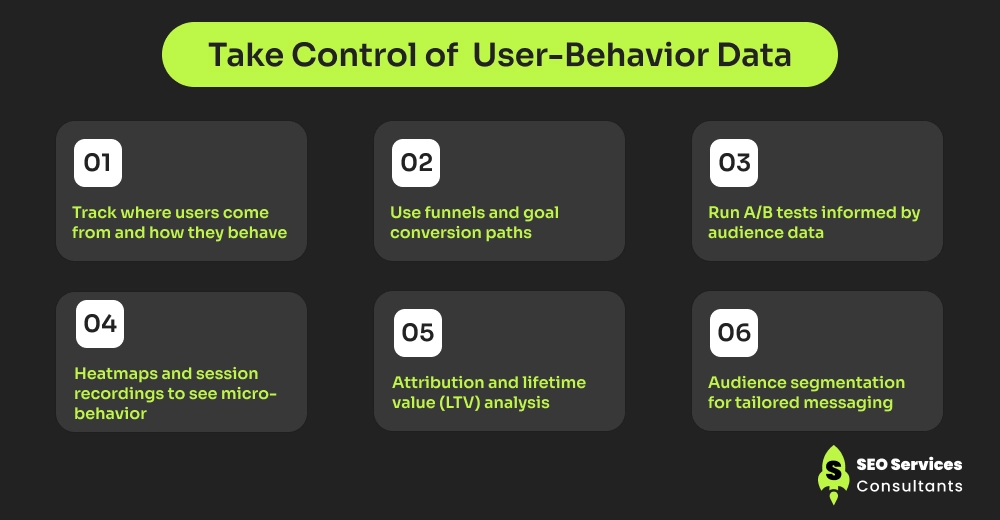
1. Track where users come from and how they behave
Segment traffic by source (organic / paid / social / referral).
Tracking helps you to understand which channels drive real results. It begins with segmenting your traffic into groups such as organic search, paid ads, social media, and referral links.
Then, you have key metrics like bounce rate, pages per session, and conversion rate that you can compare. Let’s say you run paid ads, and your visitors leave quickly. It means your ads do not perform well, and the reason might be that your ad message may not match the landing page.
If organic visitors explore multiple pages before converting, it means they are more interested and need detailed information. This simple analysis shows which channel brings quality traffic and where you should improve your strategy.
2. Use funnels and goal conversion paths
This funnel path helps you see how users move through your website and where they drop off. Start by defining a clear funnel, such as visit → product view → add to cart → checkout. Then track how many users complete each step and compare the behavior of paid and organic visitors.
If many paid visitors view a product but don’t add it to the cart, your landing page or offer may not match their expectations. If organic users drop off at checkout, you may need to improve trust signals or simplify the process.
This approach shows you exactly where you’re losing potential customers and helps you make data-backed improvements. For more clarity, look at this example.
If 40% of paid users drop off at the product page but organic users continue, perhaps your paid traffic’s ad copy promises something different from what your product page delivers. Adjust the ad or landing page to match expectations.
3. Run A/B tests informed by audience data
A/B testing helps you to gather concrete knowledge on what works and what does not. After having the insights, you can optimize your website with evidence. The process starts by testing headlines, CTAs, layouts, and form designs separately for users coming from search and paid ads.
Each traffic source has a different intent, so the same message may not work for both. For example, an ad clicker may respond better to a direct offer, while an organic visitor might prefer more information before converting.
Once you identify what performs best, implement those winning elements across your landing pages and important organic pages. This approach improves overall conversions and ensures every visitor sees the version most likely to work.
4. Heatmaps and session recordings to see micro-behavior
This gives you the authority to understand how users interact with your pages in real time. With heatmaps, you can see where people click, how far they scroll, and which sections they ignore.
Session replays show individual user journeys, including where they hesitate or abandon forms. When you compare this behavior for branded and non-branded search visitors, you learn how intent affects engagement.
Branded users may scroll less because they already trust your brand, while non-branded visitors might explore more before making a decision.
These insights reveal what content needs improvement, which elements need repositioning, and where users lose interest, helping you refine both SEO and PPC landing experiences.
5. Attribution and lifetime value (LTV) analysis
It shows you the full impact of each marketing channel, not just the final click before a sale. Multi-touch attribution helps you see how organic search and paid ads support each other during the customer journey.
For instance, a user may first discover your brand through a blog post, then click a Google ad a week later before buying. If you only measure the last click, you miss the value of SEO in creating initial awareness.
Measuring LTV by acquisition source gives you a deeper view of profitability. If customers acquired through organic search make repeat purchases over months, while paid traffic converts quickly but rarely returns, you can adjust your budget and strategy accordingly.
It guides your investment toward channels with lasting revenue impact, not temporary results.
6. Audience segmentation for tailored messaging
Create segments (new vs. returning, high-intent keywords, geographic).
Audience segmentation allows you to deliver messages that match each user’s intent and behavior. You can split your audience into meaningful groups, such as new vs. returning users, high-intent keyword searchers, or visitors from different locations.
After grouping, you will find that each segment has unique needs and expectations. For example, new users may need educational content, while returning users respond better to special offers.
Moreover, high-intent keyword traffic may convert faster if shown product-focused landing pages, while broader searchers might need comparison content first.
By serving customized ad creatives and personalized on-site experiences to each group, you increase relevance, boost engagement, and improve conversion rates effortlessly.
Segment: users who searched “best budget running shoes.” Serve educational content and a comparison table in organic results, and run a PPC campaign highlighting a value bundle to the same audience.
What Benefits Do You Gain When SEO and PPC Work Together?
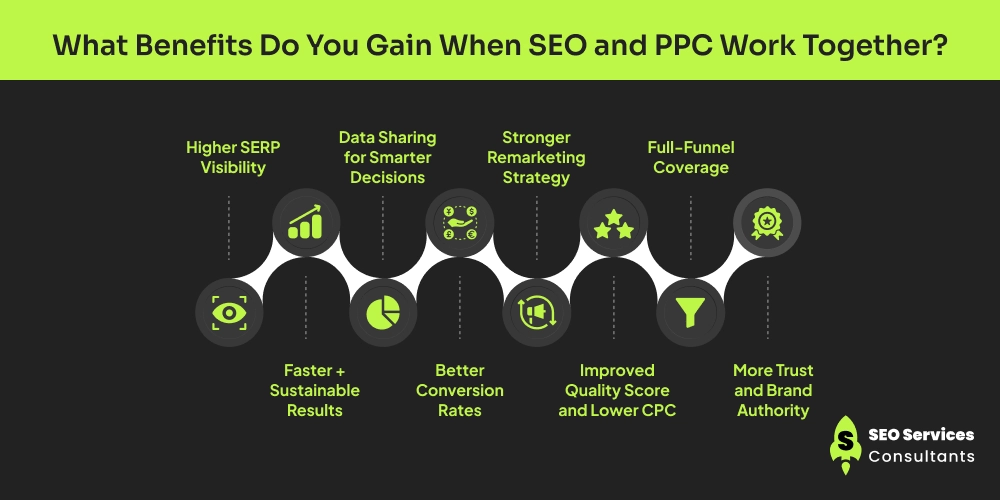
1. Higher SERP Visibility
Both channels let you appear twice on search results, one in ads, one in organic listings. This strengthens brand presence and pushes competitors down.
2. Faster + Sustainable Results
PPC drives instant traffic and conversions. SEO builds long-term authority and free traffic. Together, they give you immediate wins while securing future growth.
3. Data Sharing for Smarter Decisions
PPC keyword data helps you identify high-performing terms to target with SEO. SEO insights reveal which keywords rank well organically, allowing you to lower PPC spend on them and invest in costly competitive terms instead.
4. Better Conversion Rates
You control every step of the journey. PPC brings qualified users. SEO builds trust with relevant content. The result: more conversions at a lower cost.
5. Stronger Remarketing Strategy
Organic visitors who don’t convert immediately can be retargeted through PPC ads with tailored messages and offers, increasing lifetime value.
6. Improved Quality Score and Lower CPC
SEO-optimized landing pages improve content relevance and user intent match. This boosts PPC Quality Score, lowers cost per click, and increases ad rank.
7. Full-Funnel Coverage
SEO captures awareness and research-stage users. PPC targets high-intent buyers ready to convert. You don’t lose leads at any stage of the funnel.
8. More Trust and Brand Authority
People trust organic results. They notice ads first, but often validate credibility through organic presence. Being present in both builds authority and confidence.
Drive Higher ROI with PPC and SEO Working Together - Powered by SEO Services Consultants
Ready to maximize your growth with PPC and SEO? Great decision. To drive measurable results, you need to hire an agency that offers both PPC and SEO services. Normally, both services cost a lot, but with our customized packages, you can access both without draining your bank account.
We are experienced and use 100+ advanced tools to accelerate digital growth. We build customized strategies, implement them, and run A/B tests to see which one delivers the best results. Want to know more? Contact us today!
What is the major difference between short tail and long tail keywords?
Short‑tail keywords are short, broad terms with high search volume but heavy competition, making them harder to rank for. Long‑tail keywords are longer, more specific phrases with lower search volume but higher conversion potential. The main difference is intent: short‑tail drives visibility, while long‑tail attracts targeted users ready to take action.
What is the major difference between short tail and long tail keywords?
Short‑tail keywords are short, broad terms with high search volume but heavy competition, making them harder to rank for. Long‑tail keywords are longer, more specific phrases with lower search volume but higher conversion potential. The main difference is intent: short‑tail drives visibility, while long‑tail attracts targeted users ready to take action.
What is the major difference between short tail and long tail keywords?
Short‑tail keywords are short, broad terms with high search volume but heavy competition, making them harder to rank for. Long‑tail keywords are longer, more specific phrases with lower search volume but higher conversion potential. The main difference is intent: short‑tail drives visibility, while long‑tail attracts targeted users ready to take action.