Is ranking on a search engine alone enough? Here is the reality. Today, people do not want to read multiple articles or spend extra time searching for information. They want quick and clear answers.
After Google, ChatGPT now has a user base of over 400 million, making it one of the most widely used platforms for search queries. This shift explains why AEO or Answer Engine Optimization has become important. AEO focuses on optimizing content for AI platforms such as ChatGPT, Google AI Overview, Microsoft Copilot, and Perplexity.
In this blog, we provide a detailed analysis of AEO and explain how it is changing the way people search for and consume information.
Table of Contents:
- What is Answer Engine Optimization?
- Are AEO and SEO Similar?
- AEO vs SEO: A Real Search Faceoff
- What Makes AEO Challenging?
- How Does Answer Engine Optimization Work?
- How to Take the First Step in AEO
- Skyrocketing Business Growth with SEO and AEO
- Boost Your Revenue: Join Hands with an SEO Services Consultant
What is Answer Engine Optimization, and why is it important?
Answer Engine Optimization or AEO is the practice of structuring content to directly answer user questions across AI-powered search platforms, voice assistants, and generative AI tools. The goal is to provide clear and accurate responses that can be picked up as synthesized answers, similar to featured snippets, Google AI Overviews, and ChatGPT responses.
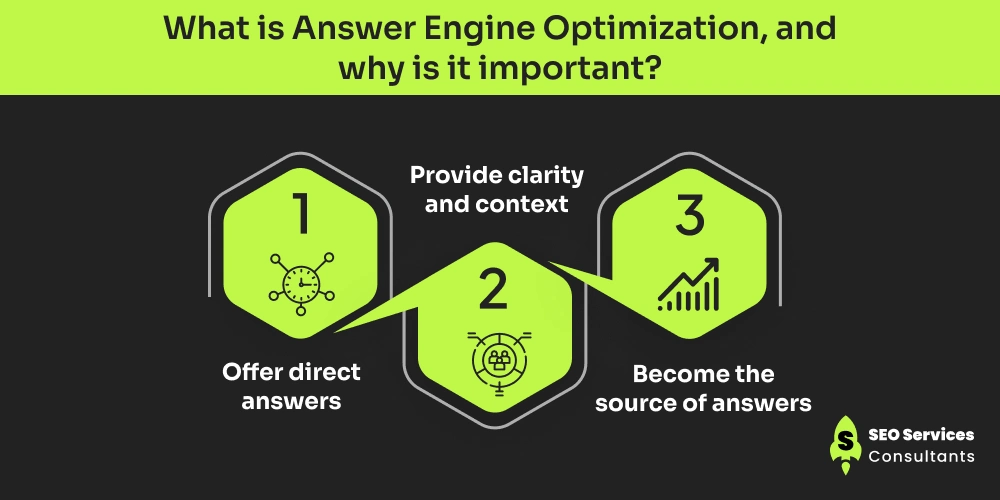
Here are some key aspects of AEO:
Offer direct answers
Focus on responding clearly to what users are asking.
Provide clarity and context
Keep content concise, well structured, and easy for AI models to understand and summarize.
Become the source of answers
Position your content as the most reliable and relevant reference for specific queries.
As search behavior evolves, so does the technology behind it. AEO reflects this shift. With the launch of ChatGPT by OpenAI, AI platforms have become a major destination for search over time. This change creates a strong opportunity for businesses to get their websites cited directly within AI-generated answers.
AEO helps bridge that gap by making your content discoverable where decisions are made. Whether you operate in B2B or B2C, AEO supports visibility, trust, and conversions by connecting your expertise directly with user intent.
Are AEO and SEO Similar?
There is no straight yes or no answer. It is a mix. Both aim for visibility and user reach, so in that sense, yes, they align. But when it comes to focus and execution, the answer is no. Let’s break it down.
SEO has existed for a long time and continues to evolve with every algorithm update. Its core objective remains the same: to rank higher on Google and other search engines. Along with this, search engine optimization helps build brand awareness, improve authority, drive qualified traffic, and generate conversions.
SEO strategies mainly focus on improving overall online visibility through keywords, content optimization, backlinks, technical structure, and user experience. The goal is to appear prominently in search results and encourage users to click through to your website.
AEO, or Answer Engine Optimization, on the other hand, reflects how users search today. Its primary focus is not just ranking, as SEO does. Instead, it optimizes content to directly answer user questions. AEO is designed for AI-driven search experiences such as featured snippets, voice search, and AI overviews.
Rather than competing only for clicks, AEO competes to become the answer. This requires structured content, clear intent matching, concise explanations, and strong topical authority. According to multiple industry reports, AEO helps drive more direct conversions compared to traditional SEO.
AEO vs SEOs: A Real Search Faceoff
Short-tail keywords, also called seed keywords, are broad, high-volume terms. These usually consist of one or two words, such as SEO services or digital marketing. They attract large audiences but face intense competition and typically have lower conversion intent. Best used for brand visibility and top-of-the-funnel awareness.
Key Areas |
SEO |
AEO |
|---|---|---|
| Platform | Works mainly on Google and other traditional search engines | Focuses on AI search platforms, voice assistants, and answer engines |
| User Targeting | Targets users searching with keywords or search phrases | Targets users asking direct, intent-driven questions |
| Content Focus | Relies on blogs, landing pages, and fully optimized website content | Relies on clear answers, FAQs, and structured short-form content |
| Goal | Aims to rank higher, increase visibility, and drive traffic and sales | Aims to deliver the best possible answer and build user trust |
| Main Focus | Focuses on keywords, backlinks, technical SEO, and user experience | Focuses on search intent, clarity, context, and content structure |
| Metrics |
Rankings Organic traffic Click-through rate (CTR) Conversions |
Featured snippets Zero-click visibility Voice search results |
| Tactics | Uses keyword research , on-page optimization, content depth, and link building | Uses question-based content, schema markup, and concise formatting |
| User Journey | Users search, click a result, explore the site, and then convert | Users ask a question, receive an answer, and build instant trust |
| Skills Needed | Requires SEO strategy, analytics knowledge, and strong content optimization | Requires intent mapping, structured writing, and AI-search understanding |
| Content Style | Detailed, informative, and designed for long-form reading | Precise, contextual, and designed for quick understanding |
What Makes AEO Challenging?
Search Engine Optimization has come into the limelight in recent years. Unlike SEO, it lacks mature systems, stable rules, and clear benchmarks. Here are the core challenges: brief, accurate, and grounded in reality.
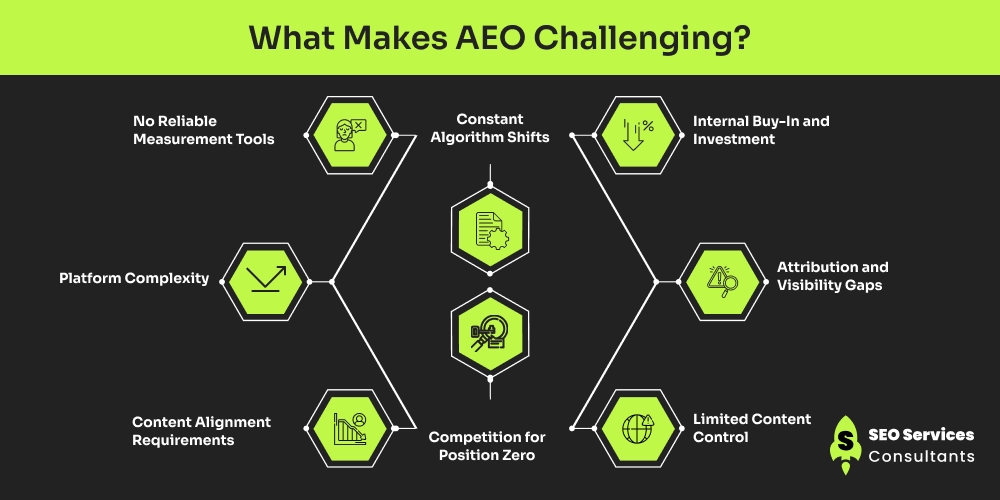
1. No Reliable Measurement Tools
There is no dedicated, industry-standard tool to track AEO performance the way Google Search Console or Ahrefs tracks SEO. Most validation is manual, testing queries in incognito or guest mode across AI platforms like ChatGPT, Perplexity, Gemini, or voice assistants.
Some platforms claim to offer “AI visibility” tracking, but results are inconsistent and not fully verifiable. As of 2025, no tool can accurately confirm why or how an AI selected a specific answer source.
2. Platform Complexity
Each answer engine works differently. ChatGPT, Google AI Overviews, voice assistants, and enterprise AI tools use distinct data sources, retrieval logic, and ranking signals. Optimizing for one does not guarantee visibility on another, which makes scaling AEO difficult.
3. Content Alignment Requirements
AEO favors precise, structured, and intent-matched content. Generic blog writing fails here. Content must directly answer questions, use clear entities, and maintain high factual accuracy. Even well-ranked SEO pages may be ignored if the answer is vague or poorly structured.
4. Constant Algorithm Shifts
Answer engines update more frequently than traditional search algorithms. Model upgrades, data refresh cycles, and policy changes can alter visibility overnight. There is little advance notice and almost no transparency.
5. Competition for Position Zero
AEO is a winner-takes-most environment. Only one or two answers are surfaced. According to industry studies, featured answers capture over 60% of user attention in AI-generated responses, leaving minimal exposure for others.
6. Internal Buy-In and Investment
AEO demands investment without immediate proof of ROI. Teams struggle to justify resources because results are indirect, such as brand mentions, implied authority, or assisted conversions, rather than clear traffic numbers.
7. Attribution and Visibility Gaps
Even when an AI uses your content, attribution is inconsistent. Some platforms cite sources. Others paraphrase without links. This makes it hard to prove impact, despite influencing user decisions.
8. Limited Content Control
Once content is consumed by an AI model, brands lose control over how it is summarized, rephrased, or contextualized. The answer may be accurate but incomplete, or correct yet stripped of brand identity.
How Does Answer Engine Optimization Work?
Answer Engine Optimization works by aligning content with how AI systems and answer engines understand questions and extract responses. Unlike traditional SEO, which focuses on ranking pages, AEO focuses on becoming the most reliable answer.
It starts with intent mapping. Most AI-driven searches are question-based. In fact, studies show that over 70% of voice searches are phrased as complete questions. AEO analyzes what users are really asking and why, then builds content that responds directly to that intent.
Next comes content structuring. Answer engines prioritize clarity. They scan headings, definitions, bullet points, and short paragraphs to identify answer-ready sections. Content that clearly explains what, why, and how in the first few lines has a much higher chance of being selected. This is why featured snippets often pull answers from concise, well-organized sections rather than long paragraphs.
Semantic understanding plays a major role. AEO uses context, not just keywords. AI systems rely on natural language processing to connect related concepts. Content that explains topics holistically, using simple language and supporting context, performs better than content stuffed with keywords.
Structured data strengthens visibility. Schema markup helps search engines understand the purpose of content elements like FAQs, how-to steps, reviews, and definitions. Pages using proper schema are significantly more likely to appear in rich results and answer boxes.
Finally, authority and trust signals influence selection. Answer engines favor content from sources that demonstrate expertise, consistency, and accuracy. Clear authorship, updated information, and factual correctness matter more than content length.
How to Take the First Step in AEO
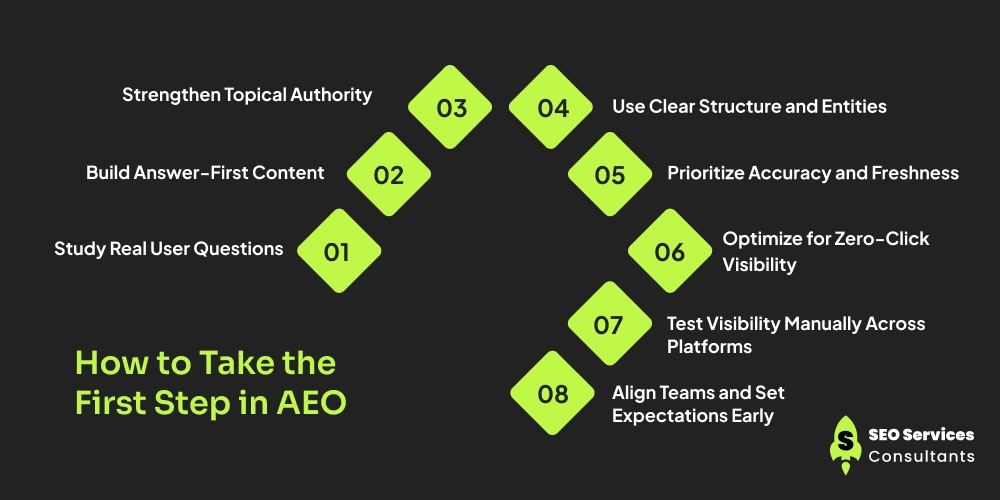
Answer Engine Optimization requires a mindset shift. You are no longer optimizing for clicks. You are optimizing to be the answer. Start with these foundational steps.
1. Study Real User Questions
AEO begins with questions, not keywords. Use sources like Google’s “People Also Ask,” community forums, customer support logs, and sales queries. Research shows that over 70% of AI search prompts are conversational or question-based, not keyword-focused. Your content must reflect how people naturally ask questions.
2. Build Answer-First Content
Each page should clearly answer one primary question within the first 40–60 words. AI systems prioritize concise, direct responses before expanding context. Follow the answer with supporting details, examples, and explanations. This structure improves answer extraction accuracy.
3. Strengthen Topical Authority
Answer engines prefer trusted sources. Instead of isolated articles, create topic clusters that fully cover a subject. According to search quality studies, content from authoritative domains is 2-3× more likely to be used in AI-generated answers than standalone pages with limited depth.
4. Use Clear Structure and Entities
Break content into logical sections with descriptive headings. Use lists, definitions, and factual statements. Clearly reference entities such as brands, locations, processes, and standards. Structured content improves machine understanding and retrieval reliability.
5. Prioritize Accuracy and Freshness
AI systems filter aggressively for outdated or unverifiable information. Cite credible sources where relevant, update content regularly, and avoid speculation. Pages updated within the last 6-12 months show higher reuse rates in AI answers compared to stale content.
6. Optimize for Zero-Click Visibility
Assume users may never visit your site. Include brand mentions, concise explanations, and authoritative language within the answer itself. This ensures recognition even when attribution is limited or absent.
7. Test Visibility Manually Across Platforms
Since no accurate AEO tracking tools exist yet, validation is manual. Test your core questions in incognito or guest mode across platforms like ChatGPT, Google AI Overviews, and Perplexity. Track patterns over time, not single appearances.
8. Align Teams and Set Expectations Early
AEO success is indirect. Set KPIs around brand authority, assisted conversions, and content reuse rather than traffic alone. Organizations that align early adapt faster as answer engines mature.
Skyrocketing Business Growth with SEO and AEO
When it comes to business growth, no single strategy is enough. Implementing strategies that align with current trends is essential. In this case, you need both SEO, which follows search engine algorithm guidelines, and AEO, which focuses on driving direct conversions. Both are equally important.
From a sales perspective, their goal is the same, conversion. The difference lies in how they achieve it. SEO works to attract users through search visibility, while AEO positions your content as the direct answer where decisions are made.
Boost Your Revenue: Join Hands with an SEO Services Consultant
With 15+ years of experience in the SEO industry, we offer result-driven SEO services for businesses of all sizes. Our approach focuses on sustainable growth, improved visibility, and measurable revenue impact. From building strong search foundations to adapting your strategy for modern AI-driven search, we help your brand stay competitive and conversion-focused.