
The internet once felt like a library with a limited number of books. Since artificial intelligence has arrived, it has brought along a flood of information. But does this guarantee that every book on the shelf contains valuable, reliable material?
Whether AI content works for SEO has become a widely debated topic. For some, AI-generated content does affect a website’s search performance. Others see it as an excellent way to yield search engine optimization results while cutting down on the cost of human hiring.
Long answer short:
AI content does work for SEO regardless of whether it’s entirely AI-generated or created with human assistance. It can help you save time and reduce costs while delivering results that contribute to your business growth. However, the AI content should be created ethically, provide real value to readers, and follow Google’s helpful content guidelines.
It’s like giving a factory the ability to produce thousands of products every day. If it doesn’t have a quality control department, production would skyrocket along with that of defective products. That’s essentially what AI has done to content marketing.
Companies and marketers are leveraging AI tools such as ChatGPT, Perplexity, and Microsoft Copilot to create hundreds or thousands of articles for a mere fraction of the traditional price. When speed takes precedence over expertise, fact-checking, and originality, however, the same content can backfire, undermining a website’s authority, credibility, and organic traffic.
Key Takeaways:
- AI content can work for SEO when it provides real value to users.
- Producing AI content in massive quantity doesn’t guarantee top rankings or more traffic.
- Using AI content does not automatically hurt rankings; quality and usefulness matter more.
- Human expertise still matters for fact-checking, originality, experience, and deeper insights.
- When generating AI content, search intent should come first.
- The goal is helpful content, not more content. To improve efficiency, marketers and businesses should not ignore quality and user intent.
What Does The Data Really Say About AI Content and SEO?
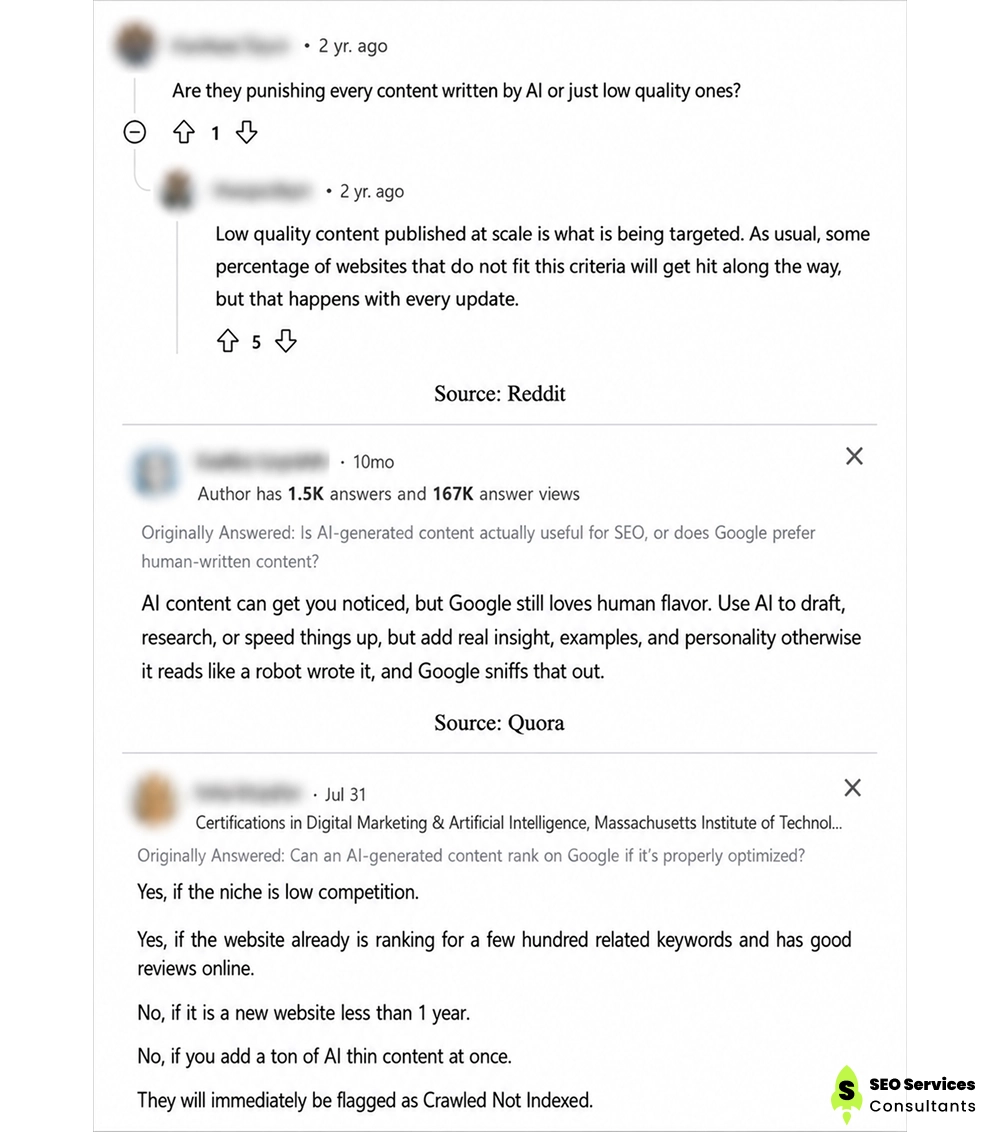
Search the internet, and you’ll get a mixed response from people about the effectiveness of AI content for SEO. Numerous Quora and Reddit conversations indicate that SEO marketers, businesses, and content writers have experienced the use of AI content differently.
According to a study by SEMrush, “Most SEO professionals that use AI content (72%) say they think AI-assisted content performs just as well or better than human-written content in search rankings; that’s up from 64% in our 2024 study. However, the number of people saying it performs worse also grew, from 9% to 13%”.
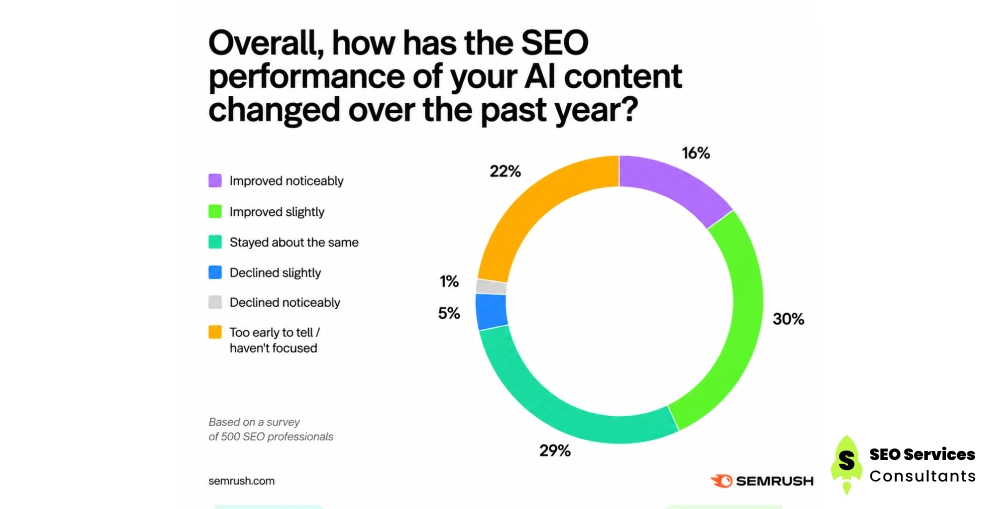
The SEMrush survey makes one thing clear—the industry is becoming more open to AI content. However, it also reveals that the results are not entirely one-sided. While a large number of professionals believe AI-assisted content performs as well as or better than human-written content, 13% believe it performs worse. The difference suggests that the way AI is used may matter as much as the use of AI itself.
Let’s get to know some more facts to understand the scenario better.
How Much AI-generated Content is on the Web?
There is no exact figure that can tell how much of the internet is now AI-generated. However, the growth of AI content is clearly visible. Now, tools such as ChatGPT and Claude have made content creation quicker and more scalable. This has resulted in a significant increase in AI-powered publishing on blogs, marketing websites, and even new platforms.
According to the Siege Media + Wynter 2026 Report, 74% of content marketers use AI for content ideation, 61% for outlining, and 44% for drafting content. These are the most popular applications of AI in content creation.
Additionally, HubSpot discovered that 79% of marketers rely on AI to create content, 78% to brainstorm ideas, and 77% to enhance content structure, but still need human writers to edit, fact-check, and add expertise. This shows a hybrid approach where AI seems to support the content creation process rather than fully replacing it.
Does More AI Content Mean Better SEO Results?
There’s no doubt that people are using AI tools increasingly to fulfill different needs of content marketing – brainstorming, outlining, and drafting.
However, this doesn’t necessarily mean that AI-generated content performs better in search results. Mass production of AI does not guarantee higher search rankings or improved visibility. That’s because SEO is no longer about quantity, but it encourages quality content.
According to a 2024 report from Originality.ai, sites that were posting excessive amounts of AI-generated content without editing were more likely to see rankings shift. This was particularly true if the content was lacking in depth, originality, or fact.
This highlights an important issue – AI content, when used as it is, can be inconsistent in quality and may fail to meet search intent effectively.
Relying entirely on AI tools has its own consequences. The biggest drawback is that AI content tools rely on patterns in the existing data instead of real-world experience or expertise. This makes AI-generated content occasionally come across as correct but lacking in actual content, updated context, and/or practical examples.
Not only this, but it may also repeat commonly available information without adding new value. This can reduce its usefulness for readers and search engines alike.
Key Drawbacks Of AI-Generated Content
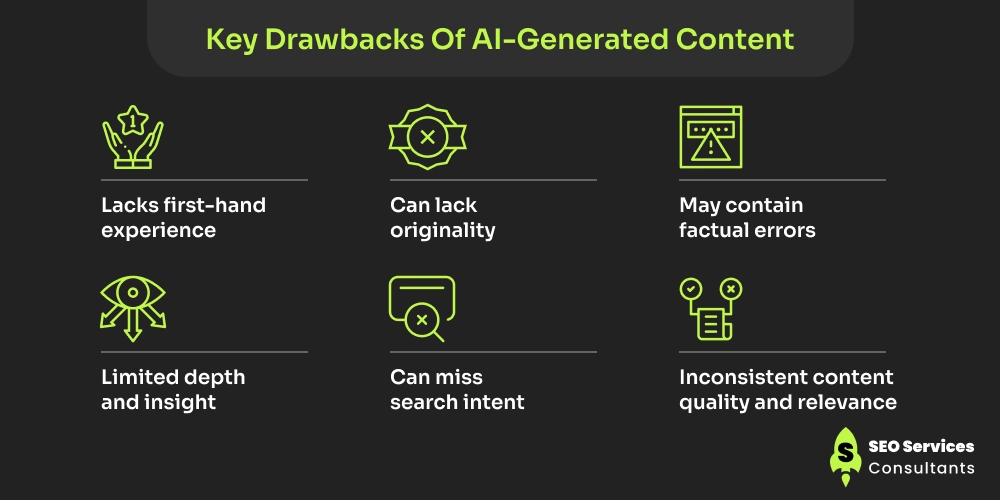
- Lacks first-hand experience - AI cannot provide genuine industry or personal experience.
- Can lack originality - Chances of repetitive information are higher in AI content. AI may repeat information that is already widely available online.
- May contain factual errors - content generated using AI tools can include outdated or inaccurate information.
- Limited depth and insight - AI may cover a topic without providing meaningful analysis or practical examples.
- Can miss search intent - Content may answer a query without fully addressing what the reader actually needs.
- Inconsistent content quality and relevance - AI -generated content can vary in accuracy, relevance, and ability to satisfy user intent.
Most importantly, the quality of the AI-generated content depends on the prompts you give. Without human intervention, an AI tool cannot function effectively. A simple prompt to “write a 5000-word detailed blog on XYZ topic” won’t deliver quality content. Simple, clear, and well-formulated prompts enable AI to better grasp the topic, audience, purpose, and desired outcome. AI needs specific information to be able to generate relevant and useful content.
Quality, relevance, and user satisfaction are core priorities for Google when it comes to SEO. Search engines are designed to focus more on helpful, reliable, and experience-driven content. That is certainly the biggest reason why AI-generated content struggles to consistently meet these expectations.
This brings us to the next and important question: does Google penalize AI content?
Let’s understand.
What Does Google Say About AI Content and SEO?
Google has clearly mentioned several times that it does not judge content based on its source. Instead, it focuses on whether the content is helpful, reliable, original, and created primarily for users.
Using AI is completely acceptable, but it should help create valuable content and not manipulate search rankings.
Google’s People-First Content Guidelines
Search engine king evaluates every piece of content, regardless of how it is generated, on the basis of the following criteria:
- Content should provide original information, analysis, examples, or insights rather than simply rewriting what already exists.
- The content should satisfy the readers’ search intent and give them enough information to resolve their issue or accomplish their goal.
- Demonstrate relevant E-E-A-T— Experience, Expertise, Authoritativeness, and Trustworthiness. Google specifically highlights trust as the most important aspect.
- Include clear authorship and credible sourcing where it fits, particularly for topics where expertise is important.
- Factual accuracy matters. The content should be well-researched and updated when information changes.
- Avoid creative mass pages just to capture search traffic or targeting large numbers of topics without adding meaningful value.
AI-Written Content, AI Search and GEO
The same principles also apply when it comes to optimizing content for Google’s AI experiences, including AI Overviews and AI Mode. There is no separate set of “GEO rules” by Google that replace SEO.
For content to be eligible for visibility in these experiences, pages still need to be crawlable, indexable, and appropriate to appear in traditional search, while providing helpful, reliable, and people-first information.
This means AI can absolutely be part of your content workflow, as per Google. All that matters is the quality, factual accuracy, and helpfulness.
In short, Google is not asking, “Was AI used to create this?” Instead, it is asking, “Does this content genuinely help the user?’
AI -Written Content Vs. Human-Written Content - What Performs Better?
It’s a common belief that AI and human-written content differ in speed and cost. But that’s not true. The difference between the two is also about depth, accuracy, originality, experience, and the ability to understand search intent.
AI content is efficient and scalable, which makes it useful for generating ideas, drafts, and structured outlines. It can significantly speed up the content creation process, especially when businesses need large amounts of production.
On the other hand, human-written content involves critical thinking, real experience, and subject expertise that AI tools can’t fully replicate. A human writer has creativity, critical thinking, and emotions. They can question whether a claim is accurate, identify gaps in existing information, add real-world examples, and understand what information a reader actually needs.
That’s why many SEO strategies today rely on a combination of both – the hybrid approach. AI can support the content creation process, while human writers remain responsible for reviewing, refining, and adding value to the final piece.
Why Human Oversight Still Matters?
Generating an article with AI and publishing it without review can create several problems. The content may contain grammatical, conceptual, or factual errors. It can use outdated information, generic explanations, or claims that lack supporting evidence. It may also cover the topic without offering anything substantially different from what is already available online.
When a human is involved, it addresses these limitations. Writers and subject-matter experts can:
- fact-check information,
- add first-hand insight,
- strengthen the content with relevant examples,
- Improve its originality, and
- Make sure it genuinely satisfies the reader’s search intent.
Therefore, there is no universal winner between AI-written and human-written content. The content that adds value to the readers’ lives performs better, regardless of who created it. AI can make content creation faster, while human expertise can make that content more useful, trustworthy, and meaningful.
When both work together, businesses can achieve the scalability of AI without compromising the quality standards that matter for SEO.
What Makes AI Content Actually Perform - The Evaluation
As the comparison above shows, AI and human writers do not have to be competing choices. While AI can ensure scalability, human involvement can refine it through quality checks. This makes a hybrid approach for SEO.
When people review, fact-check, improve, and add insights to AI-assisted content, they can shape it around Google’s people-first, E-E-A-T principles rather than publishing as is. The goal is not to avoid AI, but to use it responsibly while ensuring the content is helpful, reliable, original, and valuable to readers.
Is my AI-generated content good enough to publish?
So, before you publish your AI-generated content, use this checklist and take the right step based on the quality score your content gets:
How To Use AI Content Effectively for SEO - The Execution
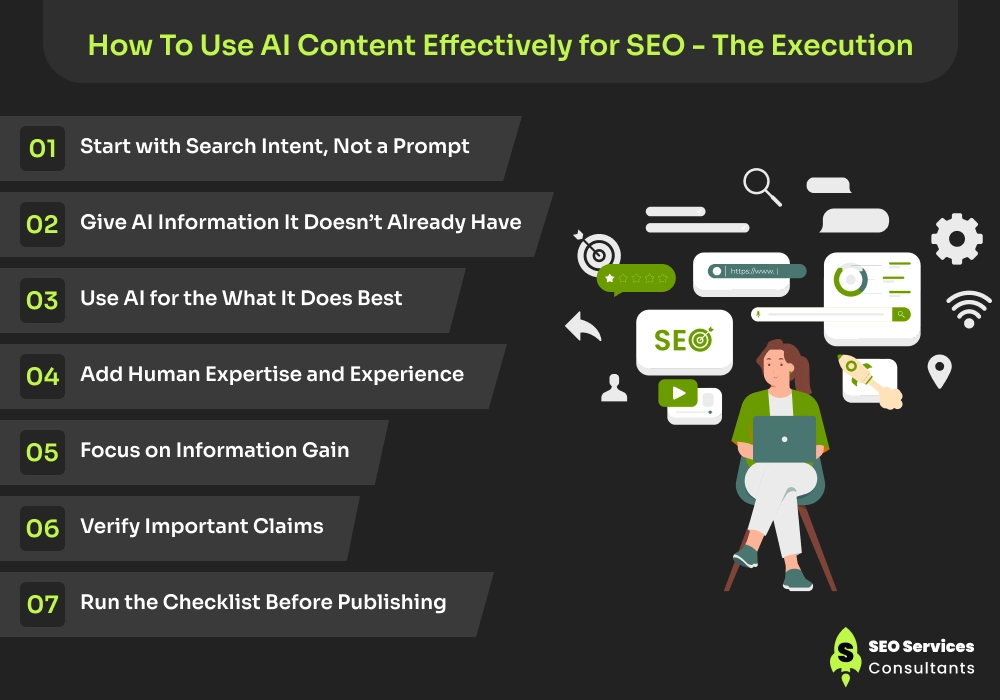
Here’s how you can make the best use of AI speed and human experience, creativity, and critical thinking to create content that ranks well and drives more traffic.
1. Start with Search Intent, Not a Prompt
Before asking AI to write, understand what the reader actually wants to accomplish. For example, someone searching “enterprise SEO cost” likely wants pricing ranges, factors that influence cost, and what different service models include. It doesn’t want a general definition of enterprise SEO or a fixed cost.
2. Give AI Information It Doesn’t Already Have
AI works best when you provide information that isn’t already available everywhere. Add original inputs such as expert opinions, customer questions, research, proprietary data, campaign observations, or real examples. These inputs can give the content a stronger foundation for originality and first-hand experience.
3. Use AI for the What It Does Best
AI is incredibly useful for brainstorming topics, creating outlines, and organizing search. It can also be used for identifying content gaps or producing an initial draft. These uses can improve efficiency without making AI responsible for the final quality of the content.
4. Add Human Expertise and Experience
Human involvement should go beyond proofreading. Subject-matter experts can challenge assumptions, explain why something works, add first-hand observations, and provide practical examples.
For instance, instead of saying “technical SEO improves crawlability,” an SEO professional could explain how they identified and resolved a crawl-budget issue on an actual website.
5. Focus on Information Gain
This is one of the most important steps. Before publishing, compare your article with the pages already ranking and ask:
“What does our content provide the readers that they cannot get from those pages?”
If the answer makes you think a lot or right away say, “nothing,” the content probably needs more work.
Adding informational value could come from:
- original data,
- a unique framework,
- first-hand observations,
- expert analysis,
- a real case study,
- Better explanation, or
- An actionable example
Google specifically encourages adding substantial value and originality instead of simply rewriting existing sources.
For example, instead of another article saying “ AI content should be fact-checked”, explain which claims need verification, how to verify them, and what changed after fact-checking an AI-generated draft. (That’s what we did!)
6. Verify Important Claims
Human reviewers (proofreaders or editors) should check statistics, research findings, dates, industry claims, and other information that could affect a reader’s decisions. Clear sourcing and factual accuracy also help build trust, an important aspect of E-E-A-T.
7. Run the Checklist Before Publishing
And at last, evaluate the content for quality. You can use the checklist we provided in the previous section. If AI helped create the article, the final responsibility still belongs to the people reviewing and publishing it.
The goal is not to avoid using AI; It is to use AI without allowing efficiency to replace human judgement, expertise, and real value.
To conclude,
AI has changed how quickly businesses, marketers, and even content writers can create content. But speed alone doesn’t determine whether the content deserves attention in search. The real opportunities lie in combining AI’s efficiency with human judgement, expertise, and understanding of what readers genuinely need.
When people shape the ideas, challenge the output, verify the details, and contribute perspectives that cannot be generated from existing information alone, AI becomes a useful part of the publishing process rather than a shortcut to more pages.
Ultimately, the question should not be whether content was written by AI or a person. It should be whether the finished piece is useful enough to earn a reader’s trust, answer their needs, and offer something worth remembering. That is where responsible AI-assisted content creates lasting SEO value.
Frequently Asked Questions
1. Does AI-generated content work for SEO?
Yes, AI produced using AI tools like ChatGPT and Gemini works for SEO. However, it should be well-researched, original, factual, and helpful. Google does not ban or penalize AI content, but it expects quality and usefulness. It should not reuse content that already exists on other websites but should have added value. If your AI content follows the E-E-A-T and people-first principles, it can bring you the desired SEO results.
2. Is AI content better than human-written content?
Neither AI nor human-written content is always better. AI is useful for speed, ideas, outlines, and drafts, while human writers can add expertise, critical thinking, and real-world experiences. A hybrid approach can work well, combining both strengths.
3. Does Google penalize AI content?
No, Google doesn’t penalize or ban any content just because it is generated using AI. However, it disregards any content that is written to manipulate rankings or is spammy. So, if your AI content isn’t informative, reliable, useful, original, or serves the user’s queries, Google can consider it unworthy of rankings.
4. How can I use AI content effectively for SEO?
The best way is not to use the AI-generated content as it is! Start with search intent, give original information to the AI tool, and use it for brainstorming, outlining, and drafting. Add human expertise and first-hand experience to make the content informative, reliable, and credible. Also, verify important claims, fact-check, and review the content before publishing.
5. What are the disadvantages of AI content?
AI content can lack first-hand experience and originality, contain factual errors, offer limited depth, miss search intent, and vary in quality and relevance. Publishing AI content without human review can make these problem worse.