
The world has changed fundamentally. Enterprise brands are not just competing for rankings now; they are also in a race to grab market share, category authority, and long-term organic dominance. With AI-driven search experiences, evolved SERP layout and zero-click search results, they are all increasing competition in the digital realm. Enterprise SEO has thoroughly transformed into a sophisticated growth infrastructure rather than a marketing tactic.
For all large-scale businesses, organic search is often known for driving the highest revenue. In many B2B and SaaS companies, 30-60% of inbound pipeline is influenced by organic visibility. For large ecommerce businesses, organic search represents millions and sometimes hundreds of millions in annual revenue. Despite its constant and consistent requirement, the question that consistently surfaces at the executive level is ‘How much does enterprise SEO actually cost, and how much does it need to be paid?”
The answer is not simple. Enterprise SEO pricing depends on multiple factors such as website complexity, scale of operations, technical architecture depth, competitive intensity, geographic expansion, content production, and integration with internal teams.
Unlike small business SEO, enterprise SEO needs to manage multiple URLs, coordinating with engineering teams, solving crawl discrepancies,s and optimizing to build a scalable and well-aligned SEO strategy with revenue forecasting.
What is Enterprise SEO?
Enterprise SEO is a strategic process that follows an advanced search engine optimization framework designed specifically for the large, complex organization that operates at scale. This SEO process applies to businesses that have more than 10,000 indexed pages, multi-location or multi-country presence, multiple product or service categories, dedicated marketing and engineering teams, and significant organic revenue dependence. You need Enterprise SEO if you have:
How much does Enterprise SEO Cost?
Enterprise SEO pricing is led by scalability, business complexity, and revenue impact, not by keyword count or page-level optimization. In 2026, if you ask most enterprise SEO engagements, you need to fall into one of the following ranges:
Pricing Model |
Estimated Investment |
Best For |
What’s Typically Included |
Strategic Purpose |
|---|---|---|---|---|
| Monthly Retainer | $7,500 – $35,000+ per month | Large SaaS, eCommerce, multi-location brands | Ongoing technical SEO, content strategy, authority building, reporting, and CRO alignment | Long-term growth & competitive dominance |
| High-Scale Enterprise Retainer | $35,000 – $75,000+ per month | Global enterprises with 100k+ pages | Advanced technical management, international SEO, automation systems, large-scale content operations, digital PR | Market leadership & revenue protection |
| Project-Based SEO (Audit / Migration / Expansion) | $20,000 – $150,000+ per project | Companies undergoing structural change | Technical audits, site migration support, international rollout, and architecture redesign | Risk mitigation & infrastructure optimization |
| In-House Enterprise SEO Team | $200,000 – $800,000+ annually | Enterprises building an internal SEO department | SEO director, technical specialists, analysts, tools, and developer allocation | Full internal control & long-term scalability |
| Hybrid Model (Retainer + Performance Incentive) | Base retainer + 10–20% performance bonus | Growth-stage enterprises | Ongoing optimization plus revenue-based incentives | Aggressive scaling with accountability |
Note: Enterprise SEO is not priced because of ‘hours worked”. It is because of the market complexity, infrastructure upgrade, revenue exposure, scalability, and operational coordination.
What Factors Influence Enterprise SEO Pricing?
Enterprise SEO pricing is not standardized because no enterprise ecosystem works under similar conditions and strategies. The cost is shaped by structural and market dynamics and complexities.
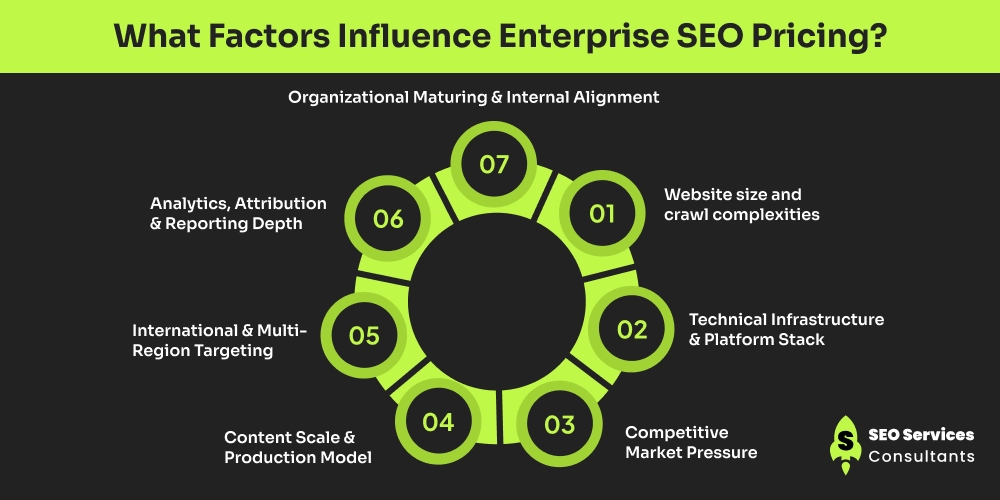
1: Website size and crawl complexities
The cost of enterprise SEO can’t be determined because of page count, and it is also influenced by complexities. There are a few factors that increase pricing: faceted navigation, parameterized URLs, duplicate content, large product data, and multi template environment.
2: Technical Infrastructure & Platform Stack
Enterprise websites generally operate on a custom CMS environment, headless architecture, JavaScript-heavy framework, multi-domain ecosystem, and international subfolders and subdomains. When SEO demands engineering sprints rather than simple CMS edits, the cost significantly increases.
3: Competitive Market Pressure
If you are competing in a low competition market, it is fundamentally different from competing in industries such as Fintech, cybersecurity, enterprise SaaS, legal services, healthcare, and global ecommerce. The high competition environment requires strict focus on authority development, advanced digital PR, deep content coverage, and aggressive internal linking strategies.
4: Content Scale & Production Model
Enterprise SEO generally includes content optimization, pillar and cluster frameworks, programmatic SEO, and international content localization. Content operations need scalability to perform well in SEO.
5: International & Multi-Region Targeting
If the brand operates globally, the business pricing can increase due to hreflang implementation, country-specific keyword research, localization vs translation strategy, regional backlink acquisition, and geo-targeting governance. Each additional region multiplies the strategic workload and impacts on cost.
6: Analytics, Attribution & Reporting Depth
Enterprise stakeholders demand revenue attribution modelling, following multi-touch funnel tracking, CRM integration, SQL-level data analysis, and executive dashboards. The deeper the reporting expectations are, the more strategic analytics resources are needed.
7: Organizational Maturing & Internal Alignment
The internal structure of a business affects pricing, as it does if the company has slow development cycles, limited engineering bandwidth, fragmented marketing teams, and complex approval workflows.
What Key SEO Services Are Included In Enterprise SEO?
Enterprise SEO is built on multi-layered and system-led mechanisms. It is not limited to on-page optimization or backlink development. A comprehensive enterprise SEO strategy includes multiple core service pillars.
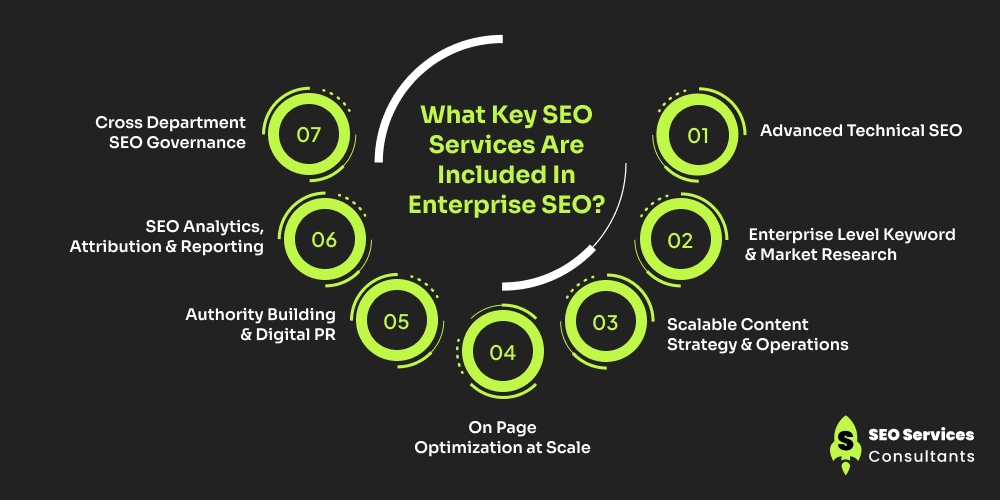
1: Advanced Technical SEO
Advanced technical Enterprise SEO forms the foundation of enterprise visibility that includes large-scale site audits, crawl budget optimization, log file analysis, indexation management, and canonical and duplicate control. Technical inefficiency can lead to the waste of thousands of crawl opportunities; experts help you protect and amplify the visibility.
2: Enterprise Level Keyword & Market Research
Beyond any keyword list, enterprise SEO needs a strategic opportunity that includes intent-based clustering, topic gap analysis, competitive landscape modeling, SERP feature analysis, demand forecasting, and category expansion opportunities.
3: Scalable Content Strategy & Operations
Enterprise SEO requires structured content systems. It works on pillar clustering frameworks, programmatic SEO, template-based content, product-led SEO, content refresh frameworks, and multilingual localization strategy.
4: On Page Optimization at Scale
Manual optimization can easily be replaced with better automation, template-level optimization, dynamic meta tag generation, and automated internal linking. This requires content modularization, structured heading hierarchy, and conversion-driven optimization.
5: Authority Building & Digital PR
High authority backlinks remain professional and critical in competitive industries. This all includes data-driven PR campaigns, thought leadership, industry report development, strategic outreach, brand mention, and link profile gap analysis.
6: SEO Analytics, Attribution & Reporting
Enterprise stakeholders need business-level insights that support revenue attribution modeling, multi-touch funnel tracking, CRM integration, executive dashboards, organic contribution, and customer acquisition cost comparison.
7: Cross Department SEO Governance
Enterprise SEO no doubt requires operational alignment supporting SEO playbooks for internal teams, developer documentation, training sessions, and workflow integration. This ensures SEO is embedded into product and marketing workflows.
What Are the Benefits of Investing in Enterprise SEO?
Enterprise SEO is not any random marketing conduct; it requires long term growth infrastructure. When implemented correctly, businesses can compound their growth over time, reduce dependency on paid acquisition, and build sustainable market authority.
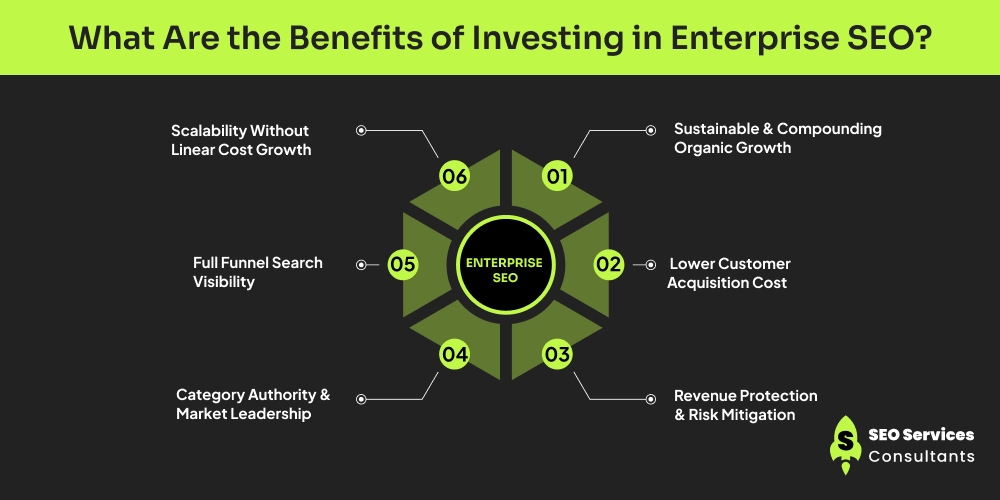
1: Sustainable & Compounding Organic Growth
Enterprise SEO acts as an asset that once start generating return it will continue on the same track. When the website ranks across thousands of high-intent search terms, it pulls traffic, lead flow improves, revenue attribution strengthens, and growth improves year over year.
2: Lower Customer Acquisition Cost
Paid acquisition costs continue to escalate across industries. Enterprise SEO reduces the long-term CAC by capturing the bottom funnel based on users’ search demand. It helps you attract high-intent users, reducing dependency and improving conversion rates through intent alignment.
3: Revenue Protection & Risk Mitigation
If the enterprise fails to work strategically with SEO, it can risk ranking loss during site migrations, crawl inefficiencies, indexation issues, technical performance declines, and competitive displacements.
4: Category Authority & Market Leadership
When the brand consistently ranks across informational queries, commercial comparison, product-specific searches, and industry terminology. If the search visibility of an enterprise is good, it influences the brand trust, investor perception, and industry credibility.
5: Full Funnel Search Visibility
Enterprise SEO fulfills demand across the entire buyer journey. It includes the awareness stage, the consideration stage, the decision stage, and the retention stage. This integrated funnel covers assisted conversions, pipeline velocity, and lifetime customer value.
6: Scalability Without Linear Cost Growth
By using automation, templated, and structured data, you can have follow-up internal linking frameworks implemented on pages without manual duplication. It needs new product categories to rank higher and to make international expansions smoother.
Common Misconceptions About Enterprise SEO Cost?
Enterprise SEO is often misunderstood because of its investment, and assumptions are made based on traditional SEO pricing models. Below are the most common misconceptions that you must be aware of:
1: Enterprise SEO is just expensive SEO
Enterprise SEO works on a completely different operational model; it includes engineering collaboration, scalable automation systems, advanced analytics integration, governance across departments, and revenue forecasting.
2: Hiring one SEO manager internally is enough
A single SEO hire cannot manage 100k+ URLs, international hreflang, log file analysis, technical debt, digital PR, content operations, and executive reporting. Enterprise SEO needs team work, not a single person can pull results.
3: Once the ranking has achieved, the work is done
Enterprise SEO is not at all a one-time ranking project; rather, it needs continuous technical monitoring, content refresh cycles, competitive gaps analysis, SERP volatility tracking, and AI search optimization.
4: Paid ads can replace SEO
Paid search visibility acts as a rented visibility. Enterprise SEO builds a foundation of owned visibility. Paid search campaigns stop adding results when the budget falls. On the other hand, organic ranking enables long-term results and compounds over time, and lower CAC. The most profitable enterprises integrate SEO with paid advertising to gain maximum output.
5: SEO ROI is impossible to measure
You can easily measure SEO results through revenue attribution, assisted conversion tracking, multi-touch funnel analysis, organic influenced pipeline, and customer acquisition cost comparison. When integration is done right, SEO becomes one of the most measurable growth channels.
How to Get Maximum Profit Using the Enterprise SEO Budget?
Enterprise SEO Investment needs to be treated as a capital allocation, not just a marketing expense. It is a strategic marketing move that helps businesses gain long-term benefits.
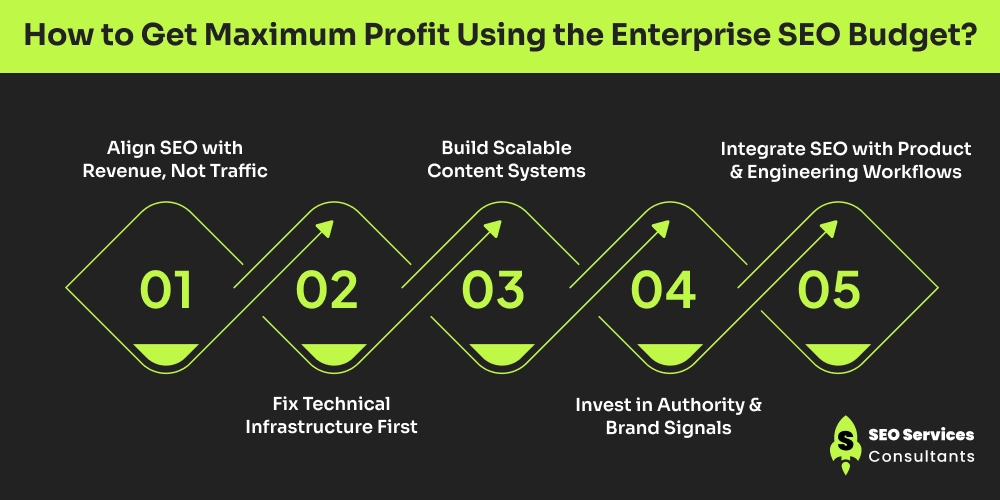
1: Align SEO with Revenue, Not Traffic
While focusing on enterprise SEO, look for button funnel intent terms, high LTV keyword clusters, category level domination, and product-led SEO.
2: Fix Technical Infrastructure First
Before scaling content, make sure you clean crawl paths, optimize site architecture, indexation, page speed optimization, and structured data implementation.
3: Build Scalable Content Systems
Instead of random blog production, implement the pillar cluster framework, programmatic SEO, template-driven landing page, international localization workflows, and content refresh systems.
4: Invest in Authority & Brand Signals
In a competitive industry, backlinks alone are not enough, enterprise authority needs digital PR campaigns, data-driven reports, thought leadership assets, brand mention reclamation, and industry partnerships.
5: Integrate SEO with Product & Engineering Workflows
SEO can’t bring effective outcomes in isolation. All high-performing enterprises need to have an effective SEO roadmap, align developers with technical recommendations, create internal SEO documentation, and train marketing teams.
All in All.
Enterprise SEO is not about investing your money; it’s about you making a sustainable marketing move. It is a long term growth infrastructure that helps you secure your business foundation following rapid gains over AI-driven search experiences, zero-click environments, semantic search expansion, and authority-driven ranking systems.
Those enterprises that treat SEO as a scalable system gain sustainable organic growth, lower acquisition costs, revenue protection, market leadership, and compounding returns. Enterprise SEO is not a tactic expense, rather it’s a way to achieve maximum visibility, pipeline share, and competitive positioning. If implemented smartly, enterprise SEO can become one of the highest ROI investments in the digital realm.