Table of Contents:
- Introduction
- What Is an LLM & How Does It Work?
- How Do LLMs Impact SEO?
- Understanding LLM SEO, AEO & GEO
- How to Optimize Your Website for LLMs & AI Search
- The Future of SEO in the Age of LLMs
- Frequently Asked Questions
Search doesn’t look the way it was two years ago. Alongside the famous list of Google SERP 10 blue links, users can now see Google AI Overviews that provide direct answers to their queries, cited from various sources. In line with these changes are the new user search behavior. Users now directly chat with AI tools such as ChatGPT, Perplexity, Gemini, or Claude to receive a synthesized response with a handful of cited sources.
At the heart of this shift are LLMs, or large language models. These are advanced AI systems trained to understand and generate human-like responses. As these models are influencing how people research services, products, or a solution, the visibility rules continue to evolve. Instead of simply matching the keywords, LLMs interpret intent, analyze content, and deliver a list of responses that feel more conversational than just outputs.
For businesses, this shift is big. The question remains how to ensure brand visibility in this AI-powered search era. Visibility is no longer just confined to ranking high in traditional searches. It’s also about being selected, trusted, and cited inside AI-generated answers. This has led to growing interest in LLM SEO, Answer Engine Optimization (AEO), and Generative Engine Optimization (GEO).
This guide explains what an LLM is, how it impacts SEO, and what LLM SEO, AEO, and GEO actually mean for your content strategy going forward. Let’s get started!
Key Takeaways:
- LLMs are reshaping how people search and consume information online. Users now receive direct answers from AI search engines instead of clicking through a list of links.
- Visibility has now shifted from getting ranked on the first page to getting cited, mentioned, and recommended by AI search engines.
- Traditional SEO is still important in the AI search era. A website with a strong technical foundation, quality content, and authority is more likely to be recommended by an AI search tool.
- The clarity and structure of your content have become more crucial than ever. Content that answers directly to users' queries makes it easier for both AI and users to process.
- LLM SEO, AEO, and GEO are extensions of SEO. These approaches focus on making your content understandable, extractable, and citable by large language models and generative search experiences.
- The winning strategy is balanced. Combine solid traditional SEO with people-first content, clear answers, topical authority, and strong entity signals to stay visible as search continues to evolve.
What Is an LLM & How Does It Work?
Large language models (LLMs) are advanced AI systems trained to work with massive amounts of text. They can interpret and generate human-like conversation. They can process questions, understand context, summarize information, and generate content.
Let’s break it down a bit more. The word large refers to an enormous amount of data that has been used to train these models. The word language signifies their ability to process and produce responses similar to humans. Model relates to their trained system, with the help of which they learn patterns from data and synthesize it for responses. So, in simple terms, “LLM” doesn’t know things the way humans do, but they predict the most likely next word or token with the patterns it has seen during training and what comes in context to the prompt given to it.
GPT-4o, Claude, Gemini, and Llama are some of the popular LLM models that power tools like ChatGPT, Perplexity, Microsoft Copilot, and Google AI Overviews.
How an LLM Works
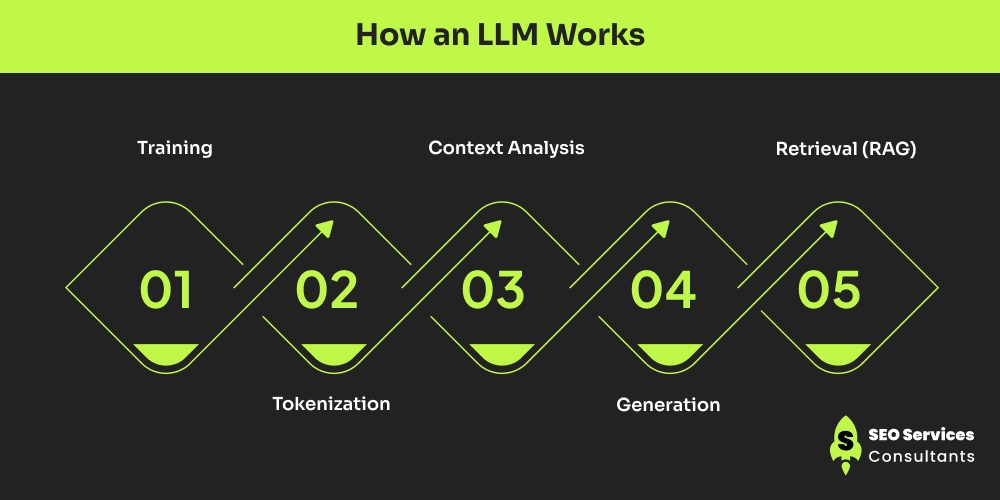
LLMs are trained to work with data. They learn patterns in language during training and use these patterns to generate responses corresponding to the given prompt.
Although the inner workflow can be complex, here is a step-by-step breakdown of the core process:
Step |
What Happens |
Why It Matters |
|---|---|---|
| Training | Model learns patterns from large datasets | Helps it recognize language and concepts |
| Tokenization | Text is broken into tokens | Allows the model to process language |
| Context analysis | Model evaluates relationships between tokens and concepts | Helps interpret the prompt |
| Generation | Model predicts and generates a response | Produces the final answer |
| Retrieval | External information may be retrieved when available | Helps provide more current or relevant information |
- Training: LLMs are trained on a collection of text from websites, books, articles, and multiple other sources. In this stage, they learn statistical patterns in languages and how words and ideas correlate.
- Tokenization: When a prompt is given to LLMs, they break it down into small units called tokens. These tokens can be words or parts of words that help them understand and process language efficiently.
- Context Analysis: At this stage, the model tries to determine the relationship between tokens and the prompt to understand the context.
- Generation: Based on what it learned in training and what it has interpreted, the model generates the most appropriate answer.
- Retrieval (RAG): Many modern AI search systems use the Retrieval-Augmented Generation (RAG) technique. In this case, the AI model refers to up-to-date information from the web in addition to what it has learned to improve the accuracy and freshness of the information it has provided.
How LLM-Powered Search Differs From Traditional Searches
LLM-powered searches work differently from traditional searches. They are based on interpretation of the user’s context, intent, and relationships between concepts. Unlike traditional searches that rely heavily on keyword matching, LLMs generate conversational answers based on their understanding.
What’s the biggest change: The goal has changed.
- In traditional search, the goal is to rank as high as possible in a list of results.
- In LLM-powered search, the goal is to ensure your content may be used as a source inside a generated answer, even if the user never clicks through to your website.
Here’s a quick explanation of the difference between the two approaches.
Feature |
Traditional Search |
LLM-Powered Search |
|---|---|---|
| How users search | Keywords and queries | Conversational prompts |
| Output | List of webpages | Synthesized answer |
| User experience | Click and compare results | Read and interact with an answer |
| Role of websites | Ranking destinations | Potential information sources |
| Context | Primarily query-based | Can consider broader conversational context |
| Visibility | Rankings | Rankings, mentions, citations, references |
How Do LLMs Impact SEO?
LLMs have reshaped the way search works. There has been a complete evolution in the way people search and how information is presented to them. Instead of just searching for a few keywords, users can now communicate, ask full questions or queries in their own natural language, and get answers in natural conversational form. The table below shows the most common changes and how marketers should track them.
Change |
What Users Do Differently |
What Marketers Should Track |
|---|---|---|
| More conversational queries | Ask full questions, often long-tail | Question-based keywords, FAQ performance |
| More zero-click answers | Get answers directly in AI/overview panels | AI citation visibility, brand mentions in AI answers |
| Higher intent clarity | Expect direct, useful answers fast | Answer quality, time to answer, bounce rate on answer pages |
| More reliance on trusted sources | Prefer brands and experts in AI responses | Brand search volume, direct traffic, share of voice in AI |
Search Behavior Is Becoming More Conversational
- The advent of AI has transformed the way users fetch information. They are not limited to short keyword-style queries. With voice search, mobile assistants, and chat‑based interfaces, they ask long queries or specific questions.
- For instance, instead of typing keywords like "best CRM software" or "SEO agency New York”, they can now ask in a more specific manner such as "What should a small ecommerce business look for when choosing an SEO agency?"
- LLMs are designed to handle natural conversation, so it is now essential for your content to carry search intent, context, and topical coverage in addition to keywords.
Rankings Are No Longer the Only Visibility Metric
- For years, SEO success has been closely related to rankings. The entire focus has been on making it to page 1 of search engines.
- AI has changed this and added a new form of visibility. It now involves being mentioned or cited in AI-generated answers.
- This new visibility comes by being referred to as sources in AI platforms, ChatGPT, Gemini, Copilot, and Google AI Overviews.
- It is now important to track AI citations, mentions, and references alongside traditional rankings to ensure optimum visibility.
Search Intent Matters More
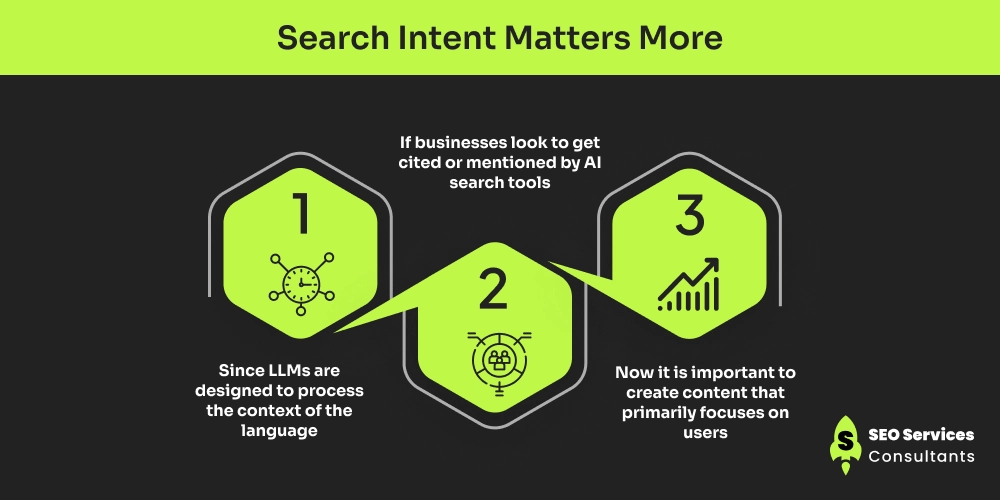
- Since LLMs are designed to process the context of the language, it makes search intent more important than ever in the AI search era.
- If businesses look to get cited or mentioned by AI search tools, they need content that directly answers users' queries rather than basic articles with stuffed keywords that are not even directly relevant.
- Now it is important to create content that primarily focuses on users’ search intent and answers questions directly.
Content Quality and Context Matter
- Well-structured, comprehensive content is the new requirement. Shallow, keyword-stuffed content is very unlikely to be cited or recommended by AI-powered tools.
- For instance, if your page is about real estate SEO services, the focus should be on holistically covering all the aspects of SEO, such as technical, on-page, and link building, rather than just repeating the phrase real estate SEO.
- The content should now prioritize depth, clarity, and context over keyword density so AI platforms understand your page well.
Brand Authority Becomes More Important
- Since AI systems source information from reliable sources to answer specific queries, brand authority has emerged as a more crucial factor than ever that influences your visibility.
- In general, LLMs use signals like consistent brand information across the web, clear expertise and author credentials, reputation, reviews, and third‑party references and quality backlinks and mentions from respected sites to determine authority and trustworthiness.
- It now becomes important for businesses to invest in E‑E‑A‑T (Experience, Expertise, Authoritativeness, Trustworthiness), maintain consistent NAP and brand details, strong author bios, and reputable mentions/links.
Zero‑Click Searches Are Becoming More Important
- Search engines now provide direct answers through features such as featured snippets and knowledge panels. Users now get responses without even clicking through links.
- These answers are directly within AI interfaces, making brand mentions and citations a visibility win. If the user looks to search further, there is also an option to click on your link.
Understanding LLM SEO, AEO & GEO
AI has revolutionized the way people search online. The focus has shifted from just getting ranked to being cited and mentioned by AI engines. With this shift, several new terms have entered the SEO arena, such as LLMO, AEO, and GEO. Understanding each of them can help you understand how modern search engines work.
The table below compares the core approaches for your quick reference:
Approach |
What It Focuses On |
Primary Goal |
|---|---|---|
| SEO | Search engines and organic search | Improve search visibility and rankings |
| LLMO | LLM-powered systems | Help AI understand and represent your content/brand |
| AEO | Answer engines | Increase the likelihood of content being used to answer questions |
| GEO | Generative search experiences | Improve visibility in AI-generated responses |
What Is LLM SEO or LLMO (LLM optimization)
LLM SEO, or LLMO (large language model optimization), is the process of optimizing your content so it is cited, mentioned, and recommended by AI engines. It goes beyond just optimizing content for ranking. The primary goal shifts to increasing the chances of appearing in AI-powered search engine outputs. For LLM optimization, your content needs to clearly explain the concept, establish relationships between topics, provide trustworthy information, and make your brand’s expertise easy to understand for search engines to trust and cite it.
Following are some common examples of LLMs and their SEO relevance.
Model |
Platform |
SEO Relevance |
|---|---|---|
| GPT-4/4o | ChatGPT, Copilot | Generate and synthesize conversational responses |
| Gemini | Google AI Overviews | Integrated into SERPs |
| Claude | Claude.ai | Strong citation/source-attribution behavior in responses |
| Llama | Open-source and third-party AI applications | Can be integrated into specialized AI applications and search tools |
What Is AEO (Answer Engine Optimization)?
AEO, or answer engine optimization, is the process of optimizing your content so that AI search engines such as Google AI Overviews, ChatGPT, Gemini, and Copilot can easily extract and use your information. It helps featured snippets, voice assistants, and chat‑based AI better understand your offerings and increase your chances of being cited by these engines.
The primary goal is to ensure an AI system will directly extract your content as an answer to a given query.
The table below shows some tips and tricks for implementing AEO with examples:
Tactic |
How to Implement |
Example |
|---|---|---|
| Answer questions directly | Start sections with 2–3 sentence clear answers | “What is LLM SEO? LLM SEO is the practice of…” |
| Use clear headings | Match H2/H3 to user questions | H2: “How Do LLMs Impact SEO?” |
| Structure information logically | Use bullets, numbered steps, tables | Step-by-step guides, checklists |
| Include concise definitions | Define key terms in 1–2 sentences | “AEO stands for Answer Engine Optimization.” |
| Use FAQs where appropriate | Add an FAQ section with short Q&A pairs | Q: “What is GEO?” A: “GEO is…” |
| Support claims with trustworthy info | Cite data, studies, experts; show author credentials | “According to [source]…”, author bio with expertise |
What Is GEO (Generative Engine Optimization)?
Generative Engine Optimization, or GEO, is the process of improving visibility inside AI-generated responses. While AEO focused on being selected as direct answers, GEO works from a broader perspective. It covers how your brand is presented so it appears to be a useful source to AI. The primary goal is to make your site look authentic and present trustworthy information to AI.
Following are ways you may implement to help LLMs better understand your website and increase its likelihood of being cited by an AI engine.
Tactic |
How to Implement |
Why It Helps LLMs |
|---|---|---|
| Demonstrate expertise | Show author credentials, case studies, real results | Increases trust and likelihood of being cited |
| Provide original, useful information | Publish unique data, frameworks, examples | Gives LLMs something new to quote |
| Build topical authority | Create clusters of deep content on core topics | Reinforces entity and topic relationships |
| Make content easy to understand & extract | Clear structure, summaries, key takeaways | Easier for models to pull quotes and snippets |
| Strengthen brand/entity signals | Consistent NAP, About page, profiles, schema | Helps AI correctly identify and represent your brand |
| Earn relevant mentions & references | PR, guest posts, industry directories | Signals authority and improves citation chances |
Bottom Line: How These Approaches Work Together
- Traditional SEO remains the foundation for search results. If your website is not optimized, lacks crawlable pages, solid technical health, and quality content, it is difficult to succeed in any AI-driven search experience.
- AEO improves the chances that your content will be selected when an answer engine needs a clear response.
- GEO expands the focus to generative systems more broadly based on trust signals so AI engines consider your website trustworthy.
- LLM SEO / LLMO serves as an umbrella term for optimizing how large language models understand and represent your brand.
In practice, the most effective strategy combines all of these: maintaining strong traditional SEO, structuring content for clear answers, building genuine authority, and making your brand easy for AI systems to recognize and trust.
How to Optimize Your Website for LLMs & AI Search
Optimizing your content for LLMs and AI searchers doesn’t always imply you have to abandon traditional SEO techniques. It rather emphasizes adding a new layer of optimization that is focused more on search-intent-based content and LLM-friendly best practices so AI engines can understand your brand and your likelihood of recommendation increases.
The table below directly compares the process of traditional optimization and how you can now update the same content in a better way to improve visibility in LLMs.
Element |
Before (Typical SEO Page) |
After (LLM-Optimized Page) |
|---|---|---|
| Intro | Long, fluffy intro with brand story | 2–3 sentence direct answer to main question |
| Headings | Generic (“Our Services”, “Why Choose Us”) | Question-based (“What Is LLM SEO?”, “How Does It Impact Rankings?”) |
| Content | Dense paragraphs, keyword-stuffed | Clear sections, bullets, definitions, examples |
| FAQs | None or hidden in accordion with long answers | Dedicated FAQ section with short, citable Q&A |
| Schema | Basic or none | FAQ, Article, Organization, Product schema added |
| Authority signals | Minimal author info, no data | Author bio, credentials, case studies, original stats |
Follow the steps below to optimize your website for LLMs and AI searches:
Create Helpful, People‑First Content
- Focus on writing content that genuinely solves users' problems and directly answers their questions rather than just stuffing keywords.
- AI often favours human-centric content. Prioritize clarity, usefulness, and readability in your content.
Answer Specific Questions Clearly
- LLMs mostly seek direct answers. You are conversing with the AI engines rather than just putting up short keywords.
- You need content that directly answers the specific query with precise information.
- It's suggested to use a concise definition, FAQs, and Q&As sections to add questions to your content naturally.
Build Topical Authority
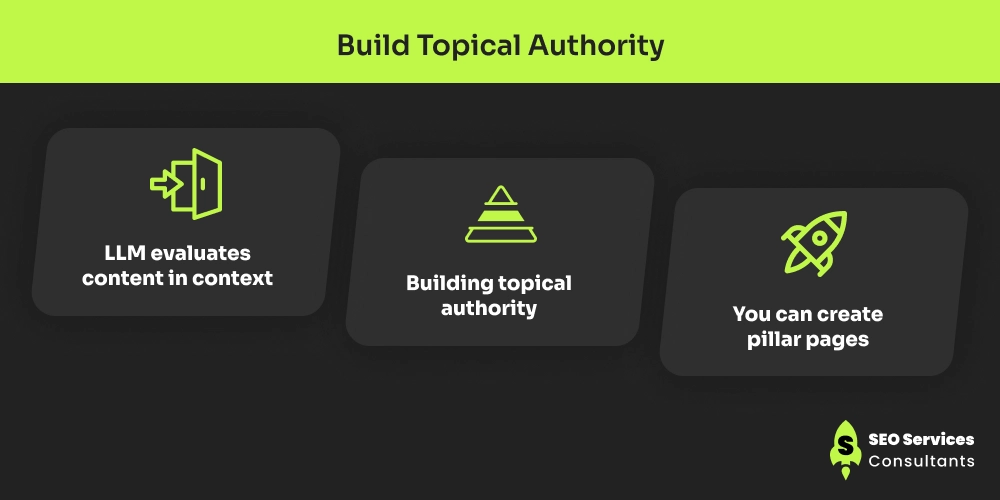
- LLM evaluates content in context, considering how well it has covered a specific topic.
- Building topical authority means you are building a cluster of related in-depth content that signals to AI your expertise.
- You can create pillar pages and supporting articles and interlink them to strengthen your brand’s topical footprint.
Demonstrate Experience & Expertise
- AI systems prefer and value trustworthy sources. You can show credentials, case studies, and real‑world proof to demonstrate your expertise.
- You can add author bios, client results, and expert commentary to reinforce your credibility.
Strengthen Your Brand’s Online Presence
- A consistent and credible presence across relevant sources can help establish strong brand signals.
- You can keep your About page, social profiles, and schema markup aligned to strengthen entity recognition.
Keep Business Information Consistent
- Inconsistent NAP (Name, Address, Phone) details can confuse both search engines and AI.
- Make sure your business information is consistent across the web.
Use Structured Data Where Appropriate
- Structured data helps better convey your information to search engines in a machine-readable format.
- Add structured data for FAQs, reviews, products, and articles to increase your chances of appearing in citations.
Earn High‑Quality Mentions and Links
- High-quality backlinks act as strong trust signals for authority.
- Investing in PR, guest posts, and partnerships can help you build brand visibility in trusted sources.
Keep Content Accurate and Updated
- Outdated content often reduces trust and citation potential.
- To stay relevant to AI answers, regularly update your content and refresh stats and references.
Optimize for Traditional Search Too
- Understand AI searches complement Google ranking, instead of completely replacing them.
- Ensure you optimize for both traditional searches as well as AI.
The Future of SEO in the Age of LLMs
LLMs are now becoming the way users search by default. SEO has evolved beyond rankings, and focus is more on context now. The table below shares some trends shaping what comes next:
Trend |
Impact |
Action for Marketers |
|---|---|---|
| Conversational Queries | More natural language | Optimize for Q&A |
| Personalized Answers | Tailored results | Build niche authority |
| Zero-Click Growth | Fewer clicks | Focus on brand mentions |
| AI-First Search | LLMs as default | Invest in entity SEO |
Final Thoughts
Large language models, or LLMs, are changing how people search online, but they can’t simply replace SEO. They are rather complementing it. Visibility has now extended to citations, brand mentions, and accurate representation inside AI-generated answers in addition to rankings.
The requirement is clear: focus on creating helpful, well-structured content that demonstrates real expertise, strengthen your brand signals, and maintain strong traditional SEO foundations for your website. Brands that focus on clarity, authority, and usefulness are expected to be best positioned as AI continues to shape the future of search.
Frequently Asked Questions
What is an LLM in simple terms?
A Large Language Model (LLM) is an AI system trained on large amounts of data so it can understand and generate human-like language. It predicts the most likely next words based on patterns it has learned, which allows it to answer questions, summarize information, and hold conversations.
How do LLMs affect SEO?
LLMs are consistently changing the way people search for and consume information online. Users can now ask long-tail questions directly on AI search engines and get synthesized direct answers instead of just a link of the list it used to get on Google result search page. It is built on established SEO practices including useful content, topical authority, technical accessibility and trustworthy information.
What is the difference between SEO, LLMO, AEO, and GEO?
Although they are interconnected, they come with different visibility goals.
- SEO focuses on improving visibility and rankings in traditional search engines.
- AEO (Answer Engine Optimization) focuses on making content easy for answer engines to select and use when providing direct responses.
- GEO (Generative Engine Optimization) focuses on improving visibility inside AI-generated answers across generative search experiences.
- LLM SEO (or LLMO) is often used as a broader term that covers optimization for large language models.
Is traditional SEO still important in the age of AI search?
Yes. Traditional SEO remains an important foundation of AI search visibility. A website with technical accessibility, crawlability, useful content, search intent, internal linking, authority, and other strong SEO fundamentals is most likely to be cited and recommended by search engines. AI search optimization further expands SEO with a primary focus on content clarity and depth.
How can I optimize my content for AI search?
You can optimize your content for AI search by using clear headings, concise definitions, logical structure, and trust signals such as author expertise. You should keep focus on creating helpful, people-first content that clearly answers specific questions.
What metrics should I track for AI search visibility?
In addition to tracking traditional metrics such as rankings, organic traffic, and CTR, you can consider tracking brand mentions in AI answers, citation frequency, branded search volume, and share of voice across AI platforms. However, measurement tools in this area are still evolving.