Keywords are the lifeline of SEO. They are the words or phrases people type into search engines when looking for information, products, or services. These keywords can be short tail or long tail, and they shape the entire SEO process.
Search engines rely on keywords to understand your content. When you use accurate and relevant keywords, your pages become easier to discover in search results. More importantly, the right keywords connect your content with the right audience at the right moment, increasing both visibility and engagement.
In this blog, we will take a closer look at long-tail vs. short-tail keywords. You will understand the key differences, which one performs better, and how to use them effectively to achieve better SEO results.
Know About Long-Tail vs Short-Tail Keywords
Long-tail keywords contain more than two words and are highly specific search phrases. These keywords show clear user intent, as people using them usually know exactly what they are looking for.
In the age of AI, users are becoming smarter, and search behavior is changing. Instead of typing short phrases, users now enter detailed and longer queries, which are known as long-tail keywords. These keywords are easier to rank for because they have less competition. They also bring higher-quality traffic and often generate better leads.
Let’s understand this with an example. If a user is looking for durable running shoes, they may search using phrases like:
- Best running shoes for men
- Affordable running shoes for daily use
- Top quality running shoes for beginners
- Best running shoe store near me
- Deep analysis of the long tail keyword:
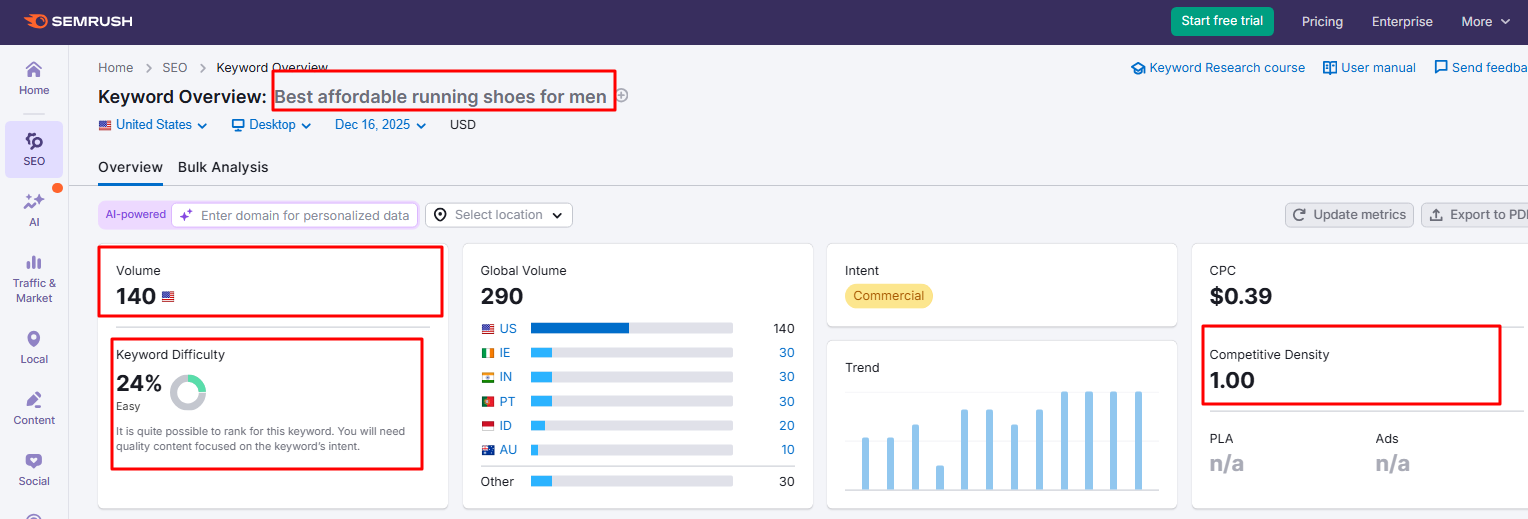
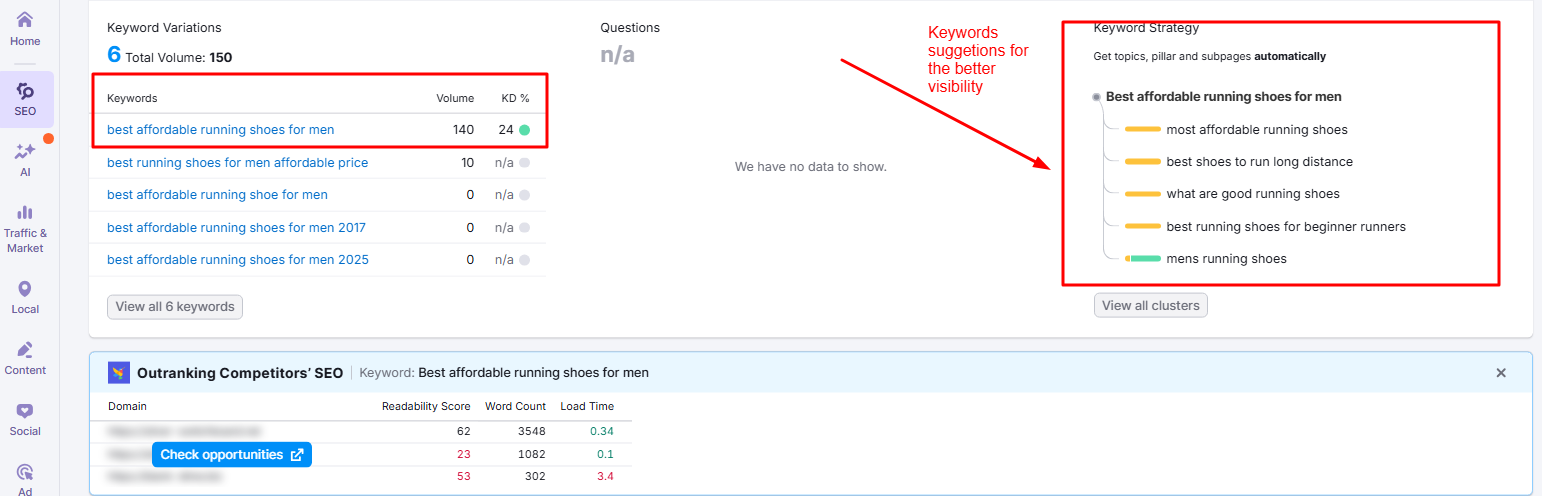
In the image, it is clearly shown that long-tail keywords have lower search volume when checked in Semrush, an SEO tool. The screenshot highlights key metrics such as global search volume, keyword difficulty (lower KD means higher chances of ranking), and keyword suggestions related to affordable running shoes for men.
This data proves that long-tail keywords offer website owners a better opportunity to attract users who are closer to taking action. Since these users have clear intent, long-tail keywords often lead to higher conversions.
Short-Tail Keywords
Short-tail keywords, on the other hand, are also known as seed keywords and have a broader scope. They usually contain one or two words. These are among the most searched terms and are highly competitive in nature, which makes them difficult to rank on search engines.
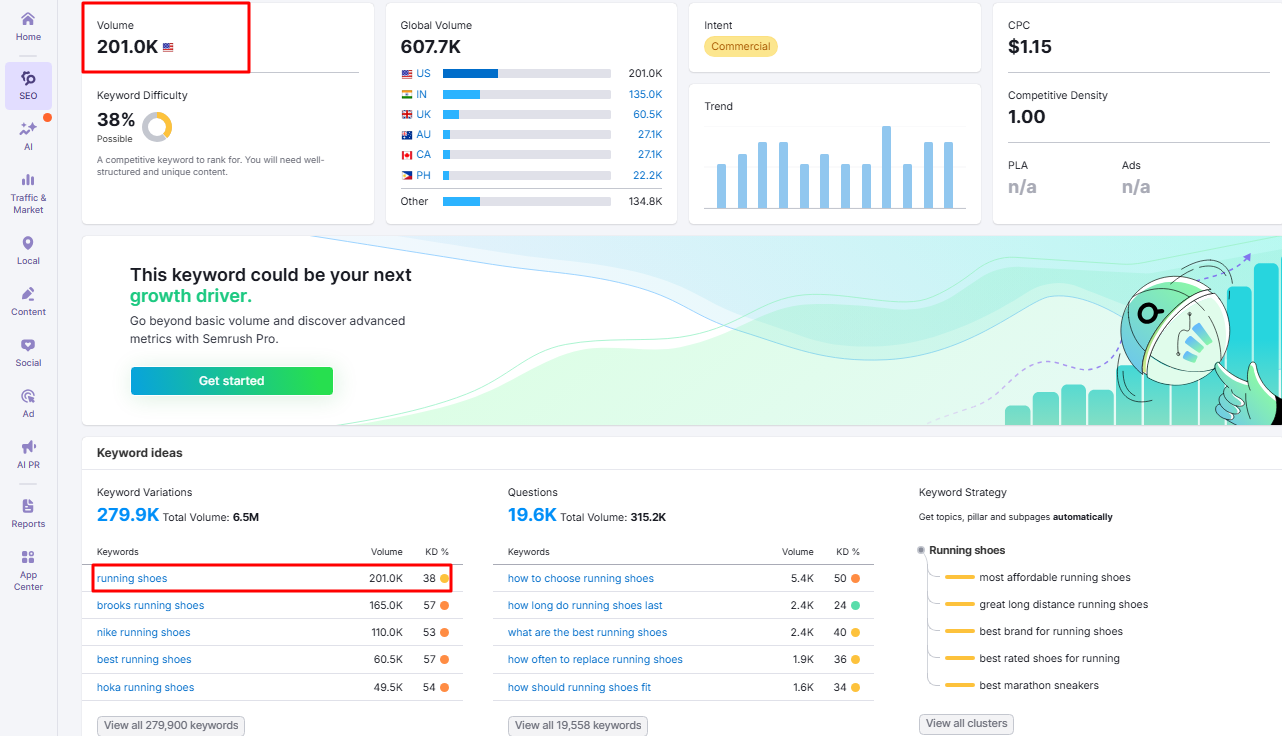
Short-tail keywords have high search volume, but user intent is often unclear. Users typically search using short phrases, which results in broad and less targeted search results. For better understanding, consider this example: if a user searches for “shoes”, it is a very broad term with high competition and mixed intent.
In the case of short-tail keywords, the audience reach is wide, and competition is intense, which directly affects rankings. Ranking for these keywords is difficult, but when achieved, it helps build strong visibility and brand awareness.
Why Are Long-Tail Keywords Better Than Short-Tail Keywords?
Short-tail keywords are also known as seed or head keywords. They are broad in nature and mainly used for brand awareness, high-level pages such as homepages, pillar pages, and early-stage research.
Long-tail keywords, on the other hand, are more specific and user-focused. They clearly reflect search intent and are often used by users who are closer to making a decision. From an SEO perspective, both short-tail and long-tail keywords play important roles and serve different purposes.
However, long-tail keywords are more effective for conversions. They attract targeted traffic, capture user attention more easily, and show strong purchase intent. This is why long-tail keywords are considered better for driving meaningful actions.
The chart below highlights why long-tail keywords perform better than seed keywords in practical SEO scenarios.
Key Factor |
Long Tail Keywords |
Short Tail Keywords |
|---|---|---|
| Search Volume | Lower volume but attracts users with clear intent who are closer to conversion | High volume but attracts a broad, unfocused audience often researching or browsing |
| Keyword Difficulty (KD) | Low to medium difficulty, making ranking easier for most businesses | High difficulty dominated by big brands and authority websites |
| Ranking Factor | Depends mainly on content quality, relevance, and user intent | Relies heavily on domain authority, backlinks, and long-term SEO investment |
| Effectiveness | Higher conversion rates due to specific and focused search intent | Lower conversion rates because intent is mixed or unclear |
| Relevancy | Highly relevant to niche topics, products, or services | Broad relevance, often reducing content precision |
| Ease | Easier to research, optimize, and track with faster results | Harder to optimize and track, requiring more time and budget |
Best Tools for Finding Long-Tail Keywords
Below are some popular keyword research tools that help you find long-tail keywords with clear search intent. These tools provide data such as search volume, keyword difficulty, competition level, and keyword variations, which makes keyword research easier and more effective.
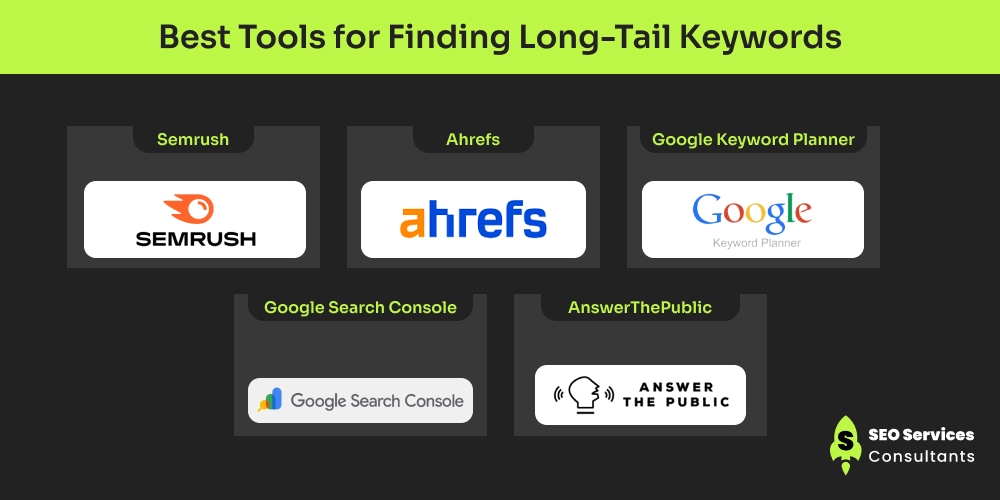
1. Semrush
Semrush is one of the most widely used SEO tools for keyword research. It helps you find long-tail keywords by showing keyword suggestions, related questions, and search trends. You can check important metrics such as global and local search volume, keyword difficulty, and competitive density.
Semrush also allows you to analyze competitor keywords. This helps you identify long-tail opportunities that your competitors are already ranking for. Its AI-powered features suggest keywords that match user intent, which makes it useful for both informational and transactional content.
2. Ahrefs
Ahrefs is a powerful tool for discovering long-tail keywords through its Keywords Explorer. It provides detailed insights such as keyword difficulty, clicks, return rate, and parent topics. This helps you understand how competitive a keyword is and whether it is worth targeting.
Ahrefs is especially useful for finding question-based and intent-driven long-tail keywords. You can also analyze top-ranking pages to see how competitors are using those keywords in their content.
3. Google Keyword Planner
Google Keyword Planner is a free tool provided by Google. It is mainly designed for advertisers, but it is also useful for SEO keyword research. The tool helps you find keyword ideas directly from Google’s database.
You can discover long-tail keywords by entering a seed keyword and checking related keyword suggestions. It also shows average monthly searches and competition level, which helps in selecting keywords with realistic ranking potential.
4. Google Search Console
Google Search Console helps you identify long-tail keywords that your website is already ranking for. It shows real search queries users typed before clicking on your pages.
This tool is useful for optimizing existing content. By identifying long-tail keywords with impressions but low clicks, you can improve your content and increase rankings with minimal effort.
5. AnswerThePublic
AnswerThePublic focuses on question-based keyword research. It shows long-tail keyword ideas in the form of questions, comparisons, and prepositions based on real search behavior.
This tool supports creating blog content that targets informational long-tail keywords. It clearly reflects user intent and helps you structure content around real user queries.
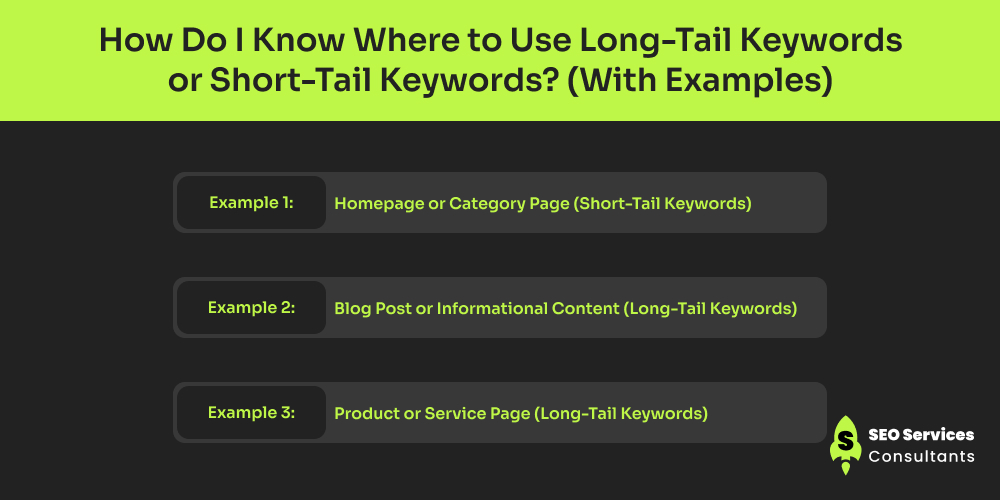
How Do I Know Where to Use Long-Tail Keywords or Short-Tail Keywords? (With Examples)
The right use of long-tail and short-tail keywords depends on the purpose of the page and the user’s search intent.
Example 1: Homepage or Category Page (Short-Tail Keywords)
If you are creating a homepage or a main service page, short-tail keywords work better because the goal is visibility.
Example keywords:
Shoes
Running shoes
Digital marketing agency
These keywords are broad and attract a wide audience. Users may be researching or just exploring options. Ranking for these terms helps build brand awareness, but conversions are usually lower.
Example 2: Blog Post or Informational Content (Long-Tail Keywords)
For blog posts and educational content, long-tail keywords are more effective because they target specific questions.
Example keywords:
Best running shoes for beginners
How to choose running shoes for daily use
Affordable running shoes for men
These keywords show clear intent. Users are looking for detailed information, which makes them more likely to engage with the content.
Example 3: Product or Service Page (Long-Tail Keywords)
On product or service pages, long-tail keywords perform better because users are closer to taking action.
Example keywords:
Buy running shoes for men online
SEO services for small businesses
Affordable NYC SEO agency
These searches often lead to higher conversions because the user already knows what they want.
Get the Right Keywords, Get Real SEO Results With SEO Services Consultants
In the digital world, everyone is using keywords, but not everyone is seeing success. The difference comes from choosing the right ones. Most agencies don’t use long‑tail and short‑tail keywords effectively. At SEO Services Consultant, our team knows how to make them work. We have real, hands‑on experience with advanced SEO tools. We build content strategies and research keywords based on your business needs.
Want to rank higher? Partner with us and watch your business grow.
FAQs
What is the major difference between short tail and long tail keywords?
Short‑tail keywords are short, broad terms with high search volume but heavy competition, making them harder to rank for. Long‑tail keywords are longer, more specific phrases with lower search volume but higher conversion potential. The main difference is intent: short‑tail drives visibility, while long‑tail attracts targeted users ready to take action.
Which is the best tool for Long tail keywords?
There isn’t a single “best” tool, but several stand out. Ahrefs and SEMrush are excellent for in‑depth keyword analysis and competitor insights. KeywordTool.io is great for generating ideas from Google autocomplete, while Ubersuggest offers a beginner‑friendly option. Google Keyword Planner is free and reliable. The right choice depends on your goals and budget.
Do I need an agency for keyword research, or can I do it myself?
With plenty of tools and some SEO knowledge, you can definitely manage this on your own, especially if you’re still learning or running a startup. But if you’re already a reputable name among your audience, it’s smarter to partner with an agency like SEO Consultant Services. We know how to research both long‑tail and short‑tail keywords to drive better conversions.