A keyword is the term a user types to find answers to their queries. Proper keyword research can boost organic visibility by 30–70%, according to multiple SEO studies. It forms the real foundation of SEO rankings.
Every day, thousands of new websites go live, but only a few achieve long-term visibility. Often, the reason is not weak services or poor products, but the language. Many brands fail because their targeted keywords are either too competitive or outdated, failing to align with actual search queries.
We understand the frustration of not ranking. Many brands struggle without knowing the real cause. Even if you implement the right SEO strategy, targeting the wrong keywords can prevent your success on the digital platform.
This blog is dedicated to guiding you through effective SEO keyword research. You will learn how to identify the right keywords, target the right audience, and use the best tools to maximize your reach and impact.
Table of Contents:
- What Is SEO Keyword Research and Why It Matters
- Types of SEO Keywords
- Learn How to Do SEO Keyword Research Effectively
- Why Professional SEO Keyword Research Makes the Difference
- Expert Tips for Getting the Most from Your SEO Keywords
- Ready to Turn Searches into Sales? Partner With a Growth-Focused SEO Agency
What Is SEO Keyword Research and Why Does It Matter?
Generally, SEO keyword research is the process of identifying the exact words or phrases people type into search engines when looking for a product, service, or solution. These keywords are more than just data points; they are signals of intent.
Undoubtedly, everyone adds keywords to their content, but not everyone ranks for them. Only a few websites appear in the top search results. Finding keywords that are both easy to rank for and aligned with your audience’s search intent can be a game-changer. However, this requires the right strategy. Without keyword research, SEO is a gamble. With it, SEO becomes a system for growth.
When done correctly, keyword research helps you:
- Attract the right audience, not just more traffic
- Create content that solves real problems
- Rank for searches that convert into leads and sales
- Reduce wasted effort on content that never performs
Types of SEO Keywords
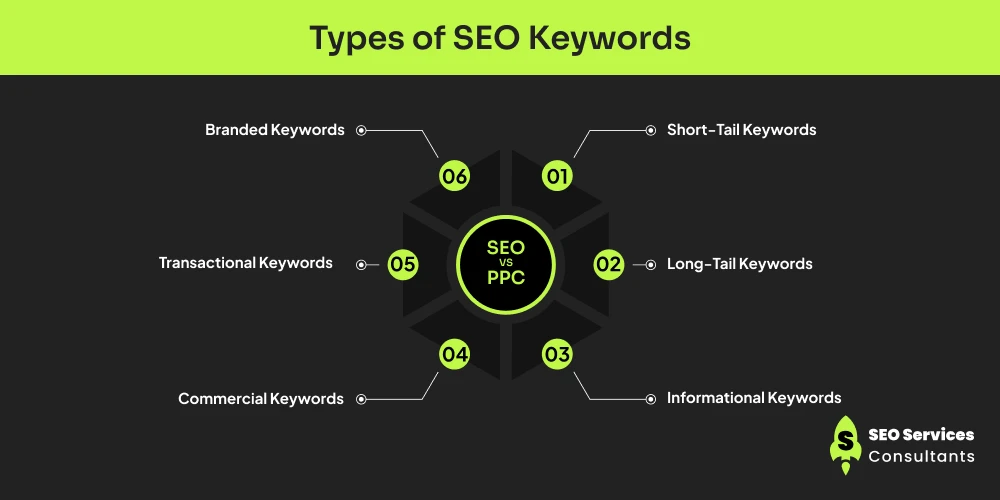
Keywords are not all the same. Each type serves a different purpose in the SEO journey and targets users at different stages of intent. Understanding these categories helps you attract the right traffic, not just more traffic.
Short-Tail Keywords
Short-tail keywords, also called seed keywords, are broad, high-volume terms. These usually consist of one or two words, such as SEO services or digital marketing. They attract large audiences but face intense competition and typically have lower conversion intent. Best used for brand visibility and top-of-the-funnel awareness.
Long-Tail Keywords
Long-tail keywords are more specific phrases with lower competition, making them easier to target for potential customers. For example, affordable SEO services for small businesses. While these keywords have lower search volumes, their intent is higher. Studies show long-tail keywords drive over 60% of organic search traffic and convert better because they match precise user needs.
Informational Keywords
Informational keywords answer questions, such as what is keyword research or how SEO works. They are ideal for users in learning mode and can be included in blogs, guides, and educational content that builds authority and trust.
Commercial Keywords
Commercial keywords indicate comparison or evaluation intent, such as best SEO tools or SEO agency pricing. Users searching for these are close to making a decision. Optimizing for them supports lead generation and sales enablement.
Transactional Keywords
Transactional keywords show strong purchase intent. Examples include hire SEO agency or buy keyword research service. They typically have lower search volume but the highest conversion potential.
Branded Keywords
Branded keywords include your company or product name. They help maintain brand presence, improve click-through rates, and capture high-intent users already familiar with your business.
Learn How to Do SEO Keyword Research Effectively
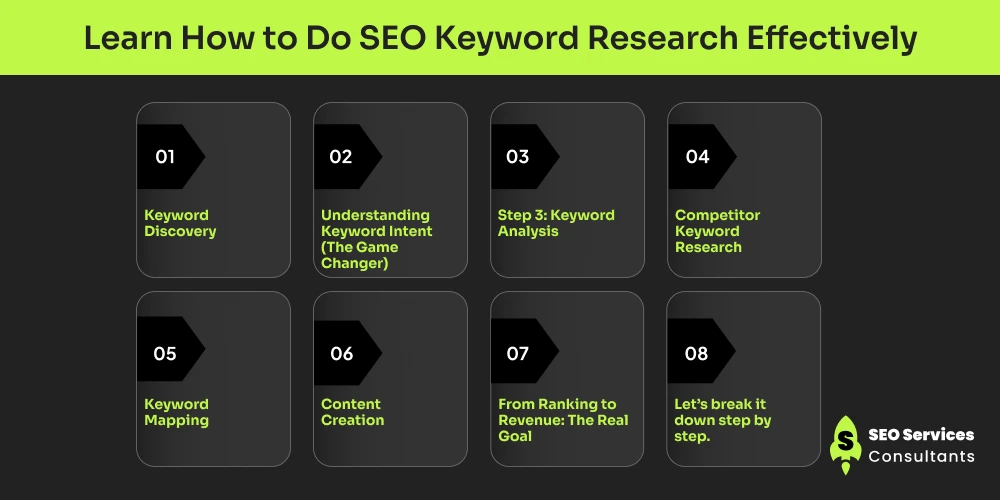
In this section, you will learn a practical strategy to find the right keywords for your website, keywords that help attract the right audience and convert traffic through quality content. SEO keyword research is not about assumptions; it’s a structured process that connects user demand with your business goals.
Let’s break it down step by step.
Step 1: Keyword Discovery
Keyword discovery is where you uncover real opportunities. This stage is about expanding ideas and validating them with data. Instead of assuming what people search for, you identify what they actually type into search engines.
To start keyword research, you can use tools like Google Keyword Planner, Ahrefs, or SEMRush. These tools provide a wide range of keywords, both long-tail and short-tail, along with search volume and competition. You can also check Google’s keyword suggestions for additional ideas.
Start by understanding three core elements:
1. Your Audience’s Problems
Before choosing keywords, understand your audience’s pain points. Think about how your product or service solves their problems. Today, people rely on online solutions, and every search reflects a problem, goal, or decision.
For example, if you offer SEO keyword research services, your audience may struggle with:
- Low website traffic
- Poor keyword rankings
Content that does not convert
Turn these problems into search phrases:
- “Why is my website not ranking?”
- “How to find profitable keywords.”
- “SEO keyword research services for small business”
Each problem creates multiple keyword opportunities.
2. Seed Keywords
Seed keywords are the foundation of your research. These are broad terms directly related to your service. Targeting them alone might not give results, but they can be expanded into valuable variations.
For example:
- SEO keyword research
- Keyword research services
- SEO services
From the seed keyword “SEO keyword research services”, you can expand into:
- Affordable SEO keyword research services
- SEO keyword research services pricing
- Professional keyword research for websites
One seed keyword can generate hundreds of targeted ideas.
3. Search Behavior Patterns
Modern users rarely search with single words. They use complete phrases, ask questions, and compare options. Understanding these patterns helps you target intent-driven searches.
Instead of searching for “keywords,” users search:
- “How to do SEO keyword research.”
- “Best SEO keyword research services”
These long-tail keywords may have lower search volume but show clear intent and often convert better.
Step 2: Understanding Keyword Intent (The Game Changer)
Analyzing your keywords reveals an important insight: not every keyword should aim for a sale. Ranking only matters when the keyword matches the user’s search intent. Aligning intent with content is what separates effective SEO from wasted effort.
Every keyword falls into one of four primary intent types:
Every keyword falls into one of four primary intent types:
1. Informational Intent
Users are seeking knowledge.
Example: “What is SEO keyword research?”
These keywords are ideal for blogs, guides, and educational content. They build authority, answer questions, and establish trust.
2. Navigational Intent
Users are searching for a specific brand, tool, or website.
Example: “Ahrefs keyword research tool”
Optimizing for these keywords protects brand visibility and ensures your audience finds you first.
3. Commercial Intent
Users are evaluating solutions and comparing options.
Example: “Best SEO keyword research services”
Content such as case studies, comparisons, and service pages performs well here. This is where trust-building begins.
4. Transactional Intent
Users are ready to take action.
Example: “Hire SEO keyword research services”
Keywords with transactional intent directly drive revenue. Service pages, product pages, and CTAs should target these searches.
Step 3: Keyword Analysis
Finding keywords is easy. Selecting the right ones needs expertise in this field. If you don’t have an idea, you can check your competitor’s website. Tools offer the option to compare your website and your competitor’s website and check which keywords they are using. With this, you can find the keyword gap, and this is your chance to shine.
When evaluating a keyword like “SEO keyword research services,” focus on three factors.
Search Volume
This shows how many people search for the keyword. High volume means demand, but also higher competition.
Keyword Difficulty
This indicates how hard it is to rank. If your site is new, targeting medium or low difficulty variations such as “SEO keyword research services for startups” is more realistic.
Business Relevance
The keyword must match your service. Ranking for traffic that does not need your offering will not generate leads.
The goal is balance, keywords that are achievable, relevant, and revenue-focused.
Step 4: Competitor Keyword Research
Your competitors already spend time and invest heavily in SEO. In fact, that data is more valuable than you might think. By carefully analyzing your competitors’ ranking for SEO keyword research services, you gain insights that go beyond just keywords. You can:
- See which keywords bring them traffic
- Identify gaps they missed
- Target keywords with proven intent
Well, instead of guessing, you build your strategy on what already works in the market. This way, you save time, reduce trial and error, and focus on opportunities that are more likely to bring results.
Step 5: Keyword Mapping
Keyword research works only when implemented correctly. Without proper mapping, even the best keywords can fail to drive results.
Keyword mapping is the process of assigning specific keywords to the right pages on your website. Well, this ensures that each page has a clear focus and avoids competing with other pages for the same keyword, a problem known as keyword cannibalization.
For example:
Homepage → “SEO services.”
Service page → “SEO keyword research services.”
Blog → “How to do SEO keyword research.”
Mapping keywords correctly strengthens the relevance of each page. Search engines understand the purpose of every page, and reward this clarity with better rankings.
Step 6: Content Creation
Keywords alone do not rank. But when content and keywords blend naturally, they definitely do. Moreover, modern SEO is not about repeating keywords or stuffing them; it is about fulfilling user intent by using a mix of long-tail and short-tail keywords while providing real value.
When creating content for SEO keyword research services, your page should:
Answer the user’s questions clearly, leaving no doubt or confusion
Use natural language that feels human, not robotic
Explain processes step by step, so users can follow and understand easily
Demonstrate expertise and credibility, showing that you know your field
Encourage action subtly, without sounding pushy or salesy
When your keywords fit naturally into content that genuinely helps users, search engines recognize the value, and rankings follow.
Additionally, creating high-quality content builds trust. Users are more likely to stay longer, engage, and convert when your content fully solves their problems. Ultimately, each page becomes an asset that supports your SEO strategy and grows your website’s authority over time.
Step 7: From Ranking to Revenue: The Real Goal
Ranking on page one feels good. But rankings are not the final goal. Effective keyword research leads to:
- Higher-quality traffic
- Better engagement
- More inquiries and conversions
- Lower acquisition costs
This is why businesses that invest in professional SEO keyword research grow faster and more consistently. SEO stops being an expense and becomes a long-term asset.
Why Professional SEO Keyword Research Makes the Difference
DIY tools provide data. Experts provide direction.
Keyword research may seem simple on the surface, but you can get search volumes, trends, and suggestions from free or paid tools. However, effective SEO is not done without the guidance of experts. This is where an SEO services consultant steps in. They bring experience, strategy, and insights that go beyond raw numbers.
A professional SEO keyword research service goes beyond counting searches. It understands search intent, buyer behavior, and market competition. It identifies which keywords can actually drive qualified traffic and conversions, rather than chasing vanity metrics like traffic volume alone.
Experts map these keywords to your website strategy, align them with business goals, and create a roadmap for content and growth. Moreover, professionals spot opportunities that tools alone cannot reveal. They analyze competitors, uncover gaps, and predict trends to give your SEO strategy a real advantage.
Expert Tips for Getting the Most from Your SEO Keywords
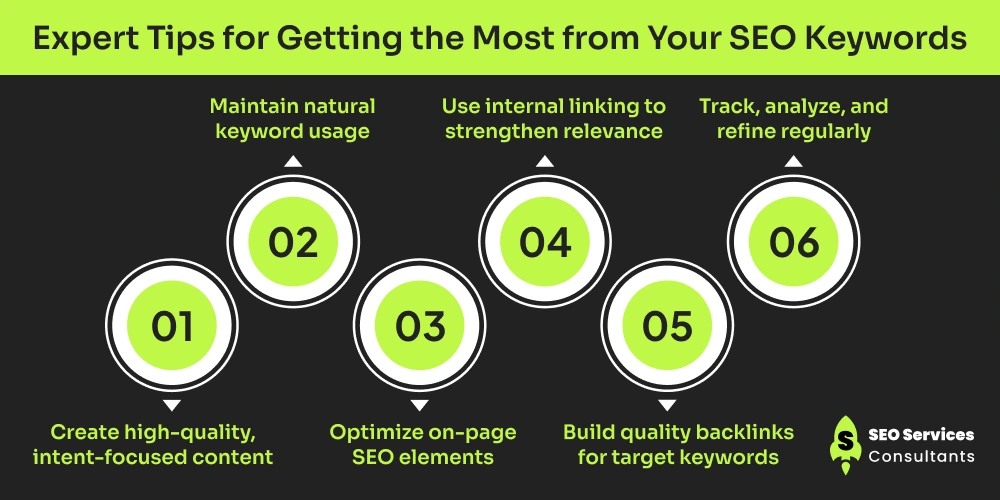
Strong keyword research delivers results only when it is applied correctly. The following best practices help your keywords perform better, rank faster, and drive meaningful traffic.
Create high-quality, intent-focused content
Content quality always comes first. Write for users, not search engines. Your content should clearly answer the search query, solve a problem, and provide real value. Well-structured, helpful content naturally performs better in search results.
Maintain natural keyword usage
Keyword density should never feel forced. There is no fixed percentage that guarantees rankings. Instead, focus on natural placement. Use the primary keyword where it makes sense, and support it with related terms and variations.
Optimize on-page SEO elements
Place your target keyword strategically in:
Meta title
Meta description
URL
Headings (H1, H2 where relevant)
Image alt text
These elements help search engines understand the page topic and improve click-through rates.
Use internal linking to strengthen relevance
Internal links guide users and search engines across your website. Link related pages using contextual anchor text. This builds topical authority, improves crawlability, and distributes ranking power effectively.
Build quality backlinks for target keywords
Backlinks remain a strong ranking factor. Focus on earning links from relevant, authoritative websites. A few high-quality backlinks are far more valuable than many low-quality ones. They signal trust and credibility to search engines.
Track, analyze, and refine regularly
A key element of the success is the track. SEO is not a one-time task. Monitor keyword performance, rankings, and user behavior. Update content, improve structure, and adjust targeting based on data to maintain long-term growth.
Ready to Turn Searches into Sales? Partner With a Growth-Focused SEO Agency
If your website attracts traffic but not results, keyword research is likely the missing link. At SEO services consultants, we help brands discover keywords that matter, rank where it counts, and convert visitors into customers. Our SEO keyword research is strategic, data-driven, and built for growth.