
The search engine optimization market is expected to grow to $108.28 billion in 2026. However, despite this rapid growth, it is one of the most misunderstood digital marketing services. The presence of many service providers with different pricing models has confused business owners, creating many myths about them. Some business owners have started believing that SEO is a one-time cost or that its pricing is standard across the industry. These misconceptions often lead businesses to waste money, follow ineffective SEO strategies, or choose the wrong provider.
The reality is that SEO pricing depends on multiple factors, such as the size of your business, your goals, industry, and target audience. In this blog, we will debunk the most common SEO pricing myths business owners believe and help you evaluate SEO services effectively so you can invest smartly. The reality is that businesses have different SEO needs, and these factors decide SEO pricing.
Key Takeaways
- SEO pricing is not a one-time process. Due to continuous Google algorithm updates and high competition in the market, consistent SEO efforts are required.
- Low-cost SEO packages may look attractive, but they often use spammy links to deliver quick results that may lead to a Google penalty and a drop in traffic.
- Large agencies do not always provide the best SEO services. They might outsource your project to an overseas agency or assign it to junior staff.
- There is no standard SEO pricing. It varies with multiple factors such as industry, geographical area, and work scope.
- An ethical SEO agency will never guarantee a #1 position. They will ensure measurable outcomes like leads and conversions.
- SEO comes with different packages and pricing. Not all packages are the same. They include different deliverables and follow different pricing models.
- SEO ROI can be measured through long-term results such as increased organic traffic, leads, and site visitors.
- Hiring an in-house SEO team is not always cost-effective. An in-house specialist may also cost more compared to outsourcing SEO services.
SEO Pricing Myths at a Glance
SEO pricing confusion stems from inconsistent deliverables and inflated promises. One agency sends you a $400 proposal for SEO services. Another agency may send a proposal of $2,000 for the same services. This makes the whole pricing structure seem vague. The SEO pricing market is full of half-truths, outdated advice, or flat-out myths that are so widely spread that they seem to be true. But the reality is that SEO cost depends on multiple factors, including your business size, market competition, and other factors. A local business in Texas will have different SEO needs than an eCommerce brand competing nationwide or internationally. Understanding these myths and the actual facts can help you take decisive action. Here’s a quick overview of common SEO pricing myths and realities to help you understand them better.
Myth |
Reality |
What Businesses Should Do |
Example |
|---|---|---|---|
| SEO is a one-time cost | SEO requires ongoing investment due to Google algorithm updates & competition | Budget monthly for SEO as a recurring expense | Local HVAC company invests $1,500/month to stay visible |
| Cheap SEO Delivers the Same Results | Low-cost packages often use spammy tactics that only prioritize rankings | Ask for deliverables, reporting, and proof of past results | $300 “SEO package” led to a Google penalty, and traffic dropped 70% |
| Higher Price Always Means Better SEO | Premium fees don’t guarantee ROI; transparency matters | Evaluate agencies based on case studies and KPIs, not price tag | Large agencies charge $10K+ but outsource overseas |
| SEO pricing is standard across the industry | Costs vary by industry competitiveness | Compare pricing within your niche (law, SaaS, ecommerce, local) | Personal Injury law firm SEO costs $5K–$15K/month. Whereas, for a local cafe SEO, the cost is $1K–$2K/month |
| Guaranteed #1 rankings | No ethical agency can promise rankings | Focus on measurable outcomes: leads, conversions, revenue growth | Agencies that promise #1 often use black-hat tactics |
| All SEO Packages Are the Same | Models differ: retainer, hourly, project, performance | Choose a model that fits your budget and growth goals | SEO consultants charge $100–$300/hour. Whereas in the monthly retainer model, the cost is $2K–$10K/month |
| ROI is impossible to measure | ROI can be tracked via leads, LTV, and conversions | Demand clear reporting tied to revenue, not just rankings | E-commerce brand achieved 15X ROAS with transparent pricing |
| Hiring an in-house SEO is always cheaper | In-house salaries, benefits, and tools often exceed agency retainers | Compare total cost of ownership (salary, tools, training) vs. agency fees | U.S. SEO manager salary averages $70K/year plus $500–$1,000/month in tools |
What are the most Common SEO Pricing Myths Business Owners Still Believe? (Detailed Breakdown)
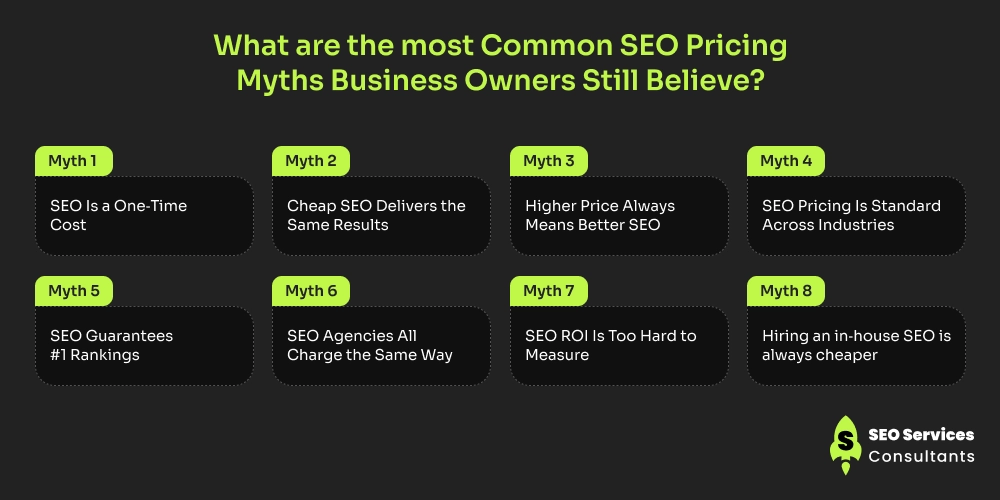
Now that you are familiar with the most common myths, let’s break each of them down in detail.
Myth 1: SEO Is a One‑Time Cost
- This is one of the most common myths about SEO: that it is a one-time cost.
- The reality is that SEO is a continuous, long-term investment. Google algorithms change frequently; the update you worked on before might not be enough for the new updates.
- If you are not optimizing your website but your competitors are, they are likely to surpass you in search results.
Myth 2: Cheap SEO Delivers the Same Results
- The idea that cheap SEO delivers the same results is a complete myth. Reality is, you need SEO customized to your business goals and audience for an effective result-oriented strategy.
- The cheap SEO strategy often opts for black-hat SEO techniques, utilizing spammy links and shortcuts to deliver results.
- You risk your business for a Google penalty and traffic loss. A study suggests that businesses that spend only $500 on SEO are 75% more likely to be dissatisfied with results as compared to those investing more.
- An SEO strategy customized to your business goals, industry, and market would bring positive results and help you attract more potential traffic.
Myth 3: Higher Price Always Means Better SEO
- It is a general assumption that if you spend more on SEO services, you will automatically achieve better results. But this is not true.
- There are instances where businesses hired a premium agency, but they outsourced the services overseas or assigned the project to junior staff.
- Irrespective of the size of the organization, it is crucial to check for deliverables, measure KPIs, and ensure transparent communication.
Myth 4: SEO Pricing Is Standard Across Industries
- SEO is not a one-size-fits-all concept. It varies depending on business size, agency, city, and industry.
- For metro areas with high competition, such as New York and San Francisco, the cost would be much higher compared to rural areas. Pricing changes based on targeted geography, industry competition, and service scope.
- For instance, in the law industry, SEO services range from $5,000 to $15,000 per month for personal injury law firms. Whereas SEO services for local restaurants may start from $1,000 per month. Industry competitiveness drives the prices.
Myth 5: SEO Guarantees #1 Rankings
- As per Google guidelines, no one can guarantee the #1 position on Google searches. It is a red flag.
- In high competition areas, the search rankings change frequently.
- An SEO campaign should focus completely on leads, conversions, and revenue growth.
- For instance, to rank a local salon service on Google would require fewer SEO efforts in comparison to ranking an e-commerce brand nationally. A seasoned agency will set realistic goals.
Myth 6: SEO Agencies All Charge the Same Way
- Not all SEO agencies charge the same way. The rates vary based on multiple factors such as the business size, niche, and target audience.
- The deliverables include technical SEO, on-page SEO, and off-page SEO. The cost varies as per the package you opt for, like the full package would be expensive compared to individual services.
- In general, there are four most followed SEO pricing models: Monthly retainer, hourly consulting, project-based, and performance-based models.
- In the monthly retainer model, you pay on a monthly basis, while in the hourly-based model, the payment is based on the number of hours involved.
- The project-based model is opted for businesses with a requirement for fixed projects.
Myth 7: SEO ROI Is Too Hard to Measure
- SEO brings a compounding long-term effect. The results will not be visible immediately.
- Significant results appear in 6 to 12 months. Businesses can track ROI by calculating cost per lead, customer lifetime value, and conversion rates.
- For example, a local business salon owner saw a three times increased number of inquiry calls.
Myth 8: Hiring an in‑house SEO is always cheaper
- Hiring an in-house SEO team is not always cheaper.
- For instance, an SEO specialist in the US charges around $75,000/month to $1,30,000/month.
- Whereas for a monthly retainer model, the SEO services cost nearly $15,00/month.
How to Evaluate an SEO Agency Before You Pay a Single Dollar?
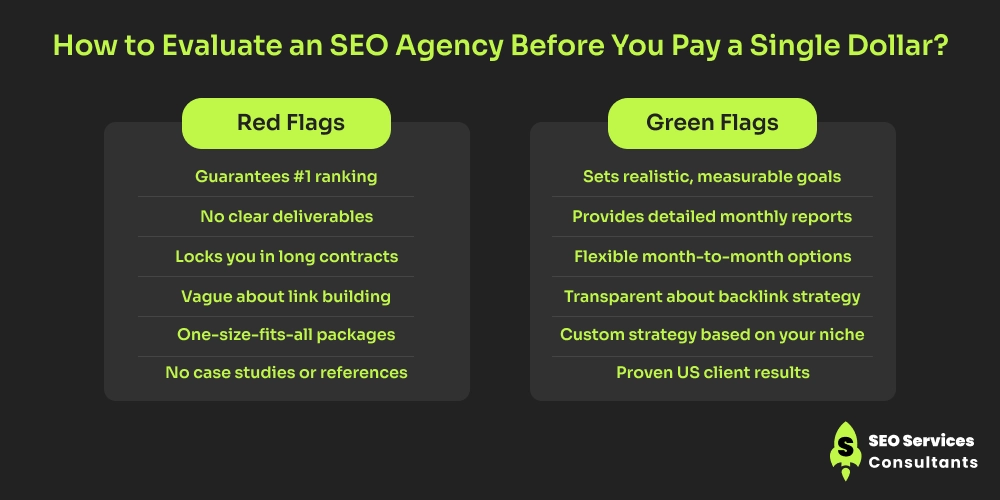
With so many agencies and options available, the next question that comes to mind is how to evaluate an SEO agency and choose the right one. You can look for key factors such as transparency in deliverables, proven results in the form of testimonials and case studies, and clear and regular reporting. Here is a list of red flags, which you can keep in mind to make an informed decision.
Final Thoughts
SEO delivers measurable results when done right. The right SEO, tailored to your business needs and goals, is a true investment that will yield productive results in the long term.
All the myths that we have debunked in this blog exist for a simple reason: lack of knowledge about the right SEO strategies. Understanding the truth behind these myths can help you make informed decisions and avoid wasting budgets on the wrong techniques. You now know which red flags to avoid. You should focus on deliverables, proven results, and the ability to generate strong ROI.
Whether you are running a small business or a large enterprise, choosing a well-suited SEO strategy can enhance your online presence, bring in more organic traffic, and increase revenue.
Frequently Asked Questions About Common SEO Pricing Myths
Can cheap SEO packages deliver the same results?
No, cheap SEO packages often rely on shortcuts such as spammy links, which can lead to Google penalties and traffic loss.
Is SEO really a one-time thing, or do I need to keep paying for it?
This is one of the biggest myths about SEO. Businesses need to understand that SEO is not a project. It is a long-term process that provides compounding results that last for years. On one side, your competitor is looking to outrank you; on the other hand, Google’s algorithm is consistently evolving. To stay competitive, you need to work on SEO consistently.
Do more backlinks always mean higher rankings?
No. High-quality backlinks contribute to a brand’s authority, which helps in higher rankings. But low-quality backlinks can be flagged by Google as spam and can hurt the domain authority. You may also lose your traffic.
Can small businesses compete with big brands in SEO?
Yes, certainly. With a comprehensive SEO strategy, small businesses can also compete with big brands. The right SEO strategy helps you strengthen brand authority and enhance your online presence.
How long before I see results from SEO?
SEO is a long-term process. You may see small improvement in 2 to 3 months, but noticeable changes take 6 to 12 months.
Why is there such a huge price difference between SEO agencies?
There are multiple factors that affect SEO pricing, such as targeted location, industry, and scope of work. For example, SEO services are generally expensive in a high-competition area such as New York or San Francisco. Whereas it may cost less in low-competition or less competitive markets.