You’re paying for monthly SEO, watching the reports roll in, and suddenly, on a fine day, your ranking drops. Frustrating and heart-wrenching, isn’t it? But here’s the surprising truth: SEO volatility is completely normal. In fact, studies from SEMrush and Ahrefs show that Google rankings can shift frequently due to algorithm updates, competition, and content freshness, and not just poor SEO work.
We spoke once with a business owner who saw a 25% traffic drop in a single month and immediately blamed their agency. A week later, the rankings bounced back after a core update settled. Nothing was actually “broken”.
This blog discusses the most common reasons that your site’s rankings may drop suddenly. We’ll also suggest tips to help you take control of the situation if it happens.
Key Takeaways:
- Ranking drops are normal and often caused by algorithm updates, not always poor SEO work.
- Outdated or misaligned content with user intent can quickly lead to a loss in rankings.
- Technical SEO issues can silently block search engines from properly indexing your site.
- Not all backlinks are harmful; improper disavowal can reduce your site’s authority.
- Violating search engine guidelines can trigger penalties and sudden traffic drops.
- The first 48 hours should focus on diagnosis, not panic-driven SEO changes.
How Do Sudden Ranking Drops Affect A Business?
A ranking drop can cost significant reductions in organic traffic and thousands of dollars in lost revenue. It can also damage your brand’s reputation. Here’s how your ranking drop can affect your business:
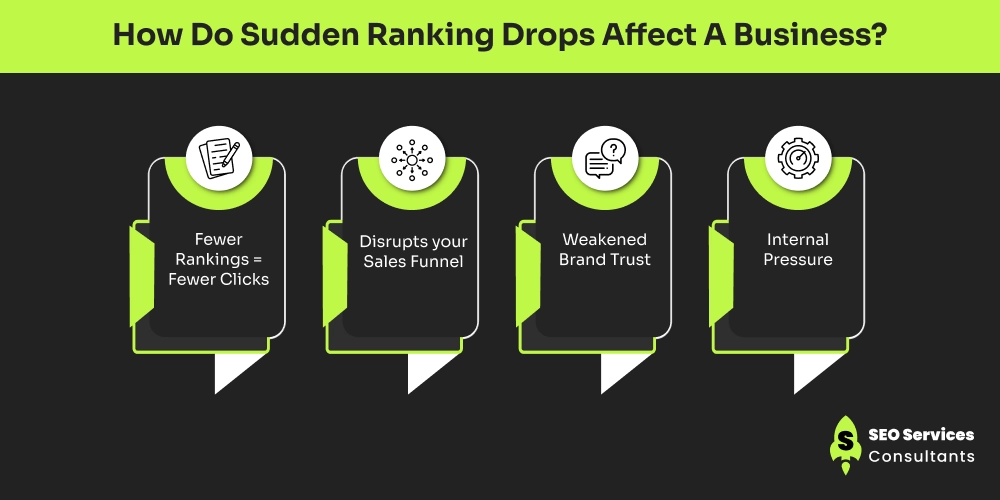
Fewer Rankings = Fewer Clicks
Most users rarely go beyond the first page of Google search results. Hence, even a small drop in rankings can drastically affect your visibility. And when people don’t “see” you to be able to click you, it directly drops your traffic, leads, and sales.
Disrupts your Sales Funnel
A majority of your high-intent users who are genuinely looking for your products or services find your website through organic traffic. But when rankings fall, those potential customers move to your competitors’ websites.
Weakened Brand Trust
Consistent top rankings help a business build brand authority and credibility. People trust a brand they see on top of every search they perform. However, when your position drops, users may perceive your business as less reliable or relevant.
Internal Pressure
Sudden drops can cause internal pressure on teams and owners, forcing rushed decisions or unnecessary changes. If the real reasons aren’t known, businesses often end up spending more without fixing the actual issue.
Top Reasons That Might Have Caused A Drop in Your Rankings
In most cases, there has never been a single reason behind a sudden ranking drop. When you invest in monthly SEO, it’s natural to expect positive results. However, technical gaps, external factors, etc., can cause your effort to pay off first but can later backfire.
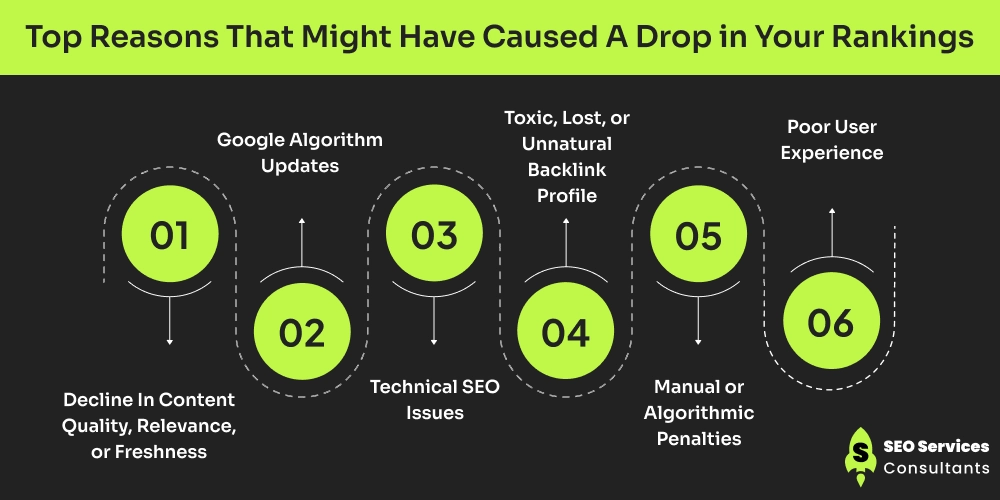
1. Decline In Content Quality, Relevance, or Freshness
Content is the essence of SEO, and hence it’s the king. Market change, algorithm updates, and customers are turning smarter each day, making regular content updates mandatory for marketers. However, if your site has outdated or copied content, the site might lose rankings.
The user intent is now more than ever before in 2026. Not only about search engines, but your content must assist users in their buying journey. And if your content doesn’t provide content that aligns with user intent, it may lose rankings.
2. Google Algorithm Updates
Google’s frequent algorithm updates are one of the most common reasons why websites’ rankings are negatively affected.
Google continues to change its algorithms with the aim of providing better search results to users. Sites that fail to adhere to or evolve according to these evolving rules are usually inclined to incur Google fines and ranking losses.
3. Technical SEO Issues
Your site may have issues in its navigation, structure, speed, etc. If your website has these technical issues, it directly affects your rankings. For example, having a well-created URL sitemap is important for search engine bots to crawl and index your site. Some of the top technical factors to check are:
- HTTP status code
- Robots.txt
- Meta robots tag
- Slow page speeds
- Broken Links
- Duplicate or canonical URLs
- Missing Mobile responsiveness
- Core Web Vitals
Even a small technical incompatibility can make search engines fail to crawl, render, and comprehend your site. This eventually decreases visibility, page indexation, and overall ranking performance even with constant search engine optimization.
4. Toxic, Lost, or Unnatural Backlink Profile
Has your website recently lost a number of backlinks? If yes, it could next cause a downfall in your rankings. When your webpage is full of backlinks, it is always tempting to view the link’s profile and disavow it since they seem spammy. But when it is done without analysis, it can even be detrimental to your SEO performance.
Most search engines, such as Google Search, are usually advanced enough to disregard low-quality links, and they will only impose a penalty when there is clear evidence of manipulative or malicious link-building techniques.
The excessive use of the disavow tool can lead to the loss of great link equity that helps to advance your rankings. Rather, you should pay attention to the quality of links and emphasize the natural and authoritative development of the backlinks rather than the clean-up.
5. Manual or Algorithmic Penalties
Breaking of Google Search Webmaster Guidelines, including keyword stuffing, hidden text, or link schemes, may lead to manual or automatic sanctions that have a devastating effect on rankings.
This can minimize your presence during the night, leading to an instant drop in traffic and subsequent problems with your pages appearing in the search results until the problem is adequately resolved and rethought.
6. Poor User Experience
A bad user experience can greatly damage your Google Search positions. The harder your site is to navigate, the more cluttered it is, the slower it is, or the less mobile-friendly it is, the more likely people will abandon it. High bounce rates and low engagement will send a signal to search engines that your content is not helpful, and this can eventually drop your ranking.
Immediate Rescue Plan - What To Do In The First 48-Hours After a Ranking Drop?
The first 48-hours are vital when your standings are abruptly declining. Acting on the spur of the moment or mindlessly may only worsen situations at this point. The trick is to remain calm and concentrate on the cause of the issue before undertaking any significant decisions.
The following are some of the immediate steps that you should undertake:
- Test your data in the Google Search Console and Google Analytics. Find patterns - were it specific pages, keywords, or your whole site that was impacted by the drop? This allows you to know whether it is a technical problem, content-based, or a wider problem, such as an update in the algorithm.
- Inquire whether Google search has been updated recently. The rankings may change suddenly with core updates, and in most instances, the ideal solution is to evaluate and not to panic.
- At the same time, perform a brief technical audit. Make sure that your site is well indexed. Ensure that crawl errors are not sudden and that your site is also accessible.
- You must also check some of the recent changes in your site. Rankings can be affected even by minor modifications, such as updating content, internal links, or metadata. In case something has been changed recently, you should think about whether it can have had an inadvertent impact on performance.
- The other one would be monitoring your backlink profile. An increase in the number of suspicious links or unexpected loss of quality backlinks may influence your rankings. However, do not hurry to break the ties without proper consideration.
- Last, stop any aggressive SEO modifications or experiments. Rather than doing numerous fixes simultaneously, focus on data-driven controlled actions. The initial 48 hours are not about quick fixes; it is about intelligent diagnosis, hence take the right measures going forward and not add additional harm.
Fixes That Can Help Recover The Lost Rankings
| Issue / Reason | Potential Fixes |
|---|---|
| Decline in Content Quality, Relevance, or Freshness | Update outdated content regularly, align with current user intent, add new insights/data, improve readability, and ensure originality. |
| Google Algorithm Updates | Monitor updates, audit impacted pages, improve E-E-A-T (experience, expertise, authority, trust), and avoid making rushed changes. |
| Technical SEO Issues | Fix crawl errors, improve site speed, ensure mobile optimization, update sitemap, resolve broken links, and maintain proper indexing. |
| Toxic, Lost, or Unnatural Backlink Profile | Audit backlinks carefully, retain high-quality links, avoid unnecessary disavow, and focus on earning natural, authoritative backlinks. |
| Manual or Algorithmic Penalties | Identify violations, remove spammy practices, fix guideline issues, and submit reconsideration requests if needed. |
| Poor User Experience | Improve site navigation, reduce clutter, enhance page speed, ensure mobile-friendliness, and optimize for better engagement. |
| Increased Competition | Analyze competitor strategies, improve content depth, target better keywords, and strengthen overall SEO strategy. |
Overcome Sudden Ranking Drops With Expert SEO Fixes
Losing the rankings that you’d achieved with years of consistent monthly SEO can be overwhelming. But the good news is they can be regained. By identifying the underlying issues and fixing them systematically, it’s possible to see your rankings rise high on the charts again.
Our experienced search engine optimization professionals can help you diagnose the potential causes behind your ranking loss and create a tailored recovery plan accordingly. We also offer monthly SEO packages in case you aren’t satisfied with your current services. Get in touch with us and get your site back on track!