As a startup, you are finding ways to grow your business steadily. But definitely, it needs an investment in your business to lead to better rankings and growth. Without online visibility, achieving your sales targets is quite challenging. That’s where SEO and PPC step in. Undoubtedly, as a new business, you are in a dilemma about choosing between SEO and PPC.
Let’s unfold everything to help you make a better choice. In this process, your budget matters, time matters, and more importantly, you need a strategy, something that an experienced expert can obviously do.
Table OF Contents:
- Know what SEO vs PPC is?
- Where You Should Invest First: SEO vs PPC
- What Services are Included in SEO and PPC?
- SEO vs PPC: Key Differences
- Want to Lead the Market? Combine SEO and PPC With Experts Who Drive Results
Know what SEO vs PPC is?
SEO and PPC are digital marketing models. Here, SEO means search engine optimization. It includes various processes where your website optimizes each element, from content to responsiveness, and everything follows search engine ranking guidelines.
The right SEO makes your website discoverable at the top of the page. The results from SEO are not instant; they generally take 3 to 6 months for already established businesses or 6 to 12 months for startups. However, these results are long-term.
Whereas PPC refers to pay-per-click. In this model, advertisers run ads on platforms like Google Ads or Meta. These ads appear on Google when a user searches for a service like yours, marked under the “Sponsored” tag. If you run Meta ads, users see your ads on social media platforms.
You need to pay a fee to the platform for each click whenever someone taps on your ads. This is expensive but gives instant results. However, it works only as long as you keep paying; once you stop, the ads stop delivering results.
Where You Should Invest First: SEO vs PPC
Firstly, there’s no one-size-fits-all answer. Before guiding you on which option is the better pick, there are some questions you need to ask yourself:
- What budget have you allocated?
- Do you need instant results or long-term success?
- Which audience are you targeting: social media users, people genuinely searching on Google, or both?
- How fast do you need results, and how competitive is your market?
After finding these answers, you can make the right investment decision. Apart from that, this section tries to understand your business setup and help you steer your thinking so you don’t get stuck or waste your energy. This guide is here to help you.
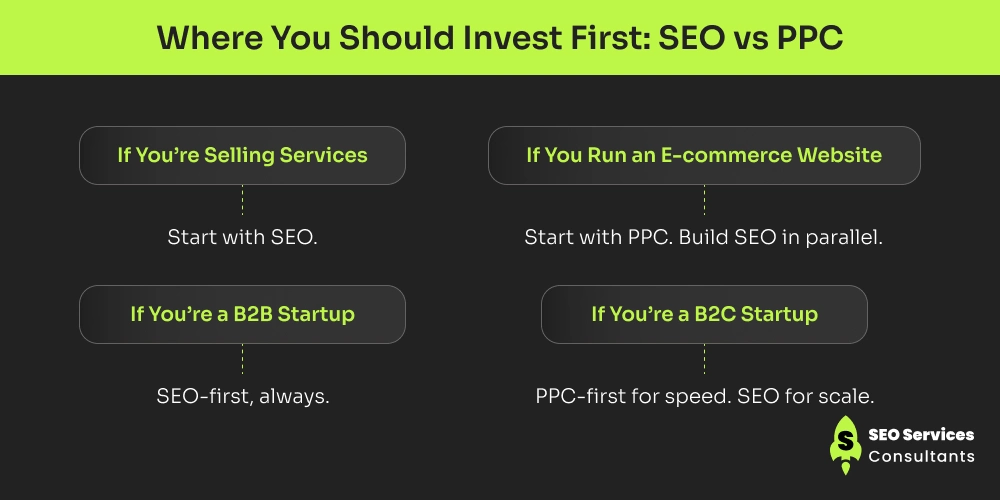
If You’re Selling Services
Start with SEO. Support with PPC when needed.
For service-based startups, trust is directly proportional to conversions. With SEO, your website becomes authoritative through reputable backlinks, informative content, and easy crawlability for search engine bots. Moreover, ranking for problem-focused keywords positions your brand as an expert.
The result? Whenever a customer searches for a service similar to yours, your website appears at the top, bringing consistent leads without paying for every click.
PPC, on the other hand, works best for immediate wins. It is useful for testing offers, promoting high-ticket services, or targeting urgent-intent keywords. However, relying only on ads can become expensive quickly, especially in competitive niches.
Best approach: For selling services, SEO is the foundation, and PPC is a growth accelerator.
If You Run an E-commerce Website
Start with PPC. Build SEO in parallel.
E-commerce is specifically an online store where a business sells products or services directly to customers over the internet. In this case, PPC is an ideal option because it delivers instant visibility for product searches and seasonal demand. You can control budgets as per your requirements, test pricing, and scale fast. Thus, PPC is also the best pick for early traction and revenue.
To maximize visibility, SEO helps optimize product descriptions, add relevant keywords, and improve website loading speed. It might take longer, but it pays off big in the long run. E-commerce consists of multiple product pages and category pages. This structure is better handled by SEO experts, helping search engines understand your website more clearly. Apart from that, content-driven SEO reduces customer acquisition costs over time.
Best approach: PPC first for sales. SEO for long-term profitability.
If You’re a B2B Startup
SEO-first, always.
In the case of B2B buyers, they always prioritize research before clicking the buy button. These services are directly sold to business owners, which means decision-makers carefully evaluate whether they are investing in the right product or service. Before making a big decision, they compare, read, and validate.
SEO supports this journey by capturing demand at every stage, from awareness to decision. It also delivers higher-quality leads with stronger intent.
Once your marketing budget increases, you can start PPC. It can support account-based campaigns or niche keywords, but it shouldn’t be your core channel early on.
Best approach: Invest in SEO. Use PPC selectively.
If You’re a B2C Startup
PPC-first for speed. SEO for scale.
When it comes to B2C startups, PPC is great for speedy traffic and conversions. If you don’t have a website and only have a social media account where you sell your product, then you need to run PPC ads along with a social media marketer who handles your captions, video shoots, and other activities. Investing in high-quality video animation can also elevate your campaigns by making your ads more engaging, scroll-stopping, and memorable across platforms. Thus, PPC helps you reach users where intent is high and attention spans are short. Moreover, it is very effective for launches, promotions, and impulse-driven products.
In a scenario where you have a website, don’t forget SEO. An optimized website becomes more powerful once your brand gains traction. It reduces dependency on ads and builds sustainable traffic.
Best approach: PPC for quick growth. SEO for stability.
What Services are Included in SEO and PPC?
Understanding each service helps you actually delivers helps startups invest smarter. No doubt, SEO builds long-term growth assets. Whereas PPC offers immediate visibility and fast feedback. Here’s where we take a deeper look at PPC versus SEO, aligned with how startups use them at different stages.
Detailed Overview of SEO Services
SEO is not a single task. It’s a system that improves visibility, trust, and conversions over time. For startups, this means steady lead flow without paying for every click.
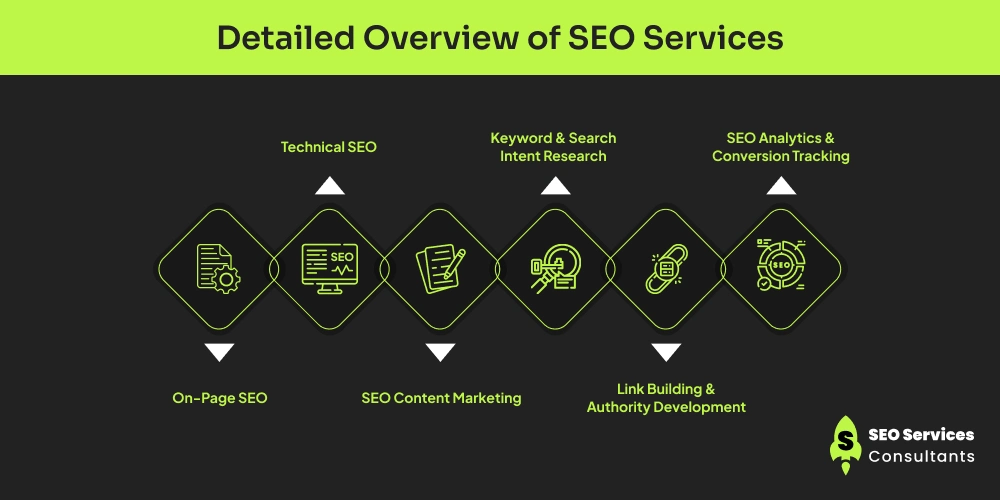
On-Page SEO
On-page SEO focuses on optimizing individual pages to match search intent. This includes keyword placement, page titles, meta descriptions, headings, internal links, and content structure. The goal is to make each page relevant, clear, and conversion-focused for both users and search engines.
Technical SEO
Technical SEO ensures your website can be crawled, indexed, and ranked without friction. It covers site speed optimization, mobile responsiveness, URL structure, schema markup, secure HTTPS setup, and fixing crawl errors. For startups, this prevents growth bottlenecks early.
SEO Content Marketing
Content marketing drives organic demand. Blogs, service pages, product guides, and comparison content attract users at different buying stages. This is especially powerful for B2B and service-based startups, where users research before they convert.
Keyword & Search Intent Research
This process identifies what your target audience is searching for and why. It goes beyond volume to focus on intent: informational, commercial, or transactional. Startups benefit by targeting keywords that convert, not just those that drive traffic.
Link Building & Authority Development
Backlinks act as trust signals. Quality links from relevant websites improve rankings and domain authority. For startups, SEO link building from reputable websites builds credibility faster and helps compete with established brands.
SEO Analytics & Conversion Tracking
SEO success is measured through traffic quality, keyword movement, engagement, and conversions. Continuous analysis helps refine strategy and maximize ROI over time.
Detailed Overview of PPC (pay-per-click)
PPC delivers instant visibility. It’s ideal for startups that need fast leads, sales, or market validation.
Search Advertising (Google & Bing Ads)
These ads appear when users search with high intent. You bid on keywords and pay only when someone clicks. This makes PPC effective for immediate demand capture.
Display & Remarketing Campaigns
Display ads build awareness across websites and apps. Remarketing targets users who’ve already interacted with your brand, improving conversion rates and lowering acquisition costs.
Shopping Ads (For E-commerce Startups)
Product-based ads show images, prices, and reviews directly in search results. They’re highly effective for driving quick purchases and testing product-market fit.
Campaign Structure & Budget Optimization
PPC success depends on how well campaigns are structured. This includes audience segmentation, bid strategies, budget allocation, and ongoing optimization to reduce wasted spend.
Ad Copywriting & Landing Page Optimization
Strong ad copy attracts clicks. Optimized landing pages convert them. Together, they improve the quality score, reduce cost per click, and increase ROI.
Performance Tracking & Scaling
PPC allows real-time performance tracking. Startups can scale what works, pause what doesn’t, and make data-driven decisions quickly.
SEO vs PPC: Key Differences
If you’re running a startup, deciding between SEO and PPC can feel overwhelming. Both bring traffic. Both generate leads. But they work in very different ways, and understanding those differences makes the decision much easier.
Let’s break it down in simple, practical terms.
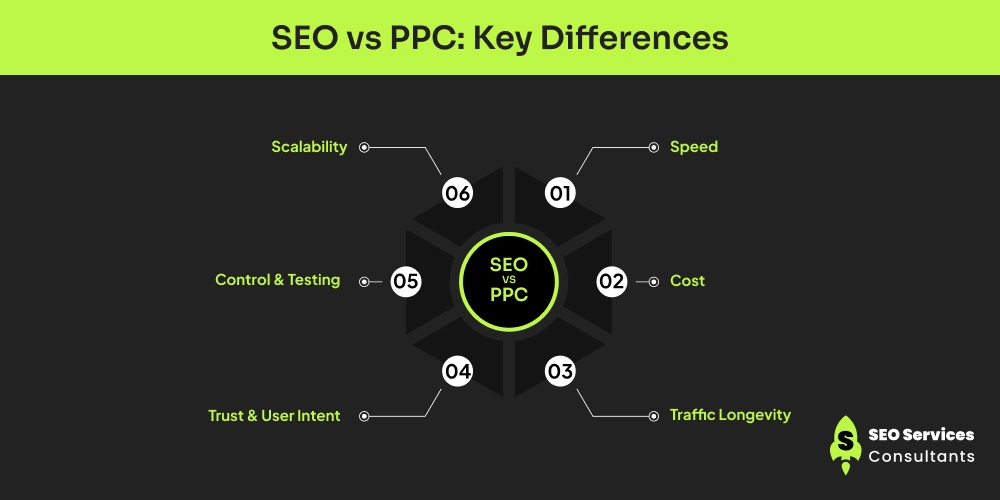
Speed: How Quickly You See Results
SEO is a long-term play. You optimize your website, publish helpful content, and improve technical performance. Search engines need time to trust your site. Results usually build gradually over weeks or months, but they become stronger with time.
PPC works instantly. You create ads, set a budget, and your website appears at the top of search results right away. This makes PPC useful when you need quick leads, product sales, or market validation.
Cost: How You Pay for Traffic
With SEO, you invest in the work: strategy, content creation, optimization, and ongoing improvements. You don’t pay when someone clicks your link. As rankings improve, your cost per lead keeps dropping.
With PPC, every click costs money. Popular keywords are expensive, especially in competitive industries. When you stop spending, traffic stops immediately. All in all, SEO is an investment. PPC is an ongoing expense.
Traffic Longevity: How Long Results Last
SEO builds long-term traffic assets. A well-ranked blog or service page can generate leads for months or even years with minimal ongoing effort.
PPC traffic only exists while ads are running. Pause or exceed the budget, and your visibility disappears.
Trust & User Intent
People often trust organic search results more. They see them as earned, not paid. This matters a lot for service-based, B2B, and high-ticket offerings where users research before deciding.
PPC attracts users with strong buying intent. These users are often ready to act: book a demo, make a purchase, or sign up now. That’s why PPC performs well for promotions and e-commerce.
Control & Testing
SEO gives limited short-term control. Rankings depend on search algorithms, competition, and consistency. Changes take time to reflect.
PPC gives full control. You can test keywords, ads, audiences, and landing pages quickly. You see what works and adjust in real time.
Scalability
SEO scales naturally. As your authority grows, more pages rank, and traffic increases without proportional cost increases.
PPC scales with budget. Spend more to reach more users, but only if your conversion rate and margins support it.
Want to Lead the Market? Combine SEO and PPC With Experts Who Drive Results
SEO and PPC are often treated as two separate channels. That’s where many startups lose momentum. When PPC and SEO work together, the impact is much stronger and far more predictable.
For the sustainable goal and long-term growth, SEO is the best stratergy. It helps your brand earn trust, rank consistently, and attract qualified traffic over time. PPC, whereas, gives you instant visibility. It puts your business in front of ready-to-convert users right when they are searching. When combined, you don’t just show up; you stay visible.
This is where experienced, result-driven SEO services consultants matter. They don’t run PPC and SEO in silos. Instead, they connect each important factor that supports your business growth. PPC data shows which keywords, offers, and messages convert faster. Those insights then shape your SEO content and landing pages. As a result, your organic traffic improves while your ad costs go down.
At the same time, strong SEO improves PPC performance. Better page experience, clearer messaging, and optimized content increase conversion rates and reduce wasted clicks. So every rupee you spend works harder.
For startups, this approach brings balance. You get leads today through PPC, while SEO quietly builds a pipeline that doesn’t depend on ads forever. Growth feels controlled, not forced.
If you want consistent visibility, better conversions, and long-term stability, combining SEO and PPC is the smarter move. And with the right SEO services consultants guiding both, you’re not just competing, you’re setting the pace.