
Once you decide to hire white label link building to accommodate more work or to fill the in-house skill gap, the first thing you explore is the pricing. You’ve probably seen agencies offering white label link building services for $50 per link, while others charge $500 or more for what seems like the same service.
So, what’s the real cost of link-building reseller services in 2026?
The truth is, white label link building isn’t as simple as it seems. The pricing varies based on factors like link quality, website authority, methods of outreach, level of service included, and more. Also, there’s a difference between choosing cheap and affordable services. Agencies that look for the cheapest option can experience poor results, while overpaying can eat into profits.
Whether you’re a digital marketing agency looking to scale SEO services or comparing providers for your clients, it is essential to understand the current pricing trends.
In this blog, we’ll cut through the noise and break down the cost of white label link building services in 2026, what influences the cost, the profitability formula, and signs that you’re overpaying or underpaying.
Key Takeaways
- White label link building pricing varies depending on quality, source, country, provider, and other factors.
- Link building in 2026 is no longer a commodity service. The cost includes the backlink, process, expertise, and resources.
- The cost of white label link building begins with $50 per link to $1,000+.
- White label link building cost depends on the provider, website authority, trust metric, effort, content requirement, link type, order volume, placement quality, location, etc.
- Understanding what each link really costs you before you sell it to your client results in profitable white-label partnerships.
- Overpaying wastes budget on weak links, while cheap links can damage SEO performance.
What Are You Actually Paying For In White Label Link Building?
Link Building reseller services are not just a commodity service today. You don’t just pay for backlinks—you’re paying for the process, expertise, and resources required to earn them.
Providers use very different methods to acquire backlinks. One agency may rely on existing website networks and automated outreach, whereas another one would be investing in manual prospecting, relationship building, and custom content creation.
Quality is another consideration. A link that is obtained from a niche-relevant website that gets organic traffic, has editorial standards, and a strong backlink profile typically costs far more than placing a link on a low-traffic site that accepts almost any guest post.
Further, industry competition also plays a crucial role. Links for niches such as SaaS, healthcare, finance, and legal cost far more. That is because publishers in these sectors receive a higher volume of outreach requests and can charge more for link placements.
It is interesting to know that even the same provider may charge different rates. This can depend on the country you want to target, the type of link (such as no follow, do follow), turnaround time, and order volume. That’s why two agencies can quote differently for campaigns that appear similar on the surface.
Average White Label Link Building Prices in 2026
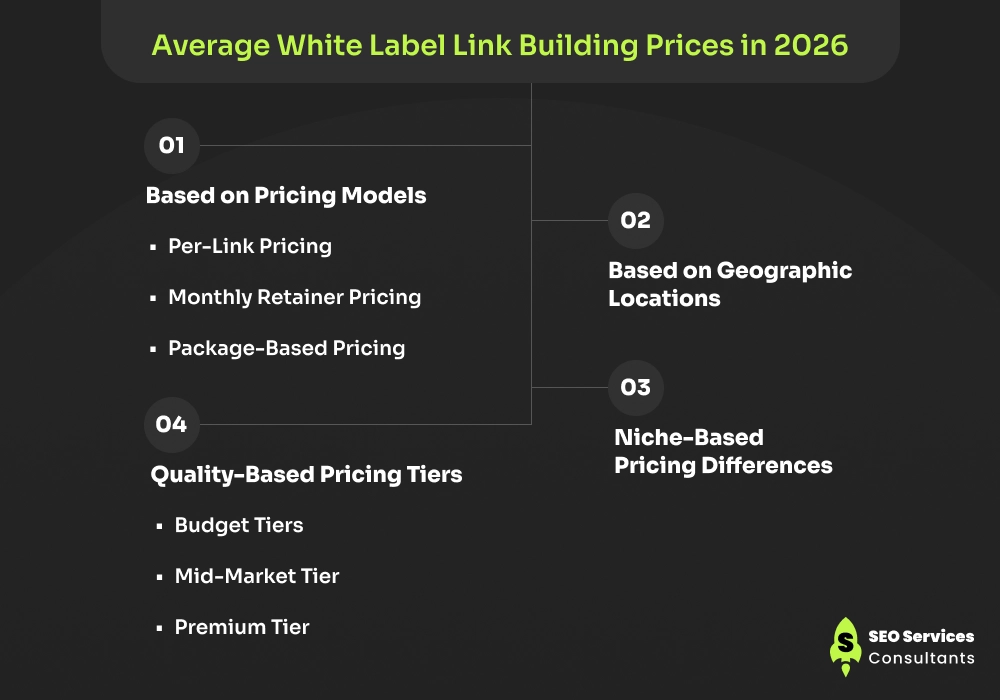
Most white label providers use different pricing structures when it comes to offering link building services. They usually consider campaign goals, link quality, and order volume (number of backlinks required).
1. Based on Pricing Models
Agencies should understand how these models work to choose the most profitable option for their clients.
Per-Link Pricing
It is the most common and transparent model in the industry. Agencies pay for each successfully secured backlink, which makes it a flexible choice for custom SEO campaigns. The cost of each link placement traffic, domain authority, link type, and niche relevance.
Link Quality |
Typical Cost Per Link |
|---|---|
| Budget | $50 - $150 |
| Mid-Tier | $150 - $350 |
| Premium | $350 - $1,000+ |
This model is the best for agencies that need flexibility and want to scale campaigns based on client requirements.
Pros:
- Cost predictability
- Helps you test a white label provider before committing
Cons:
- May prioritize the quantity of links over quality or long-term strategy
- Costs can become unpredictable at scale.
Monthly Retainer Pricing
With a retainer model, agencies pay a fixed monthly fee for acquiring links and outreaching on an ongoing basis. It is an ideal model if you want long-term SEO campaigns that require consistent link growth. The cost typically involves outreach, strategy, content creation, and reporting.
Retainer Level |
Typical Monthly Cost |
|---|---|
| Small Campaign | $500 - $1,500 |
| Mid-Size Campaign | $1,500 - $5,000 |
| Enterprise Campaign | $5,000 - $15,000+ |
Pros:
- May prioritize the quantity of links over quality or long-term strategy
- Best per-link price.
- Measurable organic traffic goals.
Cons:
- Risk of paying for unused or under-delivered capacity.
- Less flexibility in scaling up or down quickly based on campaign needs.
Package-Based Pricing
Some providers often bundle packages that include a fixed number of links each month. These are often grouped into price levels based on link quality or domain authority range. However, you should always ask for sample placements before buying a package.
Package Type |
Typical Cost |
|---|---|
| Starter | $300 - $800 |
| Growth | $800 - $2,000 |
| Advanced | $2,000 - $5,000+ |
Pros:
- Makes budgeting simple
- Makes it easier to create client proposals.
Cons:
- Discounted prices can trade off with low quality.
- Less flexibility
Pricing Model Comparison
Pricing Model |
Typical Cost Range |
Ideal For |
Key Consideration |
|---|---|---|---|
| Per-Link | $50 - $1,000+ per link | Flexible Campaigns | Cost varies by quality |
| Retainer | $500 - $15,000+/month | Ongoing SEO | Long-term commitment |
| Package | $300 - $5,000+ | Predictable budgeting | Less customization |
2. Based on Geographic Locations
Pricing based on locations varies because publishers in countries like the US, UK, Canada, and Australia are harder to secure. In fact, they have a higher demand. This increases competition in outreach, while links from other regions are easier to acquire. As a result, they cost less.
Target Location |
Average Cost Per Link |
|---|---|
| US | $200 - $800+ |
| UK | $180 - $700+ |
| Canada | $150 - $600+ |
| Australia | $200 - $800+ |
| Europe | $100 - $500+ |
| Asia & Other Regions | $50 - $300+ |
3. Niche-Based Pricing Differences
The industry you’re targeting can also influence cost. Some industries are harder to build links for than others. That is a reason why niche-based pricing varies.
Competitive sectors like SaaS, finance, legal, etc., often cost more since publishers in these spaces receive high outreach volume and prefer fewer, high-quality contributors. Easier niches like lifestyle or local services usually have more available sites and lower placement costs.
Industry |
Avg. Cost Per Link |
|---|---|
| SaaS | $250 - $1,000+ |
| Finance | $300 - $1,200+ |
| Legal | $250 - $900+ |
| Healthcare | $250 - $900+ |
| Local Services | $100 - $400+ |
| Lifestyle & General Business | $100 - $500+ |
4. Quality-Based Pricing Tiers
Quality backlinks play a major role in determining pricing. Stronger links from authoritative, relevant websites require more effort, outreach, and editorial approval. Budget links are cheaper but often come from weaker sites, mid-market links balance cost and quality.
On the other hand, premium links deliver higher authority placements with strict editorial standards and manual outreach.
Budget Tiers
Budget links typically cost between $50 and $150 per link. These often come from lower-authority websites and may involve limited outreach. While affordable, quality can vary significantly.
Mid-Market Tier
Most agencies operate under this range, with links costing between $150 and $350. These placements usually come from relevant websites with stronger authority, traffic, and editorial standards.
Premium Tier
Top-quality, premium links generally start around $350 and can exceed $1,000 per placement. They often involve manual outreach, niche authority sites, editorial placements, and higher-quality content.
Quality Pricing Based on Authority
DA/DR Range |
Avg. Cost Per Link |
Traffic |
Best Use Case |
|---|---|---|---|
| 20-40 | $50 - $150 | Low | Entry-level campaigns |
| 40-60 | $150 - $350 | Medium | Most agency SEO campaigns |
| 60-80 | $350 - $800 | High | Competitive industries |
| 80+ | $800 - $2,000+ | Very High | Enterprise and authority-building campaigns |
The Biggest Factors That Influence White Label Link Building Costs
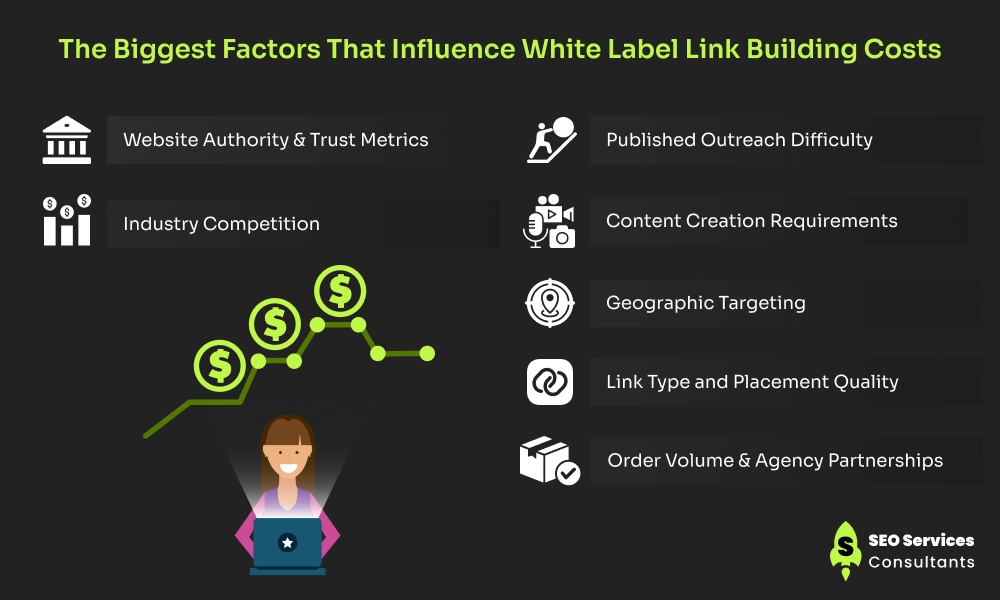
A $50 link and $500 can appear the same but deliver completely different results; they can differ in their DA values, traffic, and website quality. Moreover, not all $50 links are meaningless, nor are all $500 links worth the price.
To choose the best pricing option, it is important to understand the factors that influence the prices.
1. Website Authority & Trust Metrics
Domain authority (DA), Domain Rating (DR), organic traffic, and spam score are the primary factors that move the needle of cost for white label link building. Websites with high authority and strict traffic needs are harder to secure links from. That’s because they get many link requests and have stricter quality standards.
Hence, agencies need to spend more time and effort on outreach, which increases their costs and allows them to charge higher prices while maintaining better profit margins.
2. Industry Competition
Regulated industries like Finance, Healthcare, and Legal are highly competitive and charge 50-100% more than lifestyle or general topic websites. Such highly competitive sectors need stronger backlinks from authoritative websites to compete in search results.
To secure these placements, agencies need to perform more manual outreach, relationship-building, and high-quality content, which increases costs. As competition grows, link-building campaigns become more resource-intensive, which pushes prices toward the higher end of the market range.
3. Published Outreach Difficulty
Another critical factor is the effort it takes to acquire a backlink, which significantly affects the cost. Some providers use mass outreach, sending emails to hundreds of websites in hopes of securing placements quickly and cheaply.
On the other hand, relationship-based outreach involves building connections with publishers, pitching relevant content ideas, and negotiating placements on quality websites.
Since the process requires more time, expertise, and manual efforts, links acquired through relationship-based outreach typically cost more. However, it often delivers better relevance, authority, and long-term SEO value.
4. Content Creation Requirements
This is often an overlooked factor in link-building costs. Some publishers accept client-provided content, while others require the agency or provider to create a unique article for placement. The cost increases when experienced writers, industry specialists, or subject matter experts are involved, particularly in niches such as finance, healthcare, or legal services.
Higher-quality content not only helps secure placements on reputable websites but also improves the value and longevity of the backlink. This makes it a worthwhile investment for many campaigns.
5. Geographic Targeting
Links from websites in the UK, US, Australia, and Canada typically cost more because these markets have stronger competition, stricter editorial standards, and greater demand from businesses seeking placements.
For example, a quality US-based link may cost anywhere from $200 – $800+. In contrast, a similar placement in Europe might range from $100-$500, and links in many Asian markets can cost between $50-$300.
If your clients primarily target English-speaking countries, expect to pay a premium for relevant, high-authority placements that can provide meaningful SEO value.
6. Link Type and Placement Quality
The type of links you purchase has a direct impact on their cost. Guest posts are the most common option; they involve creating new content and securing placement on a relevant website. Niche edits, where links are added to existing articles, can be more affordable and quicker to secure.
Further, editorial placements are the most expensive because they are earned through genuine outreach and appear naturally within high-authority content. In most cases, the higher the placement quality and relevance, the higher the price.
7. Order Volume & Agency Partnerships
Most providers reward consistent agencies with better rates. Agencies that place bulk orders each month often receive discounted per-link pricing, which helps improve profit margins and makes scaling easier.
Retainer partnerships go a step further, offering predictable monthly costs, priority access to placements, and smoother workflow management for both sides.
A Simple Formula To Calculate Profitable White Label Link Building Pricing
White label link building pricing isn’t about what your provider charges. If you want to run a profitable agency, you need to understand what each link really costs you before you sell it to your client. Many agencies skip this step and end up either underpricing or cutting into their own margins. Here’s how you can do it:
Step 1: Calculate Your Pass-Through Cost
This is the total cost you pay to deliver one link. It usually includes:
- Link acquisition cost: What your white label provider charges per backlink.
- Content Cost: Payment for writing or editing the article if it’s not included.
- Management Cost: Time and effort spent on approvals, coordination, reporting, and client communication.
This is the total cost you pay to deliver one link. It usually includes:
Step 2: Add Your Agency Margin
Once you know your base cost, you add your profit margin to decide what to charge your client.
Formula: Client Price = Link Cost + Internal Costs + Desired Profit Margin
This keeps your pricing structured instead of guesswork. It also ensures every project contributes to your agency’s growth, not just covers expenses.
Let’s say:
Provider charges: $180 per link
Internal management cost: $40
Desired profit: $80
So, your final client price becomes $300 per link. That $80 profit is your real earning, not the full markup.
Cheap Vs Expensive Links - What Are You Really Paying For?
Not all link building services are equal, even if they look similar on paper. The price you pay often reflects the efforts, quality, and long-term value behind each link.
Cheap link providers usually focus on speed and volume, not quality. They may use PBNs (private blog networks), which are sites built only to sell links. Many of these sites have low or no real traffic. Some also use AI-written or low-quality content that doesn’t add real value. In some cases, links are simply resold from the same sources, which means you’re not getting anything unique.
What Premium Providers Usually Invest In?
Premium providers take a more manual and careful approach. They do real outreach on genuine websites and build relationships with editors. Their links often come from sites that already have traffic and authority. They also provide better reporting, so you know exactly where your links are placed and how they perform.
Link Pricing Red Flags: Overpaying Vs Too Cheap Deals
Not all pricing issues look the same. Some agencies overpay for poor-quality links, while others risk buying cheap links that can harm SEO performance and long-term rankings.
Category |
Red Flags That You're Overpaying for White Label Links |
Red Flags That White Label Links Are Too Cheap To Be Safe |
|---|---|---|
| Website Quality | Paying premium prices for low-traffic or irrelevant sites | No real website examples shared before purchases |
| Transparency | Providers are not clear about where the links are placed | No clarity on how or where links will be built |
| Pricing Logic | Pricing is based only on DR/DA, with no real value explanation | Unrealistically low pricing that feels “too good to be true” |
| Relevance | No niche or topical relevance checks | No mention of niche targeting or relevance strategy |
| Reporting | Poor or vague reporting after link placement | No reporting process or proof of live links |
| Delivery Promises | Over-promising high authority links at high cost | Instant turnaround promises that ignore real outreach time |
| Quality Control | Weak vetting of sites despite premium charges | No quality control or approval process at all |
Final Thoughts: Focus On ROI, Not Just Link Cost
At the end of the day, white label link building is not just about finding the cheapest or the most expensive link. It’s about what those links actually bring back to your clients.
A low-cost link might look good on paper, but if it comes from irrelevant or weak sites, it won’t move rankings or bring traffic. On the other hand, higher-quality links may cost more, but they often lead to better authority, stronger SEO results, and happier clients.
The smartest agencies don’t chase the lowest price; they focus on return on investment. If a link helps a client rank higher and generate leads, the extra cost is justified. Over time, balancing cost with quality leads to more stable profits and long-term growth. Instead of asking, “How cheap can I get this?”, the better question is, “Will this help my client win?”