Table of Contents:
- Introduction
- How Do Google AI Overviews Change The Way People Click on Search Results?
- How Much Website Traffic Are AI Overviews Taking Away?
- Which Websites and Search Queries Are Affected by AI Overviews?
- How Can You Measure the Impact of AI Overviews On Your Website Traffic?
- How Should Websites Adapt to AI Overviews Without Abandoning SEO?
- The Final Say
- Frequently Asked Questions
You can rank #1 and still receive fewer clicks!
That’s the new search reality businesses, marketers, and agencies need to understand. Google AI Overviews offer direct answers, bypassing the need for users to go to a website, as they get useful information very quickly. Thus, companies dependent on organic search traffic are seeing changes in visibility, clicks, website visits, and conversions.
These AI-generated summaries can also lower click-through rates (CTR) on organic search results, particularly for informational searches, resulting in an increased number of “zero-click” searches. Consequently, even high-ranking pages can experience lower traffic without having high SEO scores. This shift forces marketers to rethink how they measure success beyond rankings alone.
But does AI Overview always reduce traffic? Which type of searches does it affect the most? And how can you tell whether AI Overviews actually cause a drop in clicks?
Let’s explore the topic in detail.
How Do Google AI Overviews Change The Way People Click on Search Results?
Until 2024, the search journey was fair and predictable – a person typed a query, Google displayed a list of results, and the pages ranking near the top competed for clicks. But since AI Overviews came into the picture, the journey has changed.
Today, users no longer scan organic results immediately; they often see an AI-generated summary that answers the question directly, with links to supporting webpages. This matters because being visible in search results no longer always means people will visit your website.
Traditional SERP Vs. AI Overviews
Before exploring the implications of AI Overviews, it’s crucial to look at how the search results page has evolved.
In traditional Google search, users see a list of blue links, and the goal is simple: rank higher to get more clicks. The top rankings attract the most traffic because users scan down the page and click on a link.
In an AI-first SERP, however, Google displays an AI-generated summary at the top of the page that directly answers the question. This summary pulls information from multiple websites and presents it in a short, easy-to-read format.
This change has affected user behavior. How? Rather than navigating several websites, many users are now accessing the information they need directly from the AI Overview. This means that even the higher-level pages might not get as many clicks as they would have initially. That’s because the answer is already visible on the search page.
In a traditional search engine results page (SERP), the organic results were usually the main source of information. Ads, featured snippets, images, maps, or other features could appear, but users still visited individual webpages.
AI Overview summaries are placed above the traditional listings, combining information from multiple webpages and including links to sources that users can explore for more detail. According to Google, AI Overviews are designed to help people tackle more complex questions while still connecting them to the wider web.
This creates a new search path:
Traditional Search: Query -> Organic Results -> Website Visit.
AI-first Search: Query -> AI Overview -> Answer -> Optional Website Visit.
That “optional” step is important for marketers. When Google satisfies the user’s need directly on the results page, they don’t feel the need to click the link and visit the website.
Independent research reveals this is worthy of consideration. In February 2026, Ahrefs updated its analysis of 300,000 keywords using December 2025 data. It found that the presence of an AI Overview was associated with a 58% lower average CTR for the #1 organic result. The impact was not limited to the top position; the CTR was also reduced for rankings 2-10. However, the effect became smaller further down the page.
A 2026 study provides stronger evidence because it tested user behavior directly. When an AI Overview appeared, outbound organic clicks dropped by 39.8% and zero-click searches rose by 34.5%.
AI content does work for SEO regardless of whether it’s entirely AI-generated or created with human assistance. It can help you save time and reduce costs while delivering results that contribute to your business growth. However, the AI content should be created ethically, provide real value to readers, and follow Google’s helpful content guidelines.
AI Overviews Vs. Featured Snippet Vs. AI Mode
AI Overviews do affect traffic, but how do they differ from other Google search features? They may all look similar, but they work in different ways and influence clicks differently.
- A Featured Snippet typically highlights a concise passage, list, or table from one webpage near the top of the results.
- An AI Overview generates a broader summary and may draw information from several sources, while providing links for users who want to explore further.
- AI Mode is different again; it is a more conversational search experience designed for longer, follow-up, and multi-part questions. Google says AI Mode allows users to explore topics through a conversational interface rather than relying only on a single search-and-results interaction.
This difference becomes essential when analyzing traffic. A website that appears in an AI Overview is not necessarily receiving the same kind of visibility or the same click opportunity as compared to a page ranking in a standard organic result.
Why Ranking #1 Does Not Guarantee the Click Anymore?
Consider a company ranking first for a keyword, “What Is Email Marketing?” In the case of traditional search, that first position gave the page a strong chance of winning visitors. But if Google provides a useful explanation in an AI Overview, the user may already have enough information to move on.
This means: the ranking has not changed. The user’s reason to click has.
Google itself acknowledges that it can satisfy search queries without users needing to visit a website. Google also says that clicks from AI Overview pages can be more valuable because users may come with greater context and stronger interest in the source.
So, marketers now should not treat rankings as the final measure of how their websites perform in organic results. A page can maintain its top position while losing CTR, or lose some clicks but attract visitors with stronger intent.
Visibility, Citation, and Traffic Are Now Different
With AI search becoming popular, it now sees being visible, being cited, and receiving traffic differently.
- Visibility means your brand or webpage appears in the search experience.
- Citation refers to Google using or linking to your content as a source within an AI-generated answer, and
- Traffic means the user actually clicks through to your website.
These search outcomes can overlap, but they are not interchangeable. A brand may appear in AI Overview, build familiarity, and still receive no visits. On the contrary, a cited page may attract fewer visitors than it previously did but generate more engaged users.
This is why the impact of AI Overviews should not be assessed by organic clicks alone. For businesses and marketers, the biggest question today is:
“When Google answers the question before the customer reaches us, how can we make that customer still want to visit our website?”
That shift from competing only for rankings to competing for attention, citations, clicks, and meaningful conversions is at the heart of how AI Overviews are changing website traffic.
How Much Website Traffic Are AI Overviews Taking Away?
There’s no specific percentage that applies to every business, but the available research clearly shows that AI Overviews can reduce organic clicks, particularly for informational searches (Ahrefs and 2026 field experiment).
But Google’s own data tells a different story. It says that overall organic click volume remained relatively stable year over year and that clicks from AI search can be high quality, with users more likely to stay on the websites they visit.
But why the disagreement?
The studies are measuring different things; some compare CTR for keywords with and without AI Overviews, while others study users directly. A correlation can show that two things happen together, but it cannot always prove that one caused the other. Search behavior, rankings, algorithm updates, and changing query patterns can also affect traffic.
That’s why saying, “AI Overviews reduce website traffic by 40%” is actually misleading. A website might lose clicks on simple informational searches while maintaining or increasing traffic from high-intent searches. Google also reports that users who click from AI Overviews can be more engaged.
So, for businesses, the better question is, “what happened to the value of the clicks that remained?” and not how many clicks were lost. A smaller number of highly relevant visitors may generate more leads, sales, or enquiries than a much larger volume of low-intent traffic.
Which Websites and Search Queries Are Affected by AI Overviews?
Not every search is equally exposed to Google AI Overviews. The biggest factor at play here is the search intent – what the users actually want to accomplish.
Informational Searches Face The Highest Exposure
AI Overviews are most common when users want to learn, understand, compare, or solve something. In a large Ahrefs study of 146 million search results, 99.9% of keywords that triggered an AI overview had informational intent. Question-based searches were especially exposed, with AI Overviews appearing for 57.9% of question queries.
This creates a bigger risk for websites built around definitions, guides, tutorials, “how-to” articles, and basic comparisons.
Commercial searches such as “best CRM for small business” can also trigger AI Overviews. But transactional searches such as “buy running shoes online” generally give users a stronger reason to visit a website.
Some Industries Face More Exposure than Others
The risk also varies by industry. A 2026 analysis of Conductor on 21.9 million Google searches found AI Overviews appearing most often in healthcare (48.7%), followed by financial services (25.7%) and utilities (25.4%).
Branded and Local Searches Can Behave Differently
Branded searches are generally less likely to trigger AI Overviews than non-branded searches. Local searches also showed reduced overall AIO exposure in Ahrefs’ large-scale data, although specific local-intent queries can behave differently.
A simple way for marketers to evaluate this is by asking:
Can Google completely answer the query without the user needing another website?
The easier the answer is to provide directly, the greater the potential traffic risk.
Query Type |
Traffic Risk |
|---|---|
| Simple informational | High |
| How-to/definition | High |
| Commercial comparison | Medium-High |
| Branded | Lower |
| Transactional | Lower |
| Local/service | Variable |
How Can You Measure the Impact of AI Overviews On Your Website Traffic?
Once you know which searches are most affected, the next challenge is measuring what is actually happening to your own website. A simple drop in organic traffic is not enough to prove that AIO caused it. You need to connect search visibility, clicks, website behavior, and business results.
Here’s how you can do it:
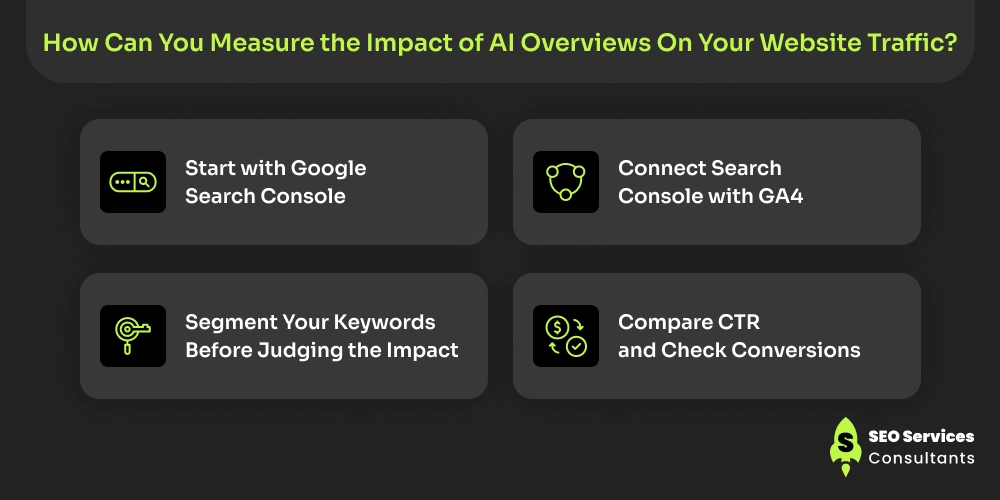
1. Start with Google Search Console
Search Console is a tool that shows impressions, clicks, CTR, queries, and average position for your pages in Google Search. Since the overall Search Performance Report also includes AI Overview and AI Mode data, this gives you the starting point for identifying changes.
Most importantly, Google launched Generative AI performance reports in June 2026. For eligible websites, these reports provide dedicated data on impressions from AI features, including AI Overviews and AI Mode, along with the affected pages, countries, devices, and performance over time. The reports are currently being rolled out to a subset of websites.
2. Connect Search Console with GA4
Search Console tells you what happened before the visitor reached your website. GA4 helps you understand what happened after the click – including sessions, engagement, leads, purchases, and other conversions.
Google recommends using the two together because their metrics are different but complementary.
3. Segment Your Keywords Before Judging the Impact
Group your important queries by:
- AIO present vs absent
- Informational vs commercial vs transactional intent
- Branded vs non-branded
- Position gained, stable, or lost
Then use a simple four-bucket method:
AIO Present |
AIO Absent |
|
|---|---|---|
| Ranking stable/gained | Possible AIO CTR impact | Baseline |
| Ranking declined | Ranking + AIO impact | Mainly ranking impact |
This makes your analysis more reliable than looking at total traffic alone.
4. Compare CTR and Check Conversions
If your CTR is falling CTR but the rankings are stable, it is a strong sign of changing search behavior. Besides, also check whether leads, sales, enquiries, or revenue changed as well.
Google also highlights that clicks from AI-powered search results are often more relevant and intent-driven, which means fewer visits do not necessarily lead to weaker business performance.
And finally, don’t conclude that “traffic dropped because AIO caused it.” Algorithm updates, seasonal changes, search demand, competitors, and ranking changes can all contribute. Ensure you measure AIO and non-AIO queries separately before deciding what needs to change.
How Should Websites Adapt to AI Overviews Without Abandoning SEO?
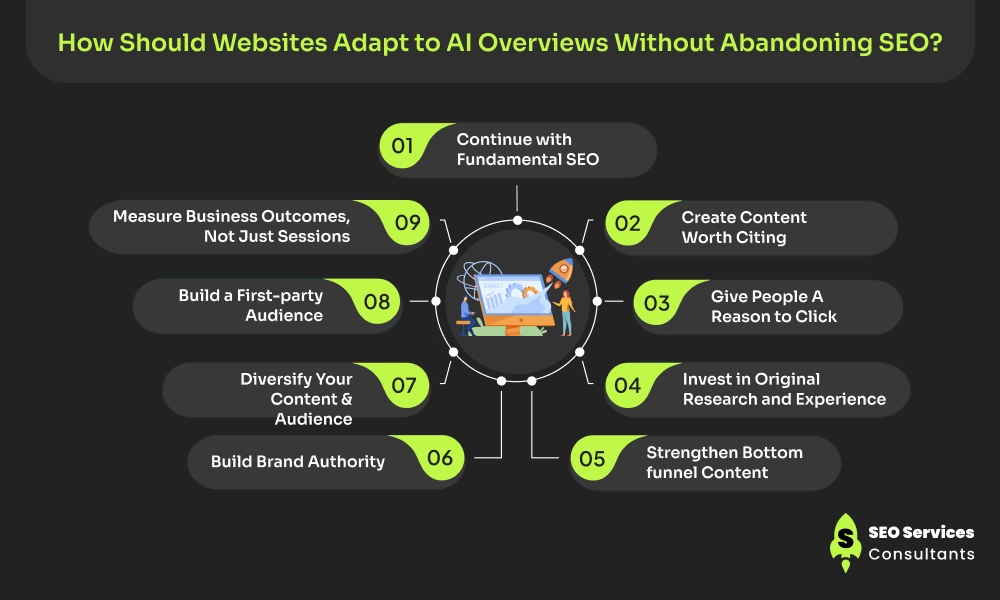
Marketers and businesses should measure the impact only if it leads to better decisions. The solution is not to abandon SEO but to change what you expect your content to achieve in an AI-led search environment. Furthermore, it’s more about visibility, authority, and conversions than just rankings and raw traffic over time.
1. Continue with Fundamental SEO
AI Overviews aren’t here to replace the basics of search optimization; it’s a misconception everyone has. Google clearly says that the same core principles still apply: pages should be crawlable, indexable, useful, fast, mobile-friendly, and easy to understand. Structured data can also give search systems a better understanding of the content of a page, but it must be consistent with what the user can view.
2. Create Content Worth Citing
Do not try to make every article or page “AI-friendly” by simply adding more keywords. Build original, useful content that adds information beyond what is already available. Google specifically recommends unique content that satisfies users rather than reusing or reproducing something that already exists.
3. Give People A Reason to Click
An AI Overview often provides only the basic answer. So, your webpage should offer something the summary cannot. This could be a detailed analysis, examples, expert opinions, research tools, templates, or practical guidance.
As per Google, users are increasingly clicking on in-depth reviews, original posts, unique perspectives, and first-hand analysis.
4. Invest in Original Research and Experience
Content that is based on original surveys, proprietary data, case studies, experiments, customer insights, and first-hand experience is more difficult to replace with a generic AI-generated response. This is becoming increasingly important as Google highlights original reporting and realistic perspectives in its newer AI search experiences.
5. Strengthen Bottom-funnel Content
If your informational content isn’t able to bring visitors, you should focus more on content that helps people make a buying decision. Service pages, product pages, pricing details, setup guides, comparisons, case studies, and customer reviews provide a better reason for the user to visit the website and take action.
6. Build Brand Authority
A recognizable brand can become an advantage when users want to verify information or explore a trusted source. Google has introduced Preferred Sources in AI Overviews and AI Mode, which allow users to see selected websites more prominently. It says users are twice as likely to click on a Preferred Source.
7. Diversify Your Content & Audience
Instead of depending entirely on text-based organic search, create additional ways for people to discover and return to your brand. This can include original video, podcasts, expert interviews, newsletters, communities, and social content. Users are increasingly looking for forums, videos, podcasts, and first-hand perspectives rather than text-based content.
8. Build a First-party Audience
Email subscribers, customer communities, and repeat visitors are valuable because they enable businesses to build a direct relationship with their audience rather than relying entirely on changing search results.
9. Measure Business Outcomes, Not Just Sessions
Measure success through qualified leads, sales, revenue, repeat visits, and customer value, and not just organic traffic. AI search may change the number of visitors without changing the value of those visitors. Therefore, the goal is not to preserve every search click, but to make the remaining traffic and the wider audience you build more valuable.
The Final Words
There’s no doubt that Google AI Overviews are changing how people discover, evaluate, and click on websites. However, they do not make SEO irrelevant. They simply change what success looks like. Yes, rankings still matter, but visibility, qualified traffic, citations, conversions, and brand authority matter more than ever.
The businesses best positioned for this shift will be those that clearly identify which types of searches are most affected, accurately measure their real impact, and focus on creating content that delivers deeper value than a quick AI-generated answer.
Instead of trying to recover every lost click, businesses should focus on earning meaningful visibility, attracting high-intent users, and building a loyal audience that isn’t dependent on Google for discovery.
Frequently Asked Questions
How do I know if AI Overviews are hurting my website?
Track metrics like organic impressions, clicks, click-through rates, and rankings for queries triggering AI Overviews. Also, compare SEO performance before and after their appearance. If impressions remain stable but clicks are dropping significantly, AI-generated answers may be reducing website visits.
Are AI Overviews replacing traditional Google search?
No. AI Overviews complement traditional Google Search rather than replacing it completely. Users can still access organic listings, ads, featured snippets, and other search features. However, AI Overviews may change how users interact with search results and websites.
What types of websites are most affected by AI Overviews?
Informational websites, blogs, publishers, review sites, and websites targeting question-based queries may be more affected. Searchers that can be answered directly within AI Overviews may generate fewer clicks, especially when users do not need additional information.
Should I optimize my website for AI Overviews?
Yes, every business should optimize their websites for AI Overviews. You can optimize your content by providing clear, accurate, well-structured answers supported by evidence and expertise. Use descriptive headings, concise explanations, relevant entities, original insights, and trustworthy sources. In addition, focus on creating content genuinely useful rather than targeting AIO alone.
Can Google Search Console track AI Overview traffic?
Google Search Console provides organic Search performance data, but it does not currently offer a dedicated filter that isolates traffic generated specifically from AI Overviews. Therefore, marketers must analyze broader query, impression, click, and ranking patterns to identify potential impact.