

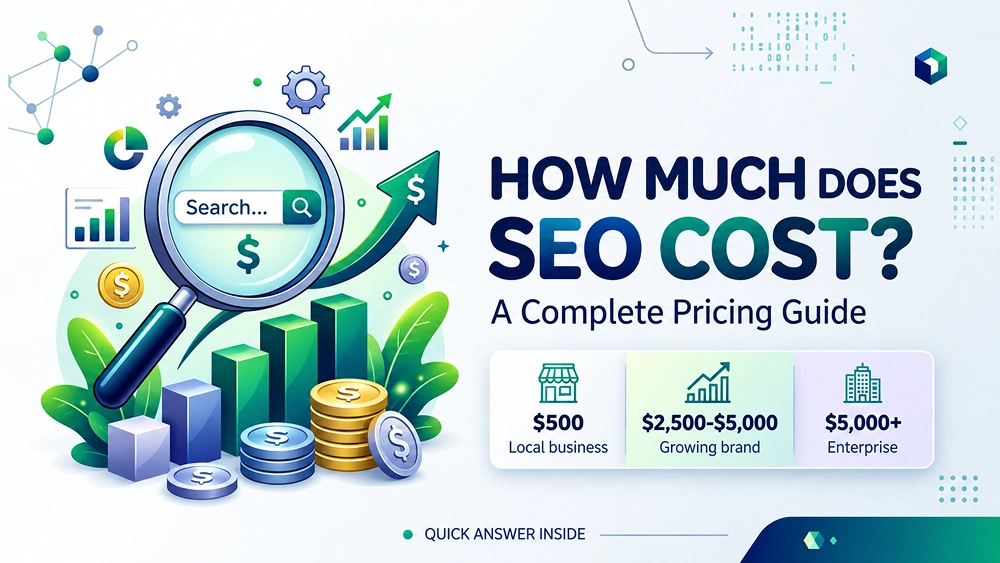
Quick Answer: SEO services typically cost $500–$10,000+ per month, depending on factors such as competition, website size, target market, and scope of work. One-time SEO projects can range from $1,500–$30,000+, while consulting typically costs $75–$250+ per hour.
Table of contents:
- Introduction
- How much do SEO services typically cost?
- Understanding SEO Pricing Models & Which One Fits Your Business
- What Factors Determine the Cost of SEO Services?
- How to Calculate Your SEO Budget & Expected ROI
- How to Choose the Right SEO Provider for Your Budget
- Frequently Asked Questions
- Conclusion
SEO pricing is one of the most confusing aspects of digital marketing services. If you are searching for SEO services for your business, you might reach out to five different agencies and get five different quotes. The price can vary dramatically, from one provider quoting $750 per month while another charges $2,000 per month or $10,000 per project. This kind of range makes it hard for businesses to understand what’s reasonable and what’s overpriced.
So what’s the real SEO cost?
The truth is, there’s no single price for SEO. It depends on various factors such as your industry competition, website size and condition, target market, content requirements, link building, and the level of work your SEO provider handles. A local bakery in Ohio and a national e-commerce brand aren’t buying the same thing, even if they’re both calling it “SEO.”
In general, most US businesses spend between $500 and $5,000 per month, but the right budget for you depends on several key factors. In this guide, we’ll break down SEO pricing models, show you what different budgets actually get you, and help you figure out how much you should realistically invest.
Let’s get started!
How much do SEO services typically cost?
SEO is not a cookie-cutter solution. Before choosing models, businesses need to understand that the way they pay affects what’s included, how work is managed, and how much flexibility you get to scale with your needs.
The requirements can also vary. Some businesses may require ongoing optimization, while some only need a technical SEO upgrade and strategic guidance. The table below provides a quick overview of each pricing model and when each can be useful. You can use it to identify the structure that best matches your current priorities, available resources, and preferred level of involvement.
Pricing Model |
Typical Cost |
Best For |
|---|---|---|
| Monthly Retainer | $500 – $10,000+/month | Ongoing growth & continuous optimization |
| Project-Based SEO | $1,500 – $30,000+ (one-time) | Audits, migrations, one-time foundational work |
| Hourly Consulting | $75 – $250+/hour | Strategy advice, training, or specific tasks |
| Performance-Based SEO | Base fee + bonus / % of results | Results-focused campaigns (less common) |
| Hybrid Pricing | Combination of above | Flexible needs or risk-sharing arrangements |
The best SEO pricing model depends on your goals, resources, and level of involvement. If you need ongoing SEO, go with a monthly retainer. If you only need a specific project or expert advice, project-based or hourly pricing can be a cost-effective choice.
Understanding SEO Pricing Models & Which One Fits Your Business
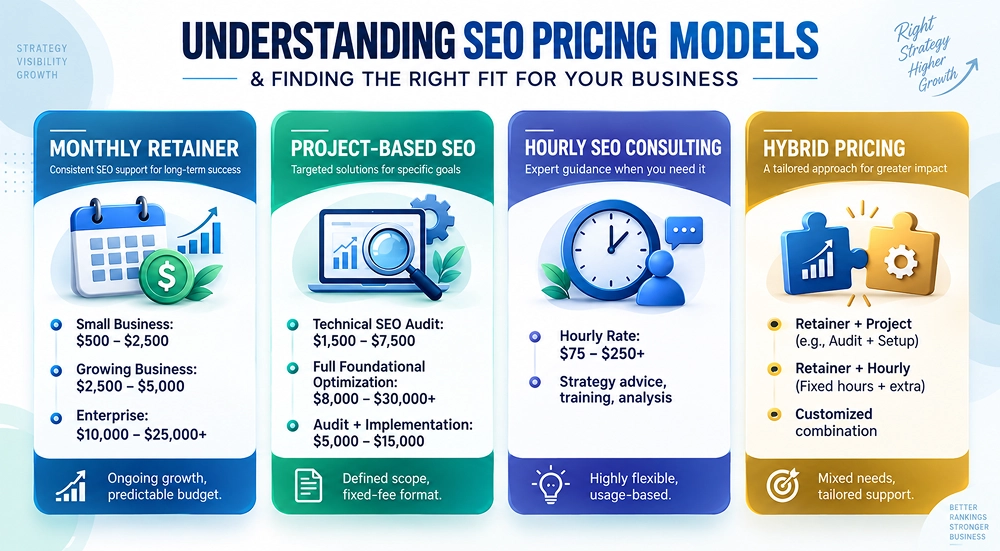
Now that you’re familiar with the five most common SEO pricing models, let’s break each of them down and what SEO services include. These models differ in predictability, flexibility, scope, and risk. The best option depends on your business goals and requirements.
Monthly Retainer
A monthly retainer is one of the most common SEO pricing models. You pay a fixed amount every month for an agreed scope of SEO services. It is well suited to businesses that are looking for continuous optimization rather than a one-time fix. The SEO price for this model generally starts at $500 per month, depending on the size of your business.
Below are average monthly SEO costs on the basis of business size and what’s generally included at each stage.
Business Size |
Typical Monthly SEO Cost |
What the Investment Usually Covers |
|---|---|---|
| Small Business | $500 – $2,500 | Local SEO, basic on-page, limited content, Google Business Profile, monthly reporting |
| Growing Business | $2,500 – $5,000 | Full strategy, content creation, technical SEO, moderate link building |
| Large Business | $5,000 – $12,000 | Advanced content strategy, competitive link building, multi-location, detailed analytics |
| Enterprise Business | $10,000 – $25,000+ | Dedicated team, international SEO, large-scale content, custom reporting, advanced technical work |
What it typically includes:
- Ongoing keyword and competitor research
- On-page and technical SEO services
- Content creation and optimization
- Internal linking and site improvements
- Link building or digital PR
- Local or international SEO, where relevant
- Performance tracking and monthly reporting
Best for:
- Businesses seeking steady, long-term organic growth.
- Companies that look for a planned and predictable SEO budget.
- Ecommerce brands with ongoing product and category updates.
Project-Based SEO
The project-based SEO model uses a fixed-fee format for a defined scope of work, a set of deliverables, and a timeline. It is useful for businesses that are looking to address specific SEO requirements without making a long-term commitment.
Here’s a quick overview of the tentative costs of various types of SEO projects and what they often include:
Project Type |
Typical Cost Range |
What's Included |
|---|---|---|
| Technical SEO Audit Only | $1,500 – $7,500 | Full site crawl, issues report, prioritised recommendations |
| Audit + Implementation | $5,000 – $15,000 | Audit + fixing critical technical issues |
| Keyword Research + Content Strategy | $1,500 – $6,000 | Keyword map, content pillars, editorial calendar |
| Full Foundational Optimization | $8,000 – $30,000+ | Technical fixes, on-page optimisation, content plan, initial link building |
What it typically includes:
- A clearly defined SEO objective
- Site audits and research
- Technical or on-page improvements
- Keyword and content strategy
- Implementation of agreed recommendations
- Final documentation or reporting
Best for:
- New websites that need SEO foundation work.
- Sites working on one-time major technical issues such as migration, redesign, or major relaunch.
- Businesses with specific SEO requirements or testing SEO before a long-term commitment.
Hourly SEO Consulting
Hourly SEO consulting is a highly flexible engagement model. It is a usage-based pricing model that allows you to pay for specialist advice, training, analysis, or support without purchasing a full SEO campaign. The pricing generally starts around $75 per hour.
Service Type |
Typical Hourly Rate |
Best For |
|---|---|---|
| Technical SEO Consulting | $100–$300+ | Complex technical problems & implementation guidance |
| SEO Strategy Session | $75–$250 | Campaign planning, prioritization & second opinions |
| SEO Training | $75–$250 | Marketing teams, business owners & in-house staff |
| SEO Audits and Recommendations | $100–$300+ | Reviewing an existing audit or diagnosing a performance issue |
What it typically includes:
- Strategy consultations
- SEO audits and analysis
- Technical guidance
- Keyword and content recommendations
- Team training
- Reviews of existing SEO campaigns
Best for:
- Businesses with an in-house marketing or development team.
- Companies that can handle implementation internally, seeking flexibility and on-demand support.
- Website owners who need a second opinion.
- Organizations that are looking to upskill their team.
Performance-Based SEO
Performance-based SEO is a pricing model where you make payment on the basis of results or agreed performance metrics like qualified leads, phone calls, ranking targets, or others.
How it works:
You typically pay a lower base fee combined with bonuses tied to specific results, such as traffic growth, leads, or rankings.
Why it's less common:
Although things look smooth on paper, SEO results depend on many factors outside anyone’s full control, such as Google algorithm updates, search demand, and website condition. This makes the whole process vague, and results can’t be fully guaranteed. So, this model is less common in practice.
For a detailed breakdown of how this model works and whether it’s worth considering, see our guide on Performance-Based SEO Pricing.
Hybrid Pricing
Hybrid pricing combines two or more pricing models to create a structure that fits the specific business needs. It allows businesses to maintain a predictable base cost while paying separately for additional projects, hours, or performance outcomes.
Following are some common hybrid pricing model examples:
Hybrid Model |
Example Structure |
Best For |
|---|---|---|
| Retainer + Performance Bonus | $2,500 base + bonus for traffic/lead targets | Motivating results while covering core work |
| Project + Retainer | One-time audit/setup + ongoing monthly retainer | Starting strong then maintaining momentum |
| Hourly + Retainer | Fixed monthly hours + extra hours as needed | Flexible support with predictable base cost |
Best for:
- Businesses that want a mix of predictability and performance alignment
- Companies that prefer to start with a project before committing to ongoing work.
- Ecommerce brands with seasonal campaigns.
Which SEO Pricing Model Fits Your Business?
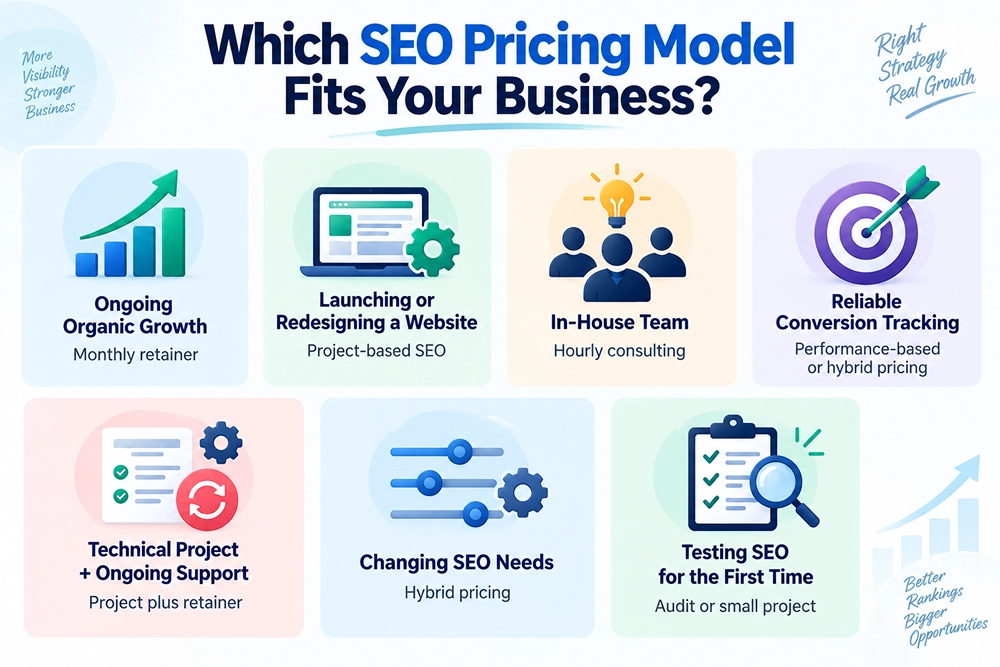
You can choose a model based on your business goals and requirements. Use the table below as a reference to compare your needs and shortlist the model that best suits your business.
Your Situation |
Most Suitable Model |
Why |
|---|---|---|
| You need ongoing organic growth | Monthly retainer | Provides continuous strategy and execution |
| You are launching or redesigning a website | Project-based SEO | Creates a defined SEO foundation |
| You have an in-house marketing or development team | Hourly consulting | Provides specialist guidance without outsourcing everything |
| You have reliable conversion tracking | Performance-based or hybrid pricing | Allows compensation to reflect agreed outcomes |
| You need both a technical project and ongoing support | Project plus retainer | Addresses immediate issues and maintains momentum |
| Your SEO needs change from month to month | Hybrid pricing | Combines predictable support with flexible capacity |
| You are testing SEO for the first time | Audit or small project | Lets you evaluate the provider before a long-term commitment |
There’s no single best pricing model. Monthly retainers suit long-term growth, while project-based and hourly options offer more flexibility for one-off work. Pick the structure that aligns with your current needs and budget.
What Factors Determine the Cost of SEO Services?
SEO pricing is largely influenced by the amount of work required, the difficulty of the market, and the resources needed to reach your business goals. A small local website that targets just one city may require a focused campaign, so the cost is reasonable. A national ecommerce brand, on the other hand, may require technical SEO, large-scale content, digital PR, and conversion tracking. This increases the cost. Therefore, to better understand why your business pays a specific amount for SEO services, it is crucial to know all the factors that influence the cost of SEO and how they impact your budget.
Here’s a table for your quick understanding of how multiple factors affect SEO pricing and their level of impact.
Factor |
How It Affects Pricing |
Impact Level |
|---|---|---|
| Business Size & Website Size | Larger sites with more pages require more work | High |
| Keyword Competition | Highly competitive keywords need more content & backlinks | Very High |
| Target Location | Local SEO is cheaper than national or international SEO | High |
| Industry | Competitive industries (legal, finance, SaaS) cost more | Very High |
| Current Website Authority | New or low-authority sites need more link building | High |
| Technical SEO Issues | Sites with many technical problems take longer to fix | Medium–High |
| Number of Pages | More pages = more optimization work | Medium |
| Content Requirements | High content volume increases cost significantly | High |
| Link Building Needs | Quality backlinks are expensive and time-consuming | High |
Let’s break down each factor.
Business size and website size
The size of your business and website directly impacts the cost of SEO services. The larger and more complex your website is, the more time an SEO provider needs to audit, optimize, and monitor it. A 10-page local service website has very different requirements from a 1,000-page ecommerce catalog with product filters, duplicate URLs, and multiple templates.
The table below shows tentative monthly SEO costs in the US based on the business size.
Business Type |
Typical SEO Cost |
Why Costs Vary |
|---|---|---|
| Local Business | $500–$2,000+/month | Local competition, GBP, citations & local content |
| Small E-commerce | $1,000–$3,000+/month | Product/category optimization & content |
| National Business | $2,000–$7,500+/month | Greater keyword and competitor competition |
| E-commerce Brand | $2,000–$10,000+/month | Large product catalogs & technical SEO |
| International Business | $3,000–$15,000+/month | Multiple markets, languages & search environments |
| Enterprise Website | $5,000–$20,000+/month | Scale, technical complexity and multiple teams |
Industry Competition
Some industries are far more competitive than others, and this can directly impact the SEO cost. SEO often tends to cost more in industries where many businesses are competing for the same high-value searches.
Highly competitive niches such as legal, finance, insurance, healthcare, SaaS, real estate, and competitive home services generally require more extensive copywriting services, authority building, technical work, and ongoing optimization. The customer value is also normally very high in these sectors. As a result, the SEO cost is mostly higher.
Local service businesses usually fall on the lower end of the pricing spectrum. You can read more about how much local SEO costs in our detailed guide.
The table below shows estimated monthly costs of SEO for different industries for your reference.
Industry |
Typical Monthly Cost (US) |
Why It Costs More / Less |
|---|---|---|
| Local Services (HVAC, Plumbing, Roofing, Dental) | $750 – $2,500 | Strong local competition in most cities |
| Real Estate | $1,500 – $5,000 | Highly competitive local + “near me” searches |
| Ecommerce | $2,500 – $10,000+ | Large product catalogs + competitive national keywords |
| SaaS / B2B Technology | $3,500 – $15,000+ | Extremely competitive + high content demand |
| Legal (Personal Injury, Family, Criminal) | $4,000 – $15,000+ | Very high competition + high client value |
| Healthcare / Medical Practices | $2,500 – $8,000 | YMYL rules + local + competitive specialties |
| Home Services & Contractors | $1,000 – $3,500 | Local-focused but rising competition |
| Finance / Insurance / Mortgage | $5,000 – $20,000+ | Highly competitive + strict compliance needs |
Geographic Targeting
The size of your target market directly impacts the cost of SEO. The geographic scope of your campaign affects keyword research, content production, listings, competition, and reporting requirements. If you are targeting just one location, less work is required, and the cost would be low. Likewise, if you are targeting multiple locations, the cost is generally higher.
The table below shows tentative SEO costs for different locations.
Campaign type |
Typical cost level |
What increases the cost |
|---|---|---|
| Single-city local SEO | $750–$2,000 per month | Local competition, reviews & service-page requirements |
| Multi-location SEO | $2,000–$7,500+ per month | Number of locations, local landing pages, listings & reviews |
| Regional SEO | $2,000–$7,500+ per month | Geographic coverage & regional competitors |
| National SEO | $3,500–$15,000+ per month | Content volume, authority building & keyword competition |
| International SEO | $7,500–$50,000+ per month | Countries, languages, hreflang, translation & regional strategies |
Current Website Condition
The current condition of your website is the starting point of SEO services. If you have a technically healthy website with a clear structure and established content, you already have the foundational work done. There will be less SEO work required, and the cost would be reasonable.
On the other hand, if your website has indexing problems, broken links, poor site architecture, duplicate content, or outdated pages. There will be lots of work required. As a result, the cost is usually higher.
Common issues that may increase the initial workload and eventually the SEO cost include:
- Technical errors affecting crawling or indexing
- Poor website architecture
- Slow or poorly optimized pages
- Duplicate or thin content
- Missing or poorly optimized metadata
- Weak internal linking
- Outdated or underperforming content
- Migration or redesign issues
Content Requirements
- Content is generally one of the biggest cost drivers.
- A program that requires two optimized articles per month will generally cost less
- On the other hand, a campaign that requires service pages, location pages, product descriptions, expert reviews, videos, graphics, and weekly thought-leadership content is often expensive.
Link Building and Digital PR
- High-quality backlinks and digital PR campaigns are often time-intensive and expensive.
- The competitiveness of your niche is one of the greatest drivers of cost.
- The more competitive your niche is, the more investment is usually required to earn authoritative links. This can increase the overall cost.
The final cost of SEO largely depends on your industry, competition, website condition, and goals. The more competitive your market or the more complex your website, the higher the investment needed to get meaningful results.
How to Calculate Your SEO Budget & Expected ROI
The right SEO budget is not a fixed percentage of your revenue. Rather, your budget should match your business goals, competitiveness of your industry, the current condition of your website, and your SEO support requirements. This helps you set a budget that makes more sense for your business.
The following framework can help you set realist budget and align it more closely with your business requirements.
Your Situation |
Budget Approach |
What to Consider |
|---|---|---|
| Testing SEO for the first time | Start with a manageable monthly budget | Focus on foundational fixes and high-priority opportunities |
| Already investing in SEO | Increase investment as opportunities emerge | Scale content, technical work, and authority building based on performance |
| Competing in a difficult market | Plan for a higher ongoing investment | Account for stronger competition and greater content and authority requirements |
| Expanding into new markets | Budget for additional SEO resources | Consider new locations, pages, keywords, and market-specific optimization |
Additionally, it is important to note that SEO results generally take time to appear. You may see some early improvement within a few months, but more prominent results generally appear in 6 to 12 months once the campaign matures. Look beyond rankings and focus on whether organic search is bringing in real traffic, leads, and revenue.
Set your SEO budget based on your goals and competition instead of a percentage of revenue. Treat SEO as a long-term growth investment and measure success by leads and revenue, not just rankings.
How to Choose the Right SEO Provider for Your Budget
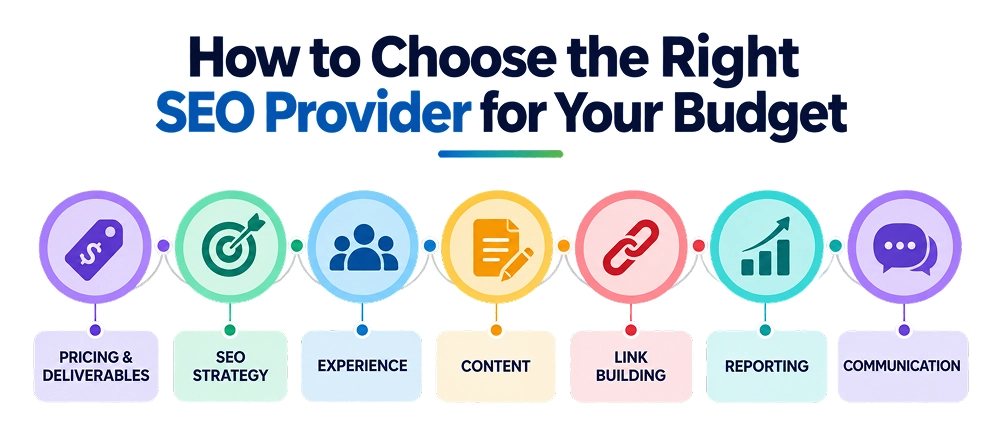
The right SEO provider isn’t necessarily the one that offers the lowest price. It is important that the provider’s experience, communication style, and deliverables align with your budget and goals. The best provider can explain its work, show relevant proof, avoid shortcuts, and tie SEO activity directly to business outcomes like leads and revenue.
You can refer to the table below while evaluating your options:
What to Compare |
What to Look For |
Red Flags to Avoid |
|---|---|---|
| Pricing & Deliverables | Clear breakdown of what's included | Vague scope of work |
| SEO Strategy | Strategy tailored to your business and market | One-size-fits-all approach |
| Experience | Relevant industry and market experience | No relevant examples |
| Content | Clear content strategy and quality standards | High-volume, low-quality content |
| Link Building | Relevant, quality-focused authority building | Guaranteed number of backlinks |
| Reporting | Regular reports covering meaningful KPIs | Rankings-only reporting |
| Communication | Clear point of contact and regular updates | Poor communication |
| Contract Terms | Transparent fees, terms, and cancellation policy | Long contracts with unclear terms |
| Results | Relevant case studies and realistic expectations | Guaranteed rankings or unrealistic promises |
The right SEO provider should fit both your budget and your growth goals, with a clear scope of work and realistic expectations for results.
Conclusion
There is no single price for SEO. It varies widely depending on the amount of work your website needs, the competitiveness of your market, the locations you target, and the growth you want to achieve. In general, businesses spend around $500 to $5,000 per month on SEO services, depending on their size and business goals.
The right investment is not always the cheapest option. Whether you go with a monthly retainer, a project, or hourly consulting, make sure the approach matches what you actually need. By understanding the different pricing models and the factors that drive costs, you can set a realistic budget, avoid red flags, and choose an SEO partner that delivers lasting value.
Frequently Asked Questions
1. How much does SEO cost per month in the US?
SEO services cost in the US typically range from $500 to $ 10,000 or more per month. It depends on factors such as business size, competition, website complexity, target market, and scope of work. Generally, enterprise SEO services and campaigns operating in highly competitive regions cost more.
2. Is it better to pay for SEO monthly or as a one-time project?
The choice primarily depends on your business goals, internal resources, and requirements. A monthly retainer pricing model is generally suited to businesses that need ongoing SEO. A project-based engagement can work better for businesses with defined needs such as a technical audit, website migration, or foundational optimization.
3. What is included in a monthly SEO package?
The deliverables generally depend on the provider and package you have opted for. Monthly SEO services typically include keyword research, technical SEO, on-page optimization, content creation, internal linking, authority building, local SEO, analytics, and reporting.
Learn more in our detailed guide: What to expect from SEO company
4. What is the average cost of SEO for a small business?
Small businesses typically spend around $500–$2,500 per month on SEO. The actual cost depends on the target market, competition, website condition, and services included in the campaign.
5. How long does it take to see a return from SEO investment?
SEO is typically a long-term investment. Some improvements may appear within the first 60 to 90 days. However, more significant changes may take 6 to 12 months, depending on the campaign and competitive landscape.
Learn more in our detailed guide: How Long Does It Take for SEO to Work?
6. Is SEO worth the investment?
Yes. SEO can help businesses build long‑term visibility, credibility, and qualified traffic. An optimization effort done today, from optimizing content to improving site authority, can continue driving high‑intent visitors for months or even years. This makes SEO one of the most cost‑effective long‑term marketing strategies.
Learn more in our detailed guide: Are SEO services worth it
7. How do I know if I’m paying a fair price for SEO?
A fair price reflects your competition level, goals, and the actual work being done. To ensure this, you can ask for clear deliverables, timelines, and reporting from SEO service providers before signing.
8. Why do SEO prices vary so much?
SEO pricing changes because every business has different needs. Costs are influenced by factors like industry competition, website size, content requirements, link building, geographic targeting, and the experience level of the provider. Since these elements differ from one company to another, SEO prices can range widely instead of following a fixed rate.

Gurpreet Singh is a Marketing Manager at SEO Services Consultants. Over the years, he has worked with businesses from different industries, building strategies and approaches based on their needs.
The everyday challenges he comes across in his work often become the topics he writes about. His articles share what he learns from his work, research, and observations on ongoing market trends. Through his content, he aims to offer practical, clear, and useful insights to readers.