


As businesses and websites grow, SEO becomes more challenging. It is easy to manage a few pages, but managing multiple pages located in different locations and international markets with complex technology can be difficult.
This is why enterprise SEO plays an important role, as it focuses on creating scalable processes for managing technical SEO, content, site structure, and search visibility across a large or complex website.
But how do you know that your business needs enterprise SEO? In this blog, we explain the key situations where enterprise SEO becomes valuable and how to build a scalable strategy.
What Is Enterprise SEO?
Enterprise SEO is a large-scale strategy focused on managing and improving a website’s organic traffic. It is a more structured approach designed to handle large, complex technical web pages, locations, teams, etc.
Instead of focusing on creating a separate SEO strategy for every location, the business can implement a scalable framework for location pages while ensuring each page delivers relevant, useful local information.
Enterprise SEO particularly focuses on scalability, consistency, automation, governance, and other aspects such as technical infrastructure and inter-team coordination.
How Enterprise SEO Is Different From Traditional SEO
Traditional SEO and enterprise SEO both focus on enhancing search and AI visibility and driving organic traffic, but they differ in scale, complexity, processes, technology, and the level of coordination required to manage SEO effectively.
Key Points |
Enterprise SEO |
Traditional SEO |
|---|---|---|
| Website Size | It focuses on managing large websites containing thousands to millions of URLs across multiple subdomains, regions, or languages. | It focuses on smaller websites having fewer than 500 pages. Any changes are usually done page by page manually. |
| Keyword Focus | It focuses on branded, highly competitive keywords because the enterprise has established brand trust. | It focuses on long-tail, low-competition keywords because small or new firms have low authority. |
| Content Strategy | Uses dynamic content models, database-driven templates, and automated workflows to manage and update thousands of pages at once. | Content optimization is done manually for small or medium firms. |
| Technical SEO | Requires large-scale management of crawlability, indexation, site architecture, internal linking, redirects, structured data, and other technical elements. | Typically focuses on core technical SEO issues such as crawlability, indexing, site speed, mobile usability, redirects, and basic structured data. |
| Monthly Budget | $10,000 to $60,000+ per month | $500 – $1,000/month |
| Example | Amazon, Canva, Apple, IBM, Salesforce, Nike. | Local small and medium e-commerce firms |
When Does a Business Need Enterprise SEO?
Enterprise SEO becomes important when website size, complexity, or business operations make traditional SEO difficult to manage efficiently at scale.
Thousands of pages
It is impractical to manage websites with multiple web pages. Instead of optimizing product, service pages, blog posts, etc. manually, enterprise seo focus on developing flexible systems such as page templates, automated titles and meta descriptions, structured data, internal-linking frameworks, and content-quality standards.
These systems allow the business to improve search visibility across large sections of the website at once.
Multiple countries and languages
Businesses such as Apple, Nestle, etc., that operate in multiple countries or languages require proven enterprise SEO in order to manage their search visibility internationally.
Each location has different search behavior, language, culture, competitors, and local regulations.
Enterprise SEO helps businesses create structured international strategies, including online localization processes like generating localized landing pages, creating content in different languages, regional keyword searches, using hreflang, etc.
These elements help search engines understand which version of a page should appear for users in specific countries or languages.
Multiple locations
Companies with multiple sites also require enterprise-level SEO. Each site may require its own specific landing page that includes accurate information about the business location, services provided, directions to the location, reviews, hours, and content relevant to that location.
At scale, managing hundreds or thousands of location pages manually becomes difficult. Enterprise SEO provides a means for effective management of location data, page templates, business listings, reviews, and local search optimization as one integrated system.
With enterprise SEO, businesses make sure their customers always get accurate and consistent information everywhere the company operates.
For example,
McDonald’s operates a large network of physical restaurant locations, so customers need an easy way to find the location that is most relevant to them. Its website includes a “Change your Location” feature that helps users select a specific restaurant location and access location-specific information.

This centralized location system helps manage information across many physical locations while giving customers a consistent experience.
Multiple teams
Enterprise SEO becomes important when website changes depend on coordination among several teams. In large organizations, SEO decisions may involve marketing, content, engineering, product, design, legal, data, and executive leadership.
Each team may have different priorities, timelines, and approval processes.
For example, an SEO team may identify a technical issue, but the development team must implement the fix. Similarly, a content team may need legal approval before publishing certain pages.
In this environment, SEO cannot operate in isolation. It requires governance, clear ownership, documented workflows, and regular communication between departments.
Enterprise SEO helps align these teams around shared goals and ensures that SEO requirements are considered early in product, content, and development decisions.
Complex technology
Technically complex websites built on custom platforms, multiple CMS, large databases, etc., can require enterprise SEO.
Complex technology can create SEO tasks such as crawling and indexing issues, slow page speed, poor mobile performance, etc., making them more challenging.
These issues may not be visible on the surface but can significantly affect how search engines crawl, understand, and rank a website.
Enterprise SEO focuses on managing technical issues of the website, and it also involves monitoring, automated audits, and scalable technical controls to ensure that the website remains accessible, fast, and easy for search engines to understand.
Stagnating organic growth
Sometimes website organic traffic and revenue stop growing, and we usually call this stagnation. It mainly occurs when your website becomes too large or too difficult to manage.
Common reasons may include content duplication, poor site architecture, technical errors, weak internal linking, outdated content, and slow implementation of SEO recommendations.
Producing more content or targeting more keywords may not solve the problem.
Enterprise SEO takes a strategic approach by auditing the entire website, identifying systemic issues, prioritizing high-impact opportunities, and implementing scalable solutions. This helps businesses regain and build a more sustainable organic growth strategy.
Multiple brands and domains
Companies like Google that utilize subdomains to run completely separate web applications and utilities under one parent brand need enterprise SEO to maintain consistency and improve search performance.
Each domain may have its own content strategy, technical setup, audience, and business goals.
Without a proper approach, businesses may face issues such as duplicate content, weak internal linking, inconsistent branding, and poor distribution of authority across domains.
Enterprise SEO helps establish clear rules for managing multiple properties while ensuring that each brand maintains its own identity and search strategy.
This is especially important for large corporations, franchise businesses, and organizations with multiple product lines or regional websites. A centralized SEO framework allows the business to manage complexity without sacrificing flexibility.
Large migrations
A major website migration can significantly affect a company’s organic visibility, especially when thousands of URLs are involved. Changes may include a change in the content management system, appearance of the site, switching domains, change of the structure, or merge of different websites.
Missing redirects, incorrect canonical tags, broken links, or incomplete sitemap updates can create problems.
Enterprise SEO should therefore be involved throughout the migration process. URL mapping, redirect testing, crawling, indexing checks, structured data, internal links, and post-launch monitoring all need to be considered before and after the change.
Which Businesses Commonly Need Enterprise SEO?
Enterprise SEO is useful for businesses with large websites, multiple markets, locations, products, or complex digital operations that require SEO to be managed at scale.
Enterprise |
Key Reason |
Example |
|---|---|---|
| Large E-commerce Businesses | Ecommerce websites generally have a large number of products. Managing titles, product descriptions, internal links, structured data, filters, and indexation across such a large website can be difficult manually. Enterprise SEO helps create scalable systems for optimizing and monitoring these pages. |
Amazon |
| Global and Multinational Companies | Businesses operating across multiple countries or languages often need a coordinated international SEO strategy. They may have country-specific websites, localized content, different search behavior, and regional requirements to manage. | Microsoft |
| Enterprise B2B and SaaS Companies | Big B2B and SaaS businesses deal with many products, services, industries, features, integrations, and use cases. This leads to a wide variety of topics to search for and requires organizing them properly without any overlapping and competing pages. | IBM |
| Multi-Location Businesses and National Chains | Companies with multiple locations should have accurate and useful location pages while maintaining a consistent structure of the website. Enterprise SEO can help in managing local content, internal links, and technical aspects of the website at scale. |
Marriott International |
| Media and Publishing Companies | Publishers can create thousands of new pages over time. Websites for news, online magazines, and big content platforms are in need of a robust system for managing indexing, internal linking, structured data, content updates, and technical performance. | The New York Times |
| Online Marketplaces | Marketplaces usually have a large number of products, sellers, categories, and pages generated dynamically. Their SEO strategy should focus on aspects such as changing inventories, duplicate links, filters, pagination, and indexation. |
Booking.com |
What Does Enterprise SEO Involve?
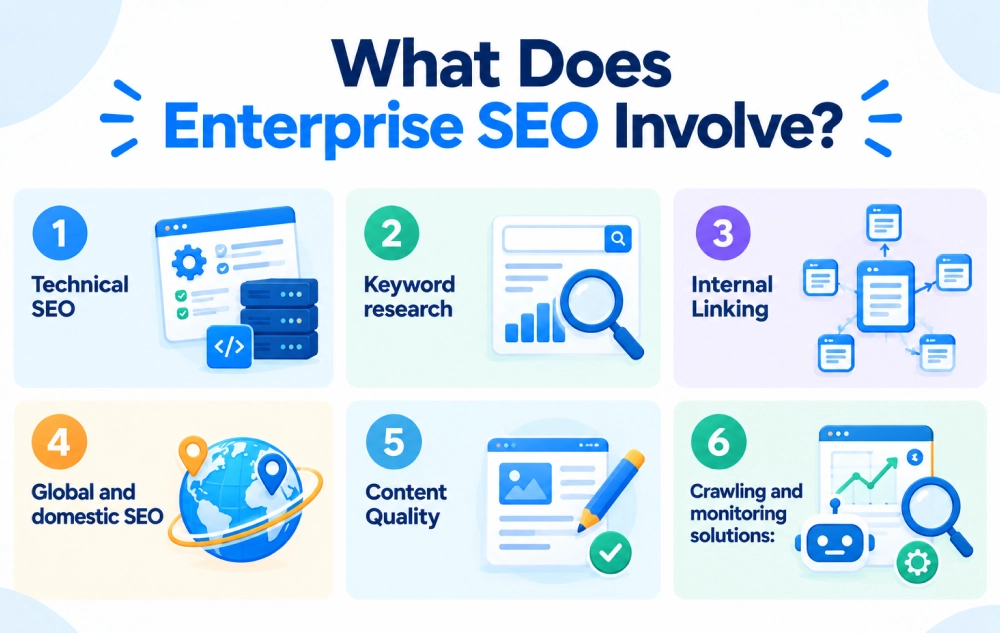
Enterprise SEO involves managing SEO at scale across a large or complex website. Rather than optimizing every page separately, it creates repeatable processes across thousands of pages, locations, products, markets, and business units.
1. Technical SEO
Enterprise SEO focuses on identifying and fixing technical issues related to the website. Typically, technical SEO covers managing crawling, indexing, site architecture, redirects, canonicalization, structured data, and site performance.
2. Keyword research
It focuses on identifying relevant search terms and queries related to your website’s products or services.
3. Internal Linking
A proper internal-linking structure helps users and search engines discover important pages and understand relationships between products, categories, services, and supporting content.
4. Global and domestic SEO
Companies that operate across countries or regions need consistent approaches for localization of webpages, language, content, and search visibility.
5. Content Quality
Content publishing at scale requires procedures that ensure the content is delivered consistently while preventing duplicated, poor-quality, outdated, or overlapping pages.
6. Crawling and monitoring solutions:
Crawling tools, SEO platforms, and automated monitoring can help identify issues across large numbers of pages more efficiently.
Also Read: How much does Enterprise SEO cost?
How to build an enterprise SEO strategy
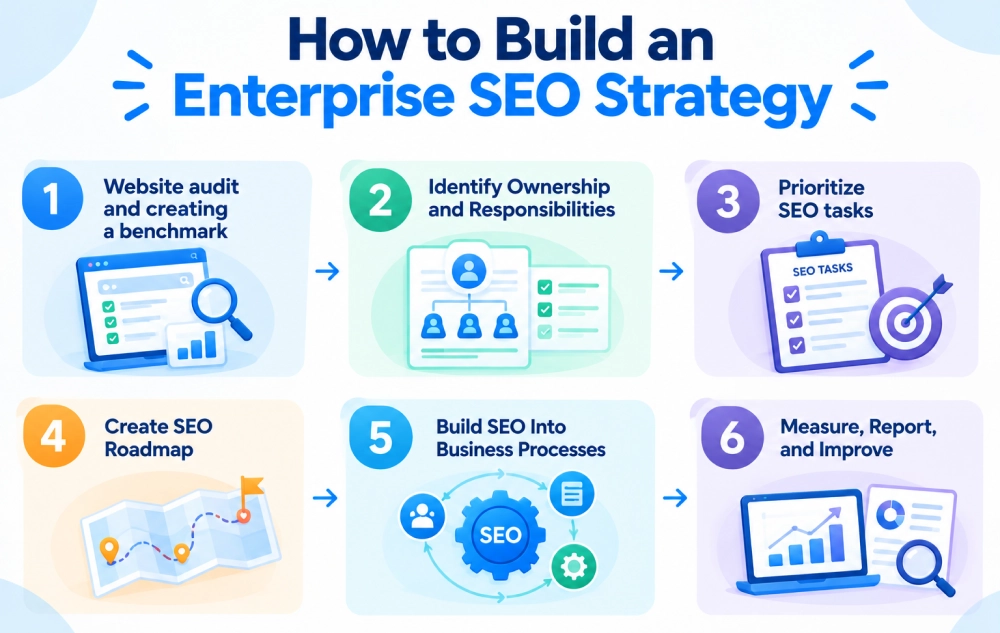
A well-planned enterprise SEO strategy starts with understanding the website’s current performance, identifying key opportunities, and establishing clear priorities for improvement.
Step 1: Website audit and creating a benchmark
The first step involves an audit of your existing website to identify the problems related to your site.
In involves :
- Crawlability and indexation issues
- Site architecture and internal linking
- Technical issues and page performance
- Content quality and keyword targeting
- Current Organic traffic and rankings
- Conversions and revenue from organic search
- International, local, or multi-brand SEO performance where applicable
A benchmark is created based on this. This will help in identifying and comparing performance after implementation and determining whether an SEO initiative produced expected results.
Step 2: Identify Ownership and Responsibilities
Enterprise SEO involves a proper, well-experienced team, including SEO specialists, developers, content writers, and a marketing team. It helps clearly define who is responsible for implementing and approving different types of SEO changes.
For example
SEO Activity |
Implementations |
Approval |
|---|---|---|
| Content updates | Content team | Marketing or brand team |
| Structured data | SEO and Development team | Development team |
Step 3: Prioritize SEO tasks
Large websites may have multiple technical issues; fixing all issues at once is impractical.
Prioritize website issues based on potential impact, implementation effort, and business importance.
For example, fixing an indexing problem affecting thousands of important product pages may deserve higher priority than optimizing a small number of low-traffic pages.
Group similar issues together where possible. This allows teams to solve problems at scale instead of repeatedly addressing the same issue on individual pages.
Step 4: Create SEO Roadmap
After prioritizing SEO opportunities, the next step is to create a clear roadmap that includes those that require more time and effort.
It is particularly based on business impact, implementation effort, and available resources.
Tasks that take a short time |
Tasks that take a long time |
|---|---|
| Correcting duplicate or poorly optimized title tags | Restructuring site architecture |
| Fixing broken internal links | Improving page and content templates |
| Correcting incorrect canonical URLs | Resolving large-scale indexation issues |
| Improving content on high-priority pages | Developing international URL and content structures |
Step 5: Build SEO Into Business Processes
Enterprise SEO is very effective when it gets integrated into the ongoing process of website development and marketing instead of a separate activity performed after changes are made.
SEO requirements should be considered when launching new products, creating templates, redesigning websites, expanding into new markets, publishing content, or changing URLs.
Step 6: Measure, Report, and Improve
It is important to constantly monitor the performance of the SEO initiatives to allow you to correlate SEO metrics with business results. Regular checks should be performed for organic traffic, rankings, indexed pages, crawling issues, conversions, revenue, and visibility for target markets or business units.
Frequently Asked Questions
1. Is enterprise SEO only suitable for large businesses?
No, it depends on website complexity, not only company size. A smaller business with thousands of URLs operating in multiple locations or complex technology may need enterprise SEO.
2. How long does enterprise SEO take to show results?
There is no fixed timeline. Results mainly depend on the website’s condition, competition, industry, technical changes, content quality, and how quickly changes can be implemented. Large websites may also require more time to implement changes across multiple systems.
3. What tools are used for enterprise SEO?
Enterprise teams commonly use advanced crawling, keyword research, rank tracking, analytics, reporting, site monitoring, and automation tools. The specific tools largely depend on the size of the website and its SEO needs, instead of settling for the most expensive solution in the market.
4. Is enterprise SEO a one-time project?
No. Enterprise SEO is an ongoing process. A website keeps changing in terms of new content, product launches, redesigns, migrations, and technical updates, so SEO needs to be monitored and maintained continuously.
5. How AI search changes enterprise SEO?
AI search turns enterprise SEO from a rankings-and-traffic discipline into a cross-functional visibility and trust program. Businesses need to rank not just in Google search results but also in AI-generated answers in platforms like Google AI Overview, ChatGPT, Perplexity, and Gemini.
Conclusion
Enterprise SEO becomes important for large websites with complex structures or operating in multiple locations. The focus is not only on optimizing multiple web pages but on creating a well-planned SEO strategy that maintains search visibility across different platforms such as search engines and AI-powered tools.
A successful enterprise focuses on solving technical issues related to the website, content optimization, automation, and business-focused reporting. By prioritizing high-impact opportunities and continuously monitoring performance, businesses can build a search presence that supports long-term organic growth.

Gurpreet Singh is a Marketing Manager at SEO Services Consultants. Over the years, he has worked with businesses from different industries, building strategies and approaches based on their needs.
The everyday challenges he comes across in his work often become the topics he writes about. His articles share what he learns from his work, research, and observations on ongoing market trends. Through his content, he aims to offer practical, clear, and useful insights to readers.