
Ok, be honest, which of the two does your business fall under:
“Tried everything, but not getting traffic at all”.
Or
“Getting traffic, but it’s not turning into meaningful engagement, leads, or customers”.
If either scenario feels like your story, you’re not alone!
We are in 2026. The digital space has tremendously evolved. Consumers are smarter than ever; their buying behaviour has changed. With a shorter attention span and a fragmented shopping journey, they now move between apps, websites, and social platforms to make a purchase.
And that’s not the biggest change; it’s the AI disruption.
The AI has brought about a dramatic shift in eCommerce – zero-click results, AI-powered search results, social commerce, and answer engines have changed the foundation of how people discover brands online. In fact,
Nearly 80% of users now rely on AI summaries for a large part of their searches, while 60% of searches end without a click to any website.
The implication is clear: businesses can no longer just rely on traditional SEO services to drive growth. In 2026 and beyond, they should be consistently visible across multiple discovery channels to drive traffic. Moreover, they should position their brand as the most trusted answer wherever their audience searches, scrolls, or asks questions. That’s the recipe for getting continuous traffic on their website!
So, if you are still following a 2020 SEO playbook in 2026, you’re already behind. Continue to read the blog to know what actually works today, and you’ll learn:
- How to build a website that search engines trust,
- Create content that attracts visitors across AI and traditional search,
- Expand your reach beyond Google, and
- Turn multiple channels into sustainable sources to drive high-quality traffic.
Key Takeaways
- Website traffic in 2026 is about attracting the right visitors with genuine intent to engage, convert, or buy.
- Search has expanded beyond Google. AI search engines, social platforms, answer platforms, email, and online communities all play a role in how users discover brands today.
- A strong technical foundation still matters.
- Fast loading speed, mobile-friendly experience, proper indexing, and clear site structure help both users and search engines trust your website.
- Content should be created around user intent and not keywords. The more effectively your content answers user queries and solves problems, the better it performs across traditional and AI-powered search.
- AI can speed up research, outlining, and optimization. But human expertise remains important for adding original insights, real-world examples, and trustworthy recommendations.
- Long-term traffic comes from a repeatable process - audit your website, optimize existing assets, publish valuable content, promote it across channels, and measure results using engagement and conversion metrics, not traffic alone.
What Website Traffic Looks Like in 2026?
A few years back, businesses that consistently received steady and continuous traffic on their websites were considered successful by search engines. Consistency was itself a strong ranking signal; brands used to rely on regular organic visits as proof of authority.
But, in 2026, website traffic is not just about some numbers on the dashboard. It’s about what kind of visitors are coming and why they are landing on your website in the first place.
Nearly 80% of users now rely on AI summaries for a large part of their searches, while 60% of searches end without a click to any website.
Getting low-intent users doesn’t help businesses as much as even a few hundred highly relevant visitors who are actually looking for a solution. In short, traffic is not about quantity anymore but quality. Today, intent-driven visitors matter far more than raw traffic volume.
For example, as a SaaS company, you may be getting 10,000 monthly visits from generic blog traffic. But if most of these visitors are just scrolling or reading and leaving, your conversions are bound to stay low. On the other hand, your competitor receiving just 1,000 visitors monthly through “best CRM for small business” (high intent) can generate significantly better leads.
This is exactly why understanding website traffic today goes beyond volume. It starts shifting toward where this traffic actually comes from and how it behaves across different channels. Moreover, not all traffic sources bring the same level of intent or willingness to buy anymore.
The New Traffic Sources Businesses Can’t Ignore
Traffic in 2026 doesn’t just come from Google but from multiple ecosystems. We aren’t saying that organic traffic doesn’t matter anymore. It still matters! But AI search platforms, social media, referral blogs, and even email or niche communities are all powerful traffic sources. Your users might find your brand in AI answers, validate it on social media, and finally convert after visiting your website.
That means website traffic is not just a single-channel journey now. Instead, it’s a connected ecosystem of touchpoints that work together. And if the way traffic behaves has changed, the strategies to grow it must also evolve beyond traditional SEO practices.
Now, let’s learn some powerful website traffic strategies that you can adopt for better results.
Strategies To Increase Website Traffic in 2026 and Beyond
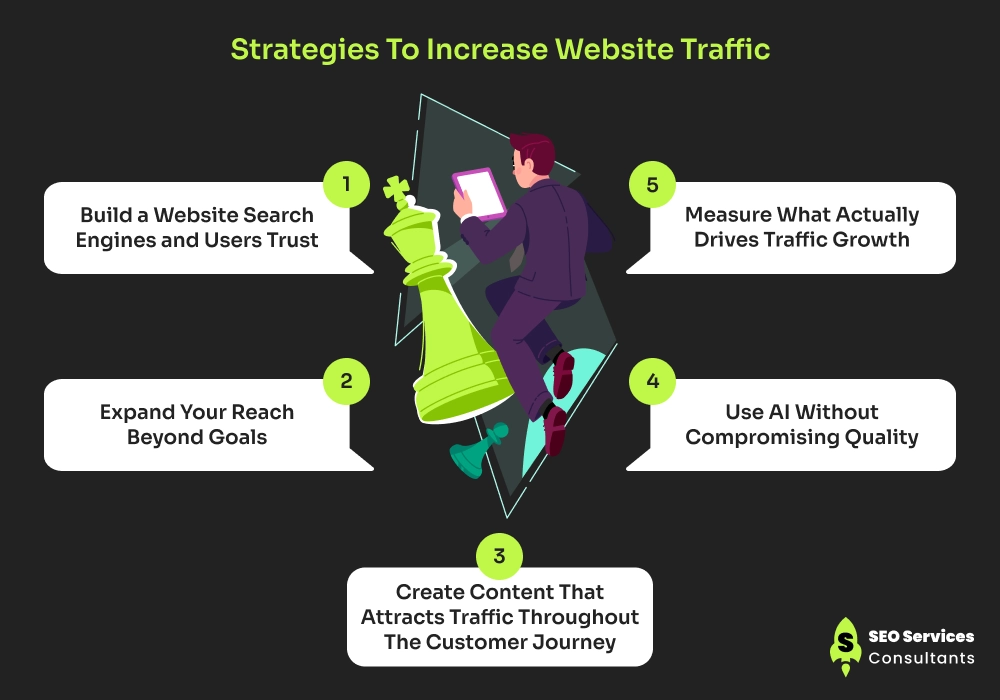
Despite the major shifts in consumer behavior and AI-powered results dominating the search space, many businesses are driving qualified traffic and leads. How? They follow the below discusses strategies:
1. Build a Website Search Engines and Users Trust
First things first! Your website still plays a crucial role in creating an impression both for users and search engines. Both of them need the same thing today—clarity, speed, and trust.
Whether it’s the looks, content, or structure, a strong website will always help you stay ahead and attract traffic. But if the structure of your website is weak, it will hold you back, no matter how good your content is.
Fix Technical Issues That Hold Rankings Back
Start with the basics. Your website should load quickly and run smoothly. Both users and crawlers should be able to explore your website easily. Here, Core Web Vitals play a crucial role because they measure real user experience:
- How quickly your pages load
- How stable it feels, and
- How responsive it is.
If your website is slow, visitors will leave even before they read your content.
Also Read: How To Improve Your Website Speed?
Just like user experience, crawlability, and indexability are equally important to drive relevant traffic to a website. How? If search engines can’t properly access or understand your pages, you simply won’t rank, no matter how good the content is.
Further, you shouldn’t ever ignore mobile experience. In 2026, most users are browsing on their smartphones, and a poor mobile layout instantly kills engagement.
Create a Site Structure That Makes Content Easy To Find
Well-organized website content is useful for visitors and search engines equally. Using topic clusters, you can group related content, which makes it easier to build authority around a subject. By interlinking these pages, you can guide users naturally through your website. Even small improvements in navigation can significantly boost time on site and reduce bounce rates.
Strengthen Trust Signals Across Your Website
Finally, trust is everything in 2026. E-E-A-T principles – expertise, experience, authoritativeness, and trustworthiness are the new way search engines evaluate your content quality. To strengthen trust on your website:
- Show expertise as a real author
- Add clear credentials
- Support claims with case studies, reviews, or testimonials.
It’s simple—when users trust the content on your website and find it credible, they stay longer, engage more, and convert better.
2. Create Content That Attracts Traffic Throughout The Customer Journey
Publishing as many blogs yet there’s no progress in the traffic? That’s because this tactic doesn’t work anymore in 2026.
Today, it’s more about creating the right content for the right audience at the right stage of their journey.
Whether users are just looking for information or ready to make a purchase, your content should help them move to the next step.
Find Topics Your Audience is Already Searching For
The best content strategy begins with understanding the search intent. Before targeting a keyword, ask yourself, Is the user looking for information, comparing options, or ready to buy? The answer will help you determine the type of content you should create.
The trend is visible across search behavior as well. According to an analysis of the most searched questions on Google, it was found that “how”, “what” and other question-based queries still dominate search activity. This highlights the preferences of users for direct, intent-driven answers rather than generic information.
Further, keyword research still matters. However, modern Organic SEO goes beyond finding high-volume search terms. Businesses should prioritize topic relevance, long-tail keywords, and question-based queries that reflect how real people search.
Here’s an example:
A business that targets only “CRM Software” won’t get quality traffic compared to someone addressing searches like “Which CRM is best for small businesses?” or “How much does CRM software cost?” These queries often reveal stronger intent and lower competition,
Publish Content Designed for AI and Traditional Search
With the increasing reliance on AI-powered searches, businesses should now also focus on creating content for AI. Both search engines and AI prefer clear, comprehensive, and easy-to-understand content.
Hence, you should start by providing direct answers to important questions early in your content. This increases your chances of appearing in featured snippets, AI summaries, and answer engines.
At the same time, focus on covering the semantic terms. Instead of using the same keyword, cover related concepts, subtopics, and entities so that search engines can understand your expertise.
Structured information – the way you present the content also plays a key role. Use clear headings, logical content hierarchies, FAQ sections, schema markup, and organized data whenever possible. These improve the ease of understanding for your content for both users and search systems.
Refresh Existing Content Before Creating New Content
Interesting fact: Not every traffic problem requires new content. Sometimes your best opportunity already exists on your site. Over time, content decays as information becomes outdated, competitors publish better resources, and search intent evolves.
To leverage your existing content to increase website traffic, here’s what you can do:
- Regularly update statistics
- Refresh examples
- Improve internal links, and
- Expand keyword coverage to address new questions.
In many cases, improving an existing page can deliver faster ranking gains than publishing an entirely new one. In 2026, content maintenance is as important as content creation for better traffic.
3. Expand Your Reach Beyond Goals
If you want to increase website traffic in 2026, you should stop considering Google the only source of visitors. Visitors today discover brands across multiple platforms before visiting a website. So, the more places your website appears, the more opportunities to attract quality traffic.
Turn Social Media Into a Traffic Engine
Social media is no longer a platform for branding. It has become a powerful discovery engine.
- LinkedIn is ideal for B2B businesses looking to share expertise, industry insights, and content on thought leadership.
- X helps brands participate in real-time conversations. This increases visibility around trending topics.
- Instagram remains a strong platform for visual storytelling, while short-form videos like Reels and Shorts can significantly expand reach through distribution that algorithms drive.
You should create platform-specific content and include clear call-to-actions that guide users back to your website.
Earn Traffic Through Mentions and Partnerships
Businesses with smarter traffic strategies don’t just rely on their own website for traffic. They know that the search space is kind. Hence, they leverage different channels to earn traffic.
Guest posting on reputable websites can expose your brand to new audiences while building high-quality backlinks. Similarly, digital PRs help secure media coverage. And brand mentions improve visibility and authority. You can also use webinars, industry collaborations, podcasts, and co-created content to drive highly relevant referral traffic from trusted sources.
Build an Audience On Your Own
Audiences that you own will remain valuable even if the algorithms change. Email marketing and newsletters have been popular channels among businesses to build their audience. These allow you to communicate directly with subscribers without depending on social platforms or search engines.
Further, you should also consider building communities through private groups, forums, or membership programs that create recurring engagement and repeat visits.
The goal is simple: turn one-time visitors into long-term subscribers. The larger your owned audience becomes, the more predictable and sustainable your website traffic will be.
4. Use AI Without Compromising Quality
AI has become an essential part of content creation today. However, most businesses fail at using it in a balanced manner. While AI can improve efficiency, it cannot replace human expertise, experience, or strategic thinking. Businesses that combine speed of AI with human insight are the real winners today.
For SEO, AI can aid in covering related keywords, entities, and search intent variations that help search engines better understand a page’s context. This can significantly reduce production time while improving the completeness of the content.
What Human Expertise Still Needs To Do
No matter how helpful AI is, human input is still critical. That’s because AI cannot replace original insights, real-world examples, industry expertise, or even customer experiences. And that’s the reason search engines are more and more prioritizing content that shows authority and experience.
To bring that to your content, include unique case studies, firsthand observations, and recommendations based on real-world experiences. All this helps differentiate your content from the growing number of AI-generated materials online.
Avoid The Common AI Content Mistakes That Hurt Rankings
Many businesses make the mistake of publishing AI-generated content without proper review. This often results in generic content that lacks depth, value, and originality. AI hallucinations can also introduce factual inaccuracies that damage credibility.
Another common issue is creating thin pages that target keywords without addressing user intent fully. If you want to succeed in 2026, use AI as a productivity tool. But it shouldn’t be used as a replacement for expertise, fact-checking, and quality control.
5. Measure What Actually Drives Traffic Growth
Consistently growing traffic was once a success metric. It still is, but not everything! More visitors don’t automatically mean better results. To grow sustainably in 2026, you need to measure the metrics that show whether your traffic is attracting the right audience and contributing to business goals.
The Metrics That Matter Most
There are some metrics that, as a business or marketer, you should focus on. Start by tracking organic sessions, which show how many visitors are reaching your website through unpaid search results. This helps you understand whether your visibility is growing over time.
The next metric to monitor is your click-through rate (CTR). If users are not clicking your result, even a high ranking doesn’t make much sense. CTR reveals how effective your titles, meta descriptions, and search snippets are at attracting attention.
Engagement metrics also provide valuable insights. Look at metrics such as coverage engagement time, pages per session, scroll depth, and bounce rate. These indicators help determine whether visitors are finding your content useful or leaving immediately.
The most important one is the conversions. Whether the goal is form submissions, demo requests, newsletter signups, or sales, conversions connect traffic directly to business outcomes.
Build a Simple Monthly Traffic Growth Framework
Businesses that follow a consistent process can grow traffic much more easily.
- Start each month with an audit to identify technical issues, content gaps, and underperforming pages.
- Next, optimize existing content. Improve relevance, internal linking, user experience, and on-page SEO elements.
- Publish new content that targets emerging opportunities and user questions.
- After publishing, promote the content through social media, partnerships, email campaigns, and referral channels.
- Finally, measure the results. Check what generated traffic, engagement, and conversions.
- Repeat what works, improve what doesn’t, and continue refining your strategy.
Continuous measurement and optimization turn occasional traffic spikes into long-term growth.
In a Nutshell,
Increasing traffic in 2026 no longer depends on chasing rankings or publishing endless content. It requires an entirely different strategy. You need:
- technically sound website,
- Content that aligns with search intent,
- visibility across multiple channels,
- responsible use of AI, and
- a clear measurement framework.
The businesses that aim for sustainable growth today are not relying on shortcuts. They are consistently improving the performance, strengthening EEAT signals, optimizing content for both traditional and AI search, building owned audiences, and tracking meaningful metrics such as organic sessions, engagement, CTR, and conversions.
Also, tracking the progress is important. Auditing, identifying technical and content gaps, and diversifying traffic sources go a long way. Even if you consistently make small improvements, you can achieve better results than businesses performing aggressive tactics.
In 2026 and beyond, traffic growth belongs to brands that focus on trust, relevance, and long-term value.
Frequently Asked Questions
1. What is the fastest way to grow website traffic in 2026?
There’s no one thing that can help you grow your website traffic, but it needs a well-planned and executed strategy. By optimizing existing content, targeting high-intent keywords, improving click-through rates, and actively promoting content through social media, email marketing, and partnerships, you can increase website traffic swiftly. When you combine SEO improvements with content distribution, you can achieve quicker results than publishing new content alone.
2. How long does it take to increase website traffic?
Typically, websites start seeing noticeable results within 3 to 6 months if they make consistent and correct SEO efforts. However, results still vary depending on the competition, location, website authority, technical health of the site, content quality, and how frequently you publish and optimize content.
3. Can AI-generated content help improve website traffic?
Yes, AI-generated content can help increase website traffic when used for research, outlining, and optimization. However, human expertise is essential for adding original insights, real examples, and accuracy. If you create content that combines AI efficiency with human value performs best in search results.
4. How can I increase website traffic without spending money on ads?
You can increase traffic on your site without paid ads by focusing on SEO. It includes site audit, high-intent keyword research and targeting, publishing helpful content, optimizing existing pages, building backlinks for authority, promoting content on social media, and growing an email list. Consistent organic marketing efforts can generate sustainable traffic over the long term.
5. Which traffic source delivers the highest-quality visitors for most businesses?
Organic search often delivers the highest quality visitors because users are actively searching for solutions, products, or information. However, email marketing can also generate higher engagement and conversions, since it targets an audience that has already shown interest in your brand.