

SEO content creation doesn’t just focus on publishing blogs or targeting keywords. You need to consider the customer’s search behaviour before they take any purchase action.
Users go through different buying stages, from identifying an issue to exploring expected solutions. Therefore, clear SEO content mapping is important for a successful customer journey.
Businesses should focus on understanding the actual customer’s need at each stage and create content accordingly.
Continue reading this blog to know how to align keywords, search intent, and website content with buying journey.
Key Takeaways
- Mapping SEO content helps businesses to understand what potential customers actually search before making any specific action.
- The buying journey includes three main stages: Awareness, Consideration, and Decision.
- Creating buyer personas and researching keywords helps identify customer needs at each stage.
- Content auditing and identifying content gaps help ensure that important customer queries are covered.
- Tracking important metrics such as organic traffic, keyword rankings, engagement, and conversions helps measure the performance of your SEO content map.
- AI search is changing how users discover queries and find solutions, making helpful and well-structured content increasingly important.
What Does "Mapping SEO Content to the Buying Journey" Mean?
As we know, users browse and explore information across multiple platforms before making any purchase decision.
For example, if you want to buy a digital camera, offcoruse, you may browse for multiple types of digital cameras and their features. Check particular specifications you are looking for, reviews, price, etc.
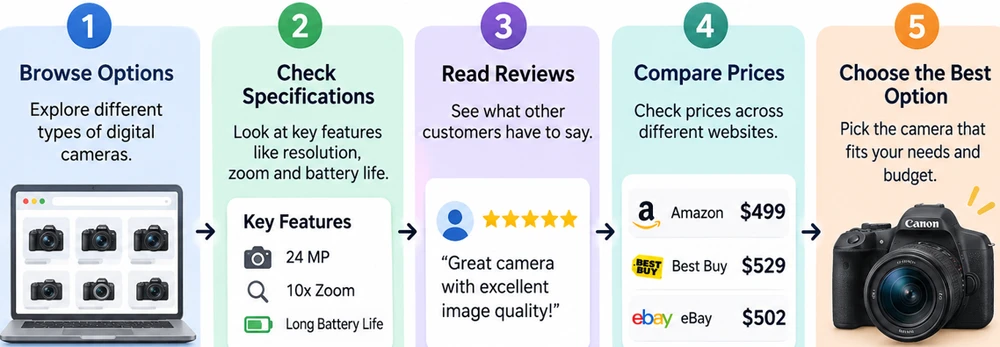
Finally, after evaluating all important information, you decide which camera you want to purchase.
That’s why mapping SEO content to the buying journey plays an important role.
This involves understanding what information potential customers are searching for at different stages and creating relevant website content to address those needs. Businesses can use informational blogs, comparison articles, product or service pages, and customer case studies to answer questions and help visitors evaluate their options.
The Three Stages of the Buying Journey You Should Know
This mainly includes 3 important stages: Awareness, Consideration, and Decision.
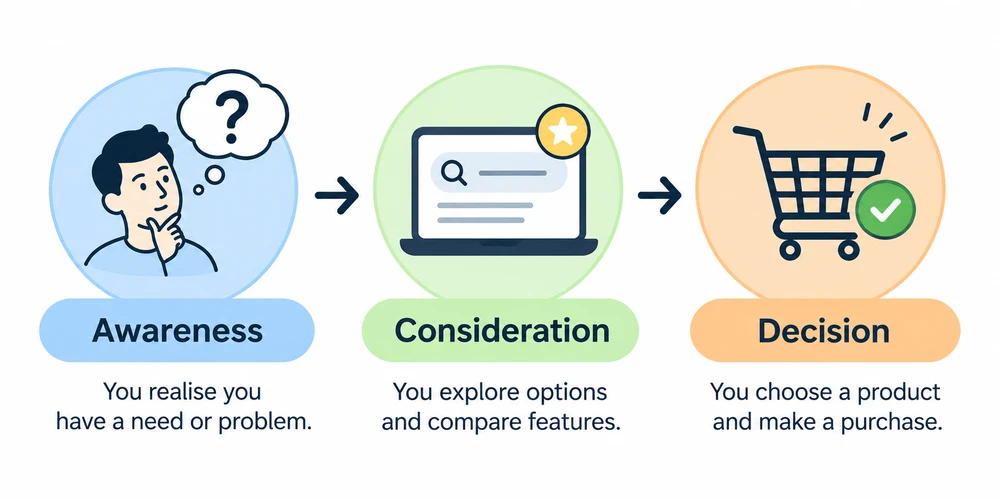
A better understanding of these stages can help businesses to recognise what potential customers are looking for, and what type of information can help them make a decision.
Here, I have explained in depth these important stages :
1. Awareness Stage
This is the first stage of the buying journey. At this point, users generally know they have quires but may not know how to find a solution. Users simply start browsing online to understand the issue, explore relevant information, and learn about possible solutions.
For example, you may publish a new blog on “When Does a Business Need Enterprise SEO?” but may not appear in Google search results.
Initially, you may not know the exact reason or assume expected issues related to crawlability, indexing settings, content quality, or technical SEO.
For this, you may search on Google quires like why is Google not indexing blog?
Or Why Pages Are Crawled but Not Indexed.
At this stage, customers are generally looking for information rather than a particular service provider. Businesses can reach these potential customers by publishing educational content that explains common queries and introduces useful concepts.
Suitable SEO content for the awareness stage includes:
- Informational Blogs
- Beginner-friendly guides
- Educational articles
- Frequently asked questions
2. Consideration Stage
This is the stage where customers actually know what problems they are facing and start exploring solutions instead of searching only for general information.
For example, after learning how SEO can improve website ranking, you may start exploring queries like the right way to choose an SEO agency or SEO cost.
At this stage, start exploring available options instead of simply gathering information. Businesses should focus on creating content that provides detailed explanations, comparisons, practical insights, and information that helps visitors assess different solutions.
Suitable SEO content for the consideration stage includes:
- Comparison Articles
- Detailed Service Guides
- Product Comparison
- Case Studies
- Solution-focused blog posts
3. Decision Stage
This is the final stage of the buying journey. At this point, customers are ready to select a particular product, service, or provider.
For example, you have decided to hire an SEO agency; for this, you may start comparing different SEO agencies, check SEO services, or check SEO pricing.
At this stage, customers need clear and trustworthy information that helps them feel confident about their final decision. Businesses should make it easy for potential customers to understand their offerings, evaluate their experience, and take the next step.
Suitable SEO content for the decision stage includes:
- Product and service pages
- Pricing pages
- Customer testimonials and reviews
- Detailed case studies
- Contact and enquiry pages
Steps To Map SEO Content to the Buying Journey
SEO content mapping requires a clear understanding of your target audience, their search behaviour, and the information they need before making a purchase.
The following steps can help you organise your content and align it with each stage of the buying journey.
Step 1. Define your buyer personas.
The first step is to understand who your customers are. Buyer personas are representations of your customers based on factors such as needs, interests, challenges, search behaviour, and purchasing preferences.
For example, if you are running a digital marketing agency offering services like on-page SEO, International SEO, etc. For this, your potential customers may include small business owners, e-commerce store owners, startup founders, and marketing managers.
You can define your buyer personas by considering:
- Business type
- Goals
- Challenges
- Search behaviour
- Buying preferences
Step 2: Research Keywords for Each Stage
After identifying your target customers, the next step is to focus on researching keywords.
Keyword research helps you to discover actual search terms people type on search platforms . However, instead of collecting keywords randomly, focus on finding queries related to different customer needs throughout the buying journey.
For example, you want to target businesses that focus on improving website online visibility.
For this, you may target keywords this way :
Stage |
Keyword Focus |
Example |
|---|---|---|
| Awareness | Informational keywords | Why is my website not getting traffic? |
| Consideration | Solution-Related Keywords | SEO vs PPC |
| Decision | Service-Related Keywords | Best SEO agency for small businesses |
Step 3: Classify Keywords by Search Intent
After keyword analysis, classify them based on search intent. Search intent refers to the reason behind a user’s search query when they type a specific query on Google.
Classification can be done based on four main search intent categories:
Search Intent |
Users Expectations |
Example |
|---|---|---|
| Informational | Learn about a topic or find answers | What is SEO? |
| Commercial | Research and compare available options | Best SEO agency |
| Transactional | Take an action or purchase a service | Buy SEO services |
| Navigational | Find a specific website or brand | Ahrefs login |
A better understanding of search intent can help you determine what type of content should be created for a particular keyword.
Step 4: Assign Each Keyword to a Buying Journey Stage
After classification, the next step focuses on assigning them to the appropriate buying journey stage.
This means identifying whether a particular search query reflects a customer’s need to understand a problem.
This classification helps you understand which topics should be covered through blogs, comparison guides, service pages, or other website resources.
Step 5: Audit your existing content
The next step is to review existing content on website pages to understand which parts of the buying journey are already covered and where improvements are needed.
A content audit helps you understand whether your existing blogs, landing pages, service pages, and other resources address the questions potential customers have at different stages.
Important points to review :
- Topic relevancy
- Keyword targeting
- Content quality
- Search performance
- Internal linking
For this, you can use tools such as Google Search Console and Google Analytics to review search visibility, organic traffic, engagement, and conversion performance.
Step 6: Content Gap Analysis
After auditing content, identify the topics, keywords, and users’ queries that your website has not covered.
A content gap occurs when potential customers search for information related to your products or services, but your website does not provide a relevant page to answer their queries.
Points to consider while identifying content gaps :
- Analyse competitor content
- Explore customer questions
- Review keyword opportunities
- Check existing pages
The main purpose is to ensure that your website provides relevant information across all three buying stages instead of focusing on informational or sales-focused content.
Step 7: Prioritize What to Create First
After identifying content gaps, the next step is to focus on which topics should be created or updated first. Not every keyword or content opportunity needs immediate attention. Focus on prioritising topics that are more relevant to your business goals and potential customers.
Consider the following factors when setting content priorities:
- Give priority to topics closely related to your products or services.
- Identify keywords that have relevant search volume and potential to attract visitors.
- Focus on queries that reflect clear customer needs at different buying stages.
- Evaluate how difficult it may be to rank for a particular keyword.
- Identify pages that could benefit from updates or improvements.
Step 8: Build Your SEO Content Map
After completing all the above steps, organise all the information into a content map. This document provides a clear overview of which keywords should target specific pages and how each page supports a particular buying stage.
A well-organised content map helps prevent multiple pages from targeting the same primary keyword and ensures that important customer queries are covered.
Type of content for each buying stage
Your content type must match potential customers’ needs at each stage. Some users are browsing the internet to get specific information, while others are comparing solutions or preparing to make a purchase.
Buying Stage |
User’s need |
Content Type |
|---|---|---|
| Awareness | Users are browsing the internet to understand a particular query. | Informational blogs, how-to guides, beginner guides, FAQs, educational articles. |
| Consideration | At this stage, users are aware of their issues and exploring different solutions. | Comparison articles, detailed service guides, case studies, expert guides, solution-focused blogs. |
| Decision | At this stage, Users are ready to choose a product, service, or provider. | Service pages, pricing pages, testimonials, reviews, client case studies, landing pages, contact pages. |
How to Measure the Performance of Your SEO Content Map?
Measurement helps you understand key factors such as target audience, business goals, and search intent.
Here I have explained how to evaluate performance :
Set Up Important Tools to Measure Content Performance
Use the tools mentioned below to collect and analyse data from your website.
- Google Search Console: With the help of GSC, you can monitor clicks, impressions, CTR, and keyword positions for the pages included in your content map.
- Google Analytics 4 (GA4: This tool helps to track organic traffic, user engagement, landing pages, and conversions to understand how visitors interact with your content.
- Keyword tracking tools: This includes tools such as Ahrefs or Semrush to monitor keyword rankings and identify changes in search visibility.
Track Performance Across the Buying Journey
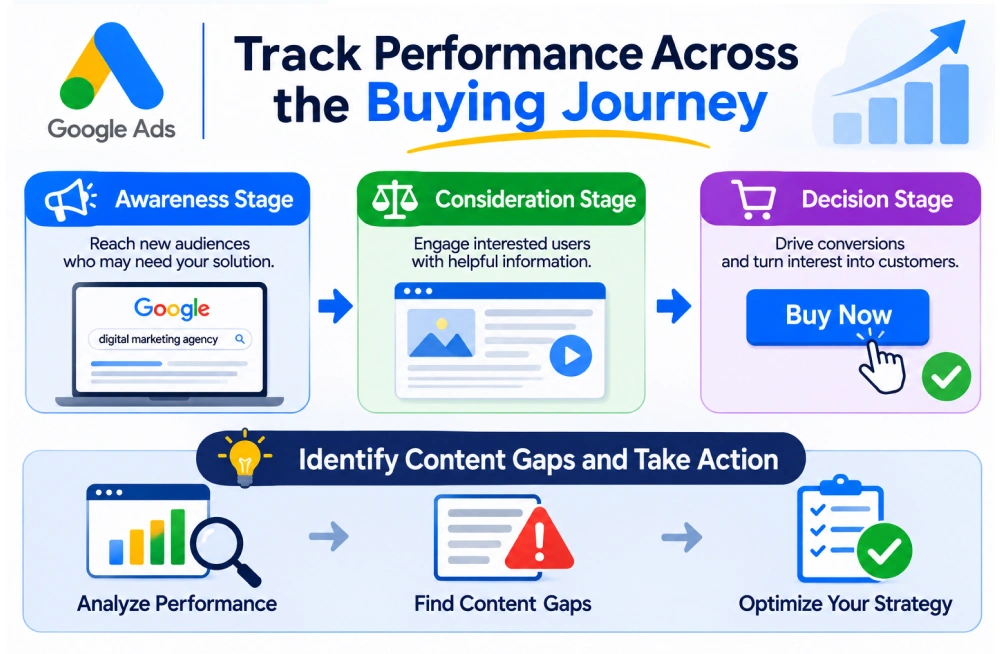
Awareness stage
At this stage, the focus is placed on these metrics:
- Organic traffic: It includes traffic that comes to your website directly from search engines.
- Keyword rankings: Monitor whether your pages are appearing for relevant informational queries.
- Search impressions and clicks: Review whether users are discovering and visiting your content.
Consideration stage
At this stage, the focus is placed on these metrics:
- Engagement: Check whether visitors are spending time reading comparison articles and detailed guides.
- Internal link clicks: Track whether users move from informational blogs to related comparison articles or service pages.
- Returning visitors: Observe whether users revisit your website while researching different solutions.
Decision stage
At this stage, the focus is placed on these metrics:
- Conversions: Measure metrics such as form submissions, phone calls, purchases, or other relevant actions.
- Landing page performance: Check whether service and pricing pages are attracting relevant visitors.
- Conversion rate: Identify how many visitors take the desired action after visiting decision-stage pages.
Identify Content Gaps and Take Action
After reviewing all the above-mentioned important metrics, identify which pages are performing well and which need attention.
In this, focus is placed on :
- Improve low-traffic pages: Review their targeted keywords, search intent, titles, and content quality.
- Update declining content: Refresh outdated information and add relevant details to improve its usefulness.
- Strengthen internal linking: Connect related blogs, comparison guides, and service pages to create a smoother user journey.
Frequently asked questions
1. How many pieces of content do I need per stage?
There is no fixed number of content pieces required for each buying stage. It mainly depends on various factors like business goals, target audience, industry, and the number of queries customers ask before making a purchase decision.
2. How often should I update my content map?
You can review your content map every three to six months to check whether your targeted keywords, existing pages, and content priorities are still relevant.
3. Can one blog target multiple stages of the buying journey?
Yes, a particular blog can answer questions that are relevant to various stages of the buying process as long as they are connected. However, it is better if the blog has a single intention behind it. Trying to cover too many unrelated search intents in one article can make the content confusing and less useful for readers.
4. What is the difference between a buying journey and a customer journey?
A buying journey particularly focuses on the steps a user performs before making any decision.
On the other hand, the customer journey covers the broader relationship between a user and a business, including discovery, purchase, onboarding, customer support, retention, and repeat purchases.
5. What role does AI search play in the SEO buying journey?
Today users are mainly depend on AI platforms as it gives direct solutions. Thus, Businesses should focus on creating clear, reliable, and well-structured content that answers customer questions across different buying stages.
Conclusion
Focusing on mapping SEO content to the buying journey helps businesses create more well-organised content based on various factors such as customers’ needs and search intent.
Better understanding of stages of buying journey can help businesses to identify relevant keywords,and create content that supports potential customers at every step.
Continuously reviewing content performance and adapting to changes in traditional and AI-powered search can also help maintain search visibility.

Gurpreet Singh is a Marketing Manager at SEO Services Consultants. Over the years, he has worked with businesses from different industries, building strategies and approaches based on their needs.
The everyday challenges he comes across in his work often become the topics he writes about. His articles share what he learns from his work, research, and observations on ongoing market trends. Through his content, he aims to offer practical, clear, and useful insights to readers.