
Table of Contents:
- Introduction
- Key Takeaways
- What Are Long Tail Keywords?
- How to Find Long Tail Keywords (10 Proven Steps)
- Why Long Tail Keywords Are Important for Google & AI Search?
- Conclusion
- Frequently Asked Questions
Keyword research has changed dramatically over the past few years, with users no longer relying solely on Google to find information. They now also use AI search platforms such as ChatGPT, Gemini, Claude, Copilot, or Google AI Overviews to find answers to their queries. Search behaviour has become more conversational and intent-driven, with AI tools answering broad questions on result pages and fewer users going beyond those searches. This is where long tail keywords come in.
These are longer, specific, real-use phrases that customers actually type or say when they are looking for a particular service or product. For instance, a long tail keyword such as ‘PPC agency for dentists in Perth’ is likely to face far less competition in comparison to a generic keyword ‘PPC agency Perth’. These long tail keywords have a greater chance of engagement and conversion. They generally face less competition and give your content a better opportunity to rank in both Google search results and AI-generated responses.
In this guide, we will break down steps to find these long tail keywords using practical and proven strategies. You will get acquainted with free methods, useful tools, and competitive tricks you can use to find long tail keywords that not only attract more qualified traffic but also turn searches into paying customers.
Key Takeaways:
- Long tail keywords are specific, intent-driven search phrases that are easier to rank for and generally attract more qualified traffic than broad keywords.
- Google and AI search platforms now prioritize conversational, user-driven content to generate answers, making long tail keywords crucial for ranking.
- You can find long tail keywords using proven strategies such as Google Autocomplete, People Also Ask, Related Searches, Google Search Console, keyword research tools, competitor analysis, online communities, and AI.
- When choosing long tail keywords, focus on how closely they match user intent rather than their search volume.
- You can validate keywords based on their results on Google searches to know relevance before creating content.
- Building content around long tail keywords improves SEO performance and increases your chances of appearing in Google and AI search results.
What Are Long Tail Keywords?
Short Tail Keywords |
Long Tail Keywords |
|---|---|
| SEO agency | Best SEO agency for small businesses |
| Running shoes | Best running shoes for flat feet |
| CRM | Best CRM for real estate agents |
| Email marketing | Best email marketing software for ecommerce stores |
| PPC management | Affordable PPC management services for startups |
The biggest difference comes down to users’ intent. Short-tail keywords are generally broad and can have multiple meanings. At the same time, long tail keywords, on the other hand, are generally exact and give a clear meaning.
How to Find Long Tail Keywords (10 Proven Steps)
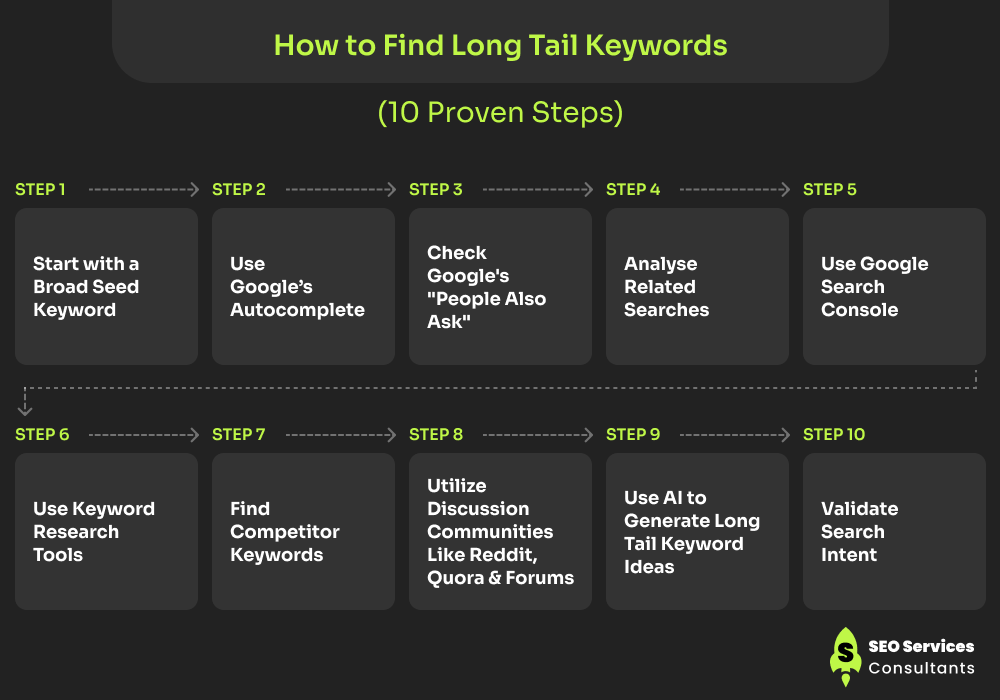
Finding long tail keywords involves the best mix of multiple approaches, such as combining Google’s built-in search features, keyword research tools, competitor analysis, and utilizing AI to uncover the best phrases your customer is likely to type or say. You can’t rely on just one tool or a simple technique.
By combining these multiple tools, you get insights into what customers are actually searching for so you can have stronger visibility and attract more qualified traffic. Below are the 10 proven practical ways to discover long tail keywords that can help you to stand out and connect more with your audience.
Step 1: Start with a Broad Seed Keyword
Begin your keyword search process with a generic or broad term that describes your core offerings. This is your seed keyword. And then narrow it down step by step.
For Example:
- Seed Keyword: SEO Services
- Add Audience: SEO Services for Dentists
- Add specificity & intensity: Affordable SEO Services for Dental Clinics
Notice how each step has added specificity and context and made the keyword more meaningful, long tail, and high intent.
How to proceed:
- List your main product or service.
- Add further details as modifiers. This can be your industry, location, price, goal, or problem.
- Keep adding information until the phrase sounds like a real customer’s search.
Step 2: Use Google’s Autocomplete
Google’s search bar is very helpful in revealing what other people are searching and actively looking for.
How to use it:
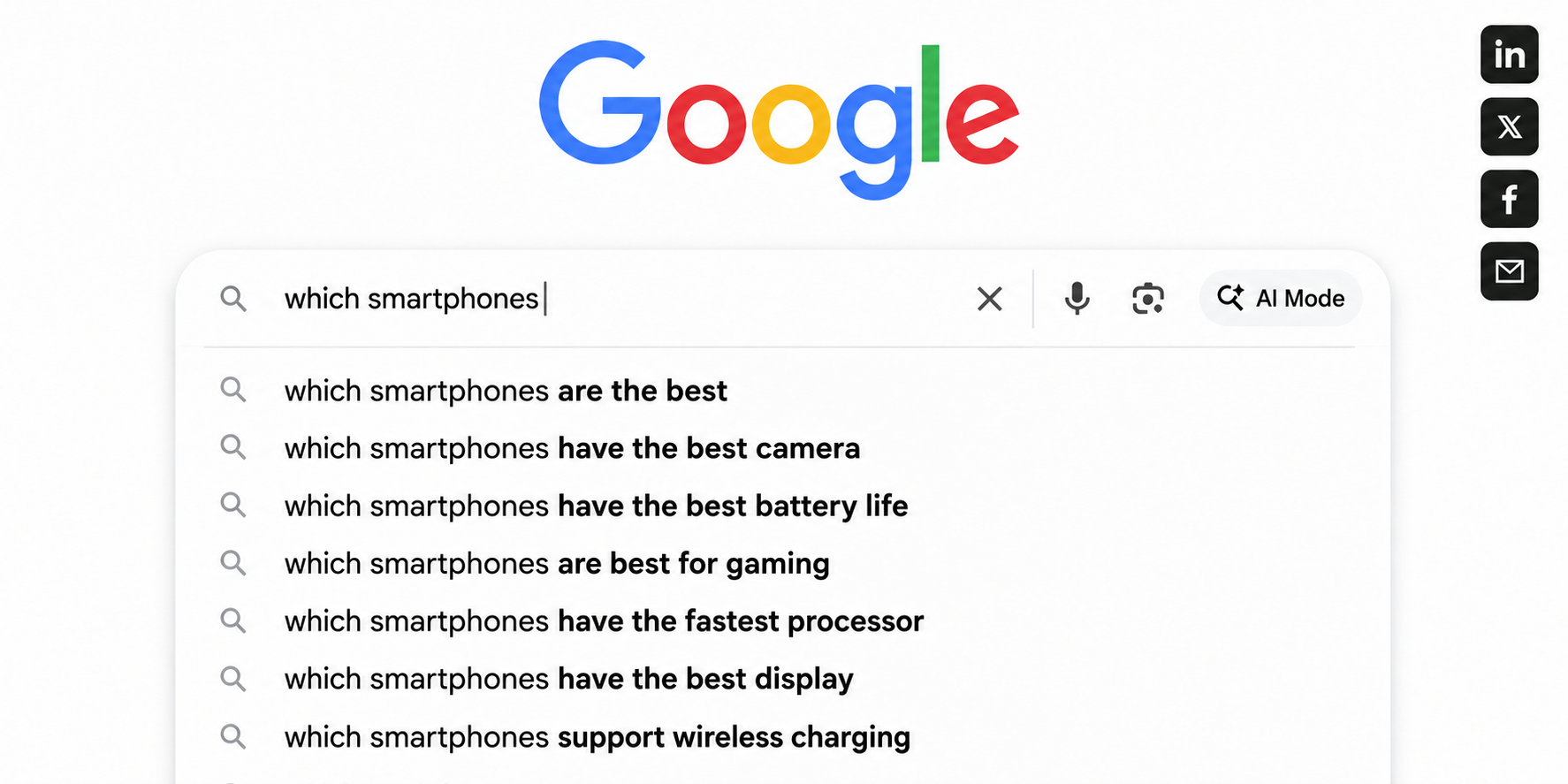
1: Search Suggestions
- Type your search keywords on Google and note the search suggestion in the dropdown.
- These searches are generally what active users are typing.
2: Alphabet method:
- Type your keyword followed by a letter like ‘SEO services a’ or ‘SEO services b’ to see variations.
- Note the long tail keywords that appear in searches.
3: Question method:
- Write how, what, or why before your keywords to see which phrases appear.
- Note queries that are relevant to your searches.
Step 3: Check Google's "People Also Ask"
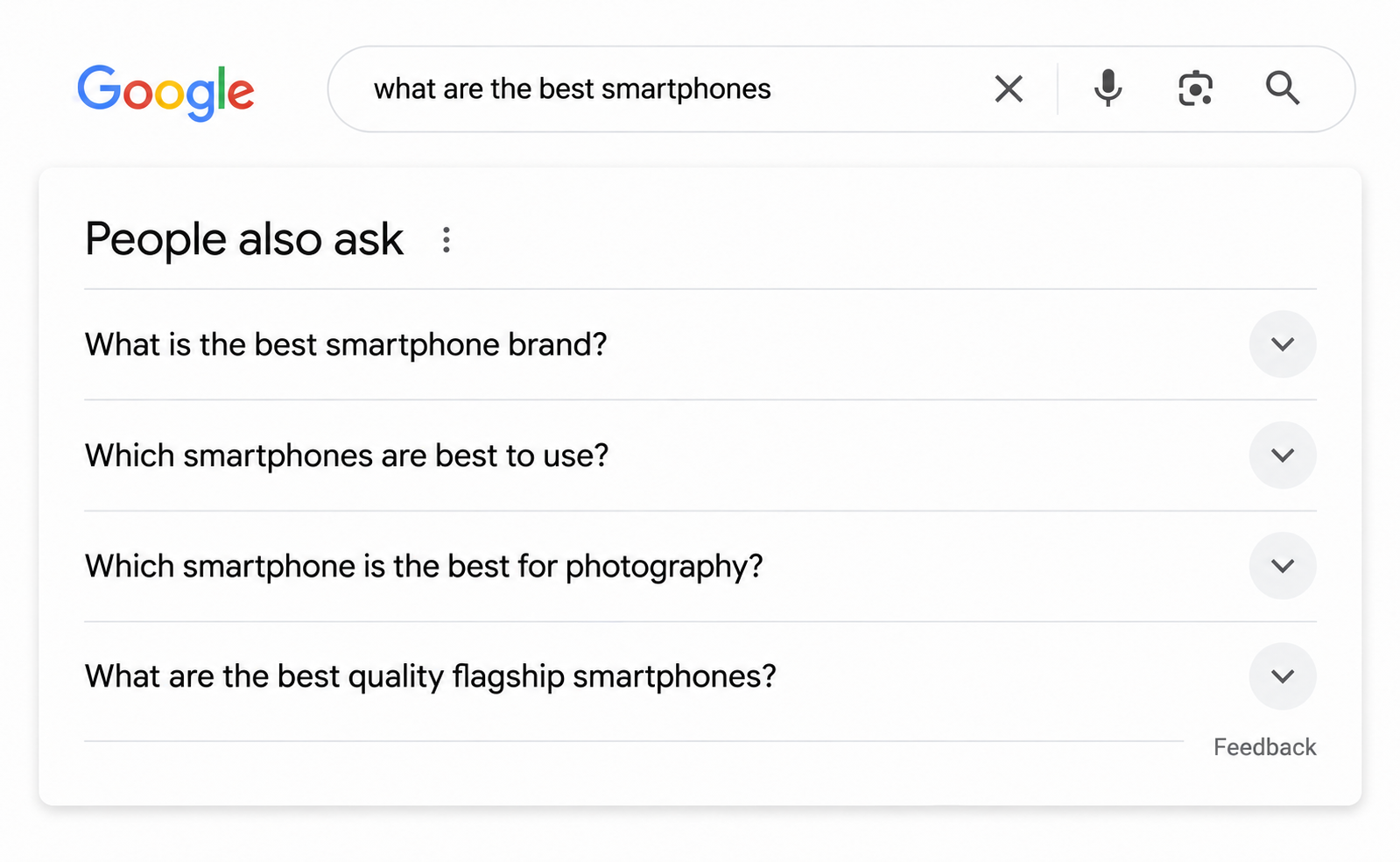
The “People Also Ask” (PAA) box on Google is a goldmine for long tail keywords and content ideas. The box shows what other questions people ask on Google that are related to your topic.
How to use PAA:
- Search your seed or mid-tail keyword on Google.
- Scroll to the PAA section.
- Click on the questions box to expand more related ones.
- Turn each question into a blog post title, an FAQ section, and a dedicated landing page.
Question Examples:
- “How much does SEO cost?”
- “How long does SEO take?”
- “Is SEO worth it for small businesses?”
Any of these questions can become your blog post title or be a part of your landing page.
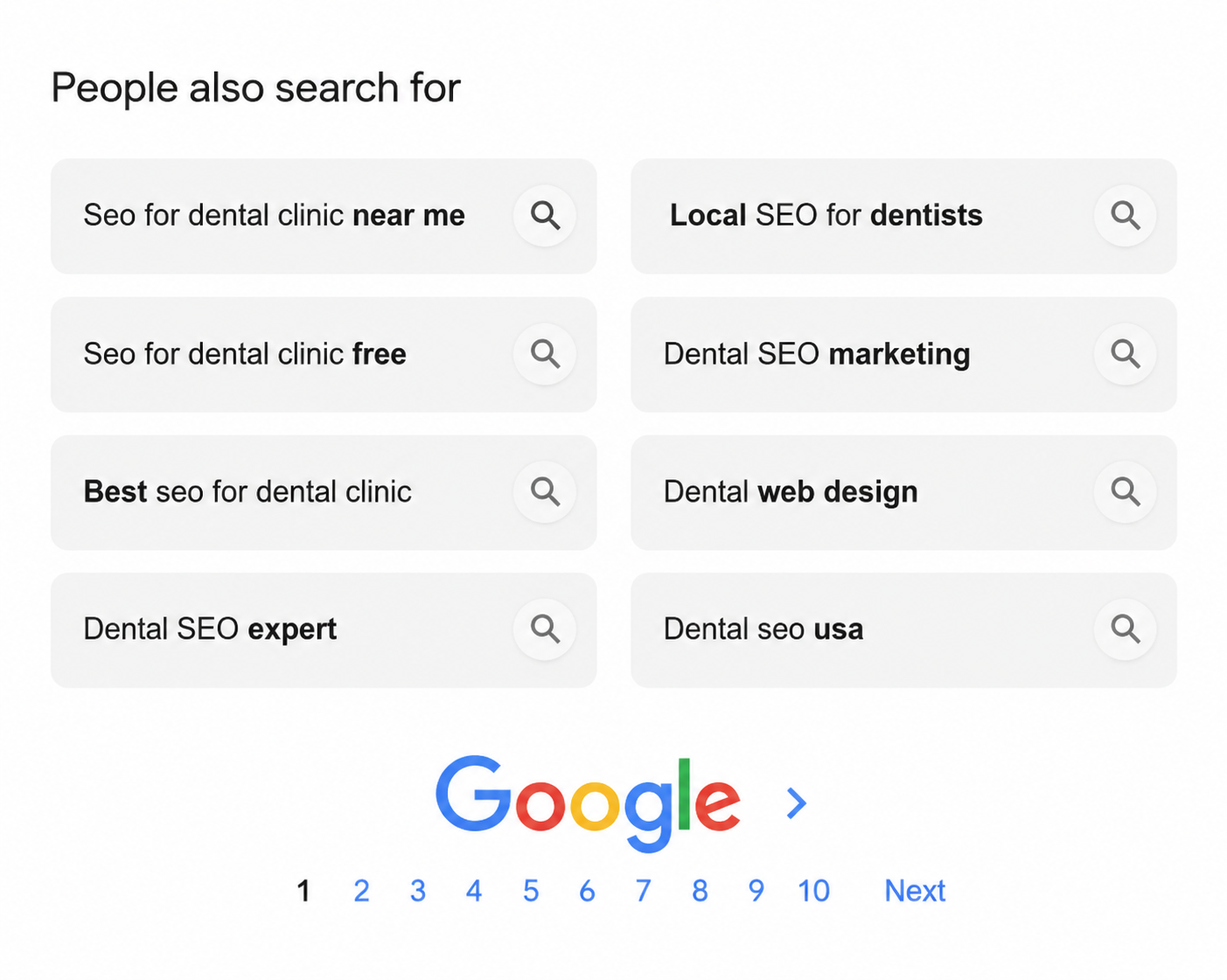
Step 4: Analyse Related Searches
When you scroll down to the bottom of the Google search results page, it shows a related searches section. These are generally long tail variations of related searches or topics.
These are intent-based searches made by users on similar topics.
How to use them:
- Search for your main keyword on Google.
- Scroll to the bottom of the page.
- Note all related suggestions.
- Combine them with your seed keyword to create more specific phrases.
These topics can be used as your title for a new blog post, a subheading within your page, or interlinking anchors.
Step 5: Use Google Search Console
If your website already has some traffic, Google Search Console can be used as a reliable tool to find long tail keyword options.
What can you look for in Google Search Console:
- Queries ranking on page 2 (positions 11–20): These queries are easiest to rank for. They are mostly quick wins. You can upgrade your content and push them to page 1.
- Low CTR keywords with decent impressions: There are some long-term phrases where your snippet doesn’t fully match the intent. You can create dedicated content to improve the relevance and earn more clicks.
- Long tail opportunities: Filter the search queries with more than three words. These are your existing long tail keywords you have not yet used.
The process:
- Export your queries and sort them by impression and position.
- Highlight anything specific or relevant and build your pages around them.
Step 6: Use Keyword Research Tools
There are dedicated tools available to speed up your long tail research process. They provide data on search volume, difficulty level, and competition. These tools can give you a broader view of keyword opportunity.
Tool |
Free |
Best For |
|---|---|---|
| Google Keyword Planner | Yes (with Ads) | PPC & SEO, especially local |
| Ahrefs | No | Competitor research, backlinks |
| Semrush | No | Keyword gap, content ideas |
| Moz | Limited free | Beginners, basic keyword data |
| Ubersuggest | Limited free | Small businesses, quick ideas |
| AnswerThePublic | Limited free | Question-based long tails |
| AlsoAsked | Limited free | People Also Ask research |
| KeywordTool.io | Limited free | Autocomplete-style suggestions |
How to use them:
- Enter your seed keyword.
- Filter for more than three words with low to medium difficulty and relevant intent.
- Export and group them by topic or page.
If you use the filter wisely, even free tools can give plenty of long tail keyword ideas.
Step 7: Find Competitor Keywords
Find out what’s working for others. Look for keywords your competitors are already ranking for.
What to analyze:
- Competitor gap analysis: You can use tools like Ahrefs or Semrush to see for which keywords your competitors are ranking, but you are not.
- Identify pages generating traffic: Identify top pages that generate the most organic traffic.
- Extract ranking keywords: Pull the list of keywords each page ranks for and look for long tail keywords with low difficulty.
What to do with the list: Create similar but better content with these keywords and phrases and try to find out missed opportunities.
Step 8: Utilize Discussion Communities Like Reddit, Quora & Forums
In these forums, people speak naturally. They ask questions in their own words.
How to use them:
- Search your niche in Reddit, Quora, industry forums, and Facebook groups.
- Look for common pain points and frequently asked questions.
- Note exact phrases used by the customers to describe their problems
- Turn the recurring queries into a blog post, FAQs, or a service page using the same phrases.

Step 9: Use AI to Generate Long Tail Keyword Ideas
You can use AI tools to brainstorm long tail keyword variations based on your seed terms and audience.
- Tools like ChatGPT, Claude, or Gemini can provide you with a list of long tail variations.
- You need to ensure you use a good prompt such as “Generate 50 long tail keywords for a local plumbing company targeting homeowners in Texas."
- Review the list and remove anything irrelevant and map the best ones to pages or posts.
- AI can be a useful idea generator, but it demands validation with real data.
Step 10: Validate Search Intent
Before targeting a long tail keyword, ensure it has a relevant search intent. The search results should match your content requirements and ensure it serves users’ needs.
In general, there are four main types of search intent:
1: Informational:
Here, the user is only looking for information, and the intention is learning.
- Example: “How does SEO work for dentists”
- Best for: blog posts, guides, FAQs.
2: Navigational:
The searcher is looking for a specific brand or website.
- Example: “Yoast SEO plugin”
- Usually not ideal unless it’s your brand.
3: Commercial
User comparing options before purchasing.
- Example: “best PPC agency for SaaS companies”
- Best for: comparison pages, “best of” lists, service overviews.
4: Transactional:
A user who is ready to take action or make buying decisions.
- Example: “hire SEO consultant for law firms in Columbus”
- Best for: service pages, landing pages, contact/booking pages.
How do you validate these search intents:
- Put the keyword on Google search.
- Look for top results and see what you see. Whether the results are blogs, service pages, or some other page.
- Only opt for keywords whose search results match your intent.
Why Long Tail Keywords Are Important for Google & AI Search?
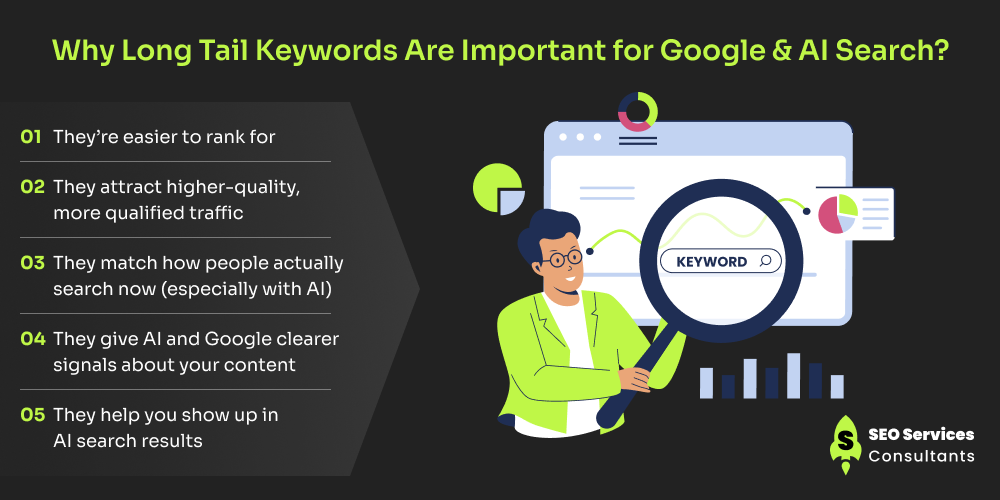
Long tail keywords are crucial to capture specific search intent. They generally have less competition and align more with natural user queries. They not only help in improving ranking but also help attract high-quality traffic.
1: They’re easier to rank for
- Broad terms like ‘SEO services’ are often difficult to rank for.
- Long tail keywords have higher chances of appearing in Google top rankings and AI search results.
2: They attract higher-quality, more qualified traffic
- People using long tail keywords often have clear requirements, know exactly what they are looking for, and are ready to make a purchase where their needs are fulfilled.
- These users are not researching; in fact, they are comparing options to get the best suited one for them.
3: They match how people actually search now (especially with AI)
- The search behaviour has shifted from short keywords to full conversational questions with the advent of AI.
- Long tail keywords closely match these searches and have a greater chance of appearing in AI search results.
4: They give AI and Google clearer signals about your content
- Content built around long tail keywords is more relevant, contextual, and closely aligned with user intent.
- It helps Google and AI systems better understand your content and have clear information about your products or services being offered.
5: They help you show up in AI search results
- AI tools like ChatGPT, Claude, Gemini, or Copilot pull information from content that is most likely to answer their search queries.
- Content created with long tail keywords tends to answer more user queries and is most likely to be picked by an AI platform.
Conclusion
Long tail keywords are a smart online strategy that helps you attract high-intent visitors and align perfectly with users’ searches. By focusing on specific, intent-driven queries, you can create content that answers real users’ queries and generate better business results.
Irrespective of your search tool, be it Google’s search features, keyword research tools, competitor analysis, discussion forums, or AI platforms like ChatGPT and Gemini, the goal remains the same of shortlisting long tail keywords that match user intent.
You can start with a seed word and apply the strategies as discussed above to build content around long tail keywords closer to your audience and niche. This approach can strengthen your SEO and improve your overall online visibility over time.
Frequently Asked Questions
What are long‑tail keywords?
Long tail keywords are more specific, long-term phrases that are generally of three or more words. They generally have lower search volume than broad keywords and are easier to rank. They have a clear intent, for example “affordable SEO services for law firms in Austin” or “SEO for dental clinics in Columbus.”
Why are long tail keywords important for SEO?
Long tail keywords help target a specific audience. They generally face less competition and are easier to rank for. They usually attract high-intent leads and higher conversion rates.
How do I find long tail keywords for free?
There are several ways to find long tail keywords for free. You can find them using Google Autocomplete, People Also Ask, Related Searches, Google Search Console, Google Keyword Planner, and online discussion communities like Reddit and Quora.
How many long tail keywords should I target on one page?
There is no fixed number for this. You can focus on one primary long tail keyword and a small group of closely related variations. Trying to force too many unrelated keywords onto a single page usually weakens the content and confuses both Google and AI systems. It is usually better to create separate pages or blog posts around a keyword cluster.
How many words make a keyword a long tail keyword?
Long tail keywords are not defined by a specific number. Although they mostly contain three or more words, what more is to keep in mind is their specificity and clear search intent rather than just the length.
How long does it take to see results from long tail keywords?
The results can vary with niche and market competition. Typically, many long tail keywords start ranking within weeks to a few months because competition is lower. With consistent content and proper on-page optimization, things speed up further.