
If you are asking the question, “Is SEO worth it?”, it means you are close to making a decision. Maybe you are considering hiring an SEO agency, or trying to decide if SEO deserves a place in your marketing budget.
And it’s a fair question. SEO often requires a monthly investment and consistent efforts. It takes longer for SEO to work and show results. Further, it gets you traffic, which is good. But getting more traffic doesn’t promise more customers; it doesn’t pay your bills on its own.
TL;DR: SEO can be one of the most valuable long-term marketing investments for a business. But it isn’t automatically worth it for everyone.
The real value of SEO depends on factors such as:
- how much people search for your products or services
- the value of each customer
- how competitive your market is
- whether your website converts visitors, and
- When generating AI content, search intent should come first.
- How long you can wait for the results.
In other words, the question shouldn’t simply be, “Does SEO work?” It should be “Can SEO generate enough business for my company to justify the investment?”
Keep reading, and you’ll have enough information to make an informed decision.
Key Takeaways:
- SEO is valuable when search demand and customer value justify investment.
- Neither rankings nor traffic alone can guarantee meaningful business growth. These metrics are important, but the ultimate business growth comes from leads, conversions, and sales.
- Businesses with strong search demand often have greater potential for SEO.
- SEO isn’t a one-time activity. It requires consistent efforts, strategy adjustments, and realistic expectations.
- A good SEO provider clearly explains strategy, work, progress, and outcomes.
- SEO may not work when demand, conversions, budget, or time are limited.
So, Are SEO Services Worth The Money?
Long answer short: Yes, for the right business, with the right strategy and realistic expectations.
But SEO is not automatically a good investment simply because your competitors are doing it.
The better way to decide is to look at whether the economics and conditions make sense for your business. More people are discussing SEO ROI, which includes factors such as search demand, customer value, competition, conversion potential, budget, and the time available to see results.
Ask yourself the following questions before you make a move:
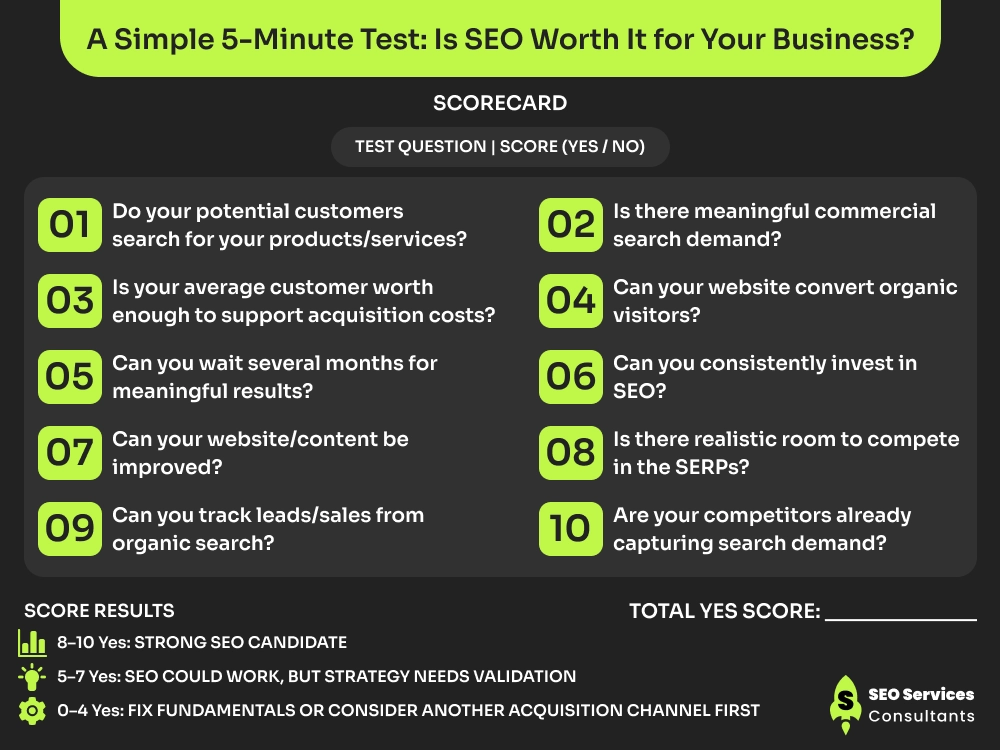
- Do your customers search for what you offer? If there is little or no relevant search demand, SEO has limited opportunity to generate business.
- Is each customer valuable enough? A business that earns thousands from one customer can justify a larger SEO investment than one earning a small profit per sale.
- Does your website convert visitors? Even if you rank for valuable keywords with SEO, it won’t help much if visitors leave without taking any action - calling, submitting a form, booking a consultation, or buying.
- Can you compete with the market and your competitors? It often gets difficult to rank because of your industry, competitors, website authority, content quality, and the specific keywords you target.
- Can you wait patiently for results? The biggest difference in SEO vs PPC is the timeline. While PPC delivers instant results, SEO delivers results over months with consistent effort. So, SEO isn’t for businesses that need a large number of leads immediately.
- Can you invest consistently? One of the biggest SEO mistakes that you can make is starting and stopping optimization before it gains momentum, which limits its potential. SEO requires both consistent investment and optimization.
TL;DR: SEO is worth considering when there is a real search demand, strong customer value, a realistic competitive opportunity, and enough time to budget and execute the strategy properly.
A 5-Minute Test: Is SEO Ideal For Your Business?
Not sure whether SEO makes sense for your business? Use the quick test below to assess your situation. Answer each question thoughtfully and honestly with Yes or No. Your score can help you understand whether SEO is likely to be a strong investment or whether you should address a few fundamentals first.
What Are You Actually Paying For When You Buy SEO Services?
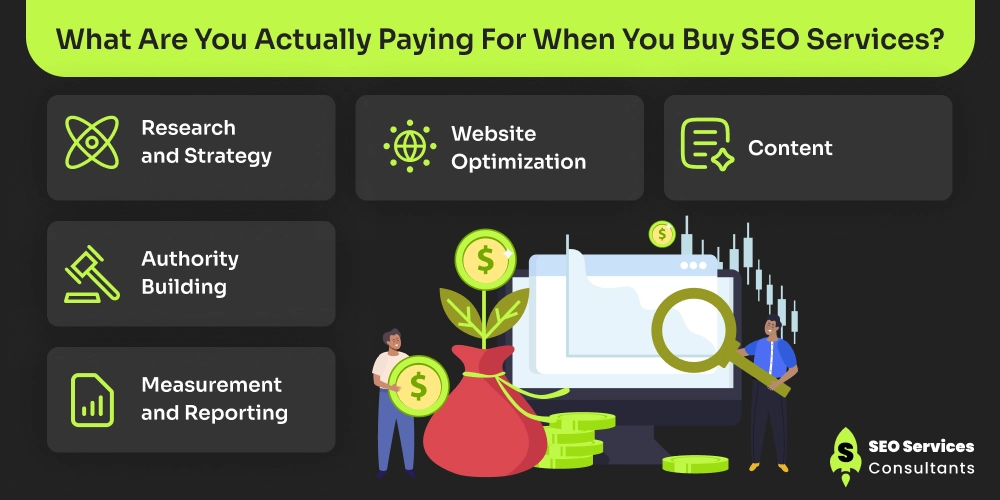
Do you think, “If I spend $X every month on SEO, what will I actually get?”
So, when you pay for SEO services, you don’t just pay someone to “get your website ranked on Google.”
A good SEO strategy involves several tasks and techniques that work together toward one goal: bringing the right people to your website and turning that visibility into business results.
Here’s what you can expect from an SEO company to offer you in your SEO services package:
Research and Strategy
You can expect SEO to deliver desired results only when it is designed around your business. SEO begins with understanding your business, customers, competitors, and search behavior. This includes keyword research, analyzing search intent, SERP research, and deciding which pages should target which opportunities.
Website Optimization
To make your website visible to users and search engines, it should be well optimized. Optimization involves identifying and fixing technical issues that can affect crawling and indexing, improving on-page elements, internal linking, page experience, and conversion. As per Google recommendations, making important content accessible, crawlable, and easy to discover through internal links is also significant.
Content
SEO may involve creating or improving service pages, product pages, blog content, comparison pages, and other resources that genuinely answer customer questions. Google’s current guidance recommends producing original, useful, non-commodity content for both traditional and AI-powered search.
Authority Building
This can include earning relevant links, mentions, and other signals that strengthen the credibility of your website.
Measurement and Reporting
A professional SEO campaign should track more than rankings. Google Search Console can show search queries, impressions, clicks, and indexing issues, while analytics and CRM data can help connect organic traffic with leads and sales.
Thus, when you evaluate or choose an SEO provider, don’t get impressed by their ranking achievements; look for the work behind those rankings.
If you are paying an SEO agency every month, you should be able to see what work was completed, why it was done, and what happens next. While the exact deliverables will depend on your website, industry, and SEO plan, a genuine monthly SEO package will usually include:
- Website Audit
- Strategy Adjustments
- Technical SEO
- On-page Optimization
- Content Work
- Link & Authority Building
- Local SEO
- Performance Monitoring & Reporting
How Does SEO Add Value To Your Business?
Or, in simple words, how seo helps your business grow? SEO is often measured on the basis of rankings and organic traffic, but those numbers are only a part of the story.
TL;DR: The real value of SEO is what those improvements do for your business. A page that ranks higher for the right search term can bring the right visitors, generate quality leads, support sales, and strengthen your online presence over time.
Here’s how you can leverage SEO for your business:
1. It captures existing customer demand
When a user triggers a search query such as “PUMA shoes near me”, “SEO agency for small business,” or “how much does a roofer SEO cost?”, they already have a need. SEO helps your business appear when people are actively looking for solutions like yours.
2. It can create a long-term acquisition cost
Paid advertising stops generating traffic or leads when you stop spending. But that’s not how SEO works; useful SEO content and optimized pages can continue attracting visitors over time. This doesn’t mean SEO becomes completely passive – it still needs monitoring, updates, and ongoing optimization. But successful work can continue creating value long after the initial investment.
3. It reduces dependence on paid channels
SEO doesn’t have to replace PPC or other marketing channels. It can give your business another way to reach potential customers and reduce reliance on continuously paying for every website visit.
4. It improves your website performance
SEO can detect technical problems, weak content, poor internal linking, and pages that don’t properly address customer needs. Fixing these issues can make your website visible and easier for both search engines and users to navigate. Google also recommends making content crawlable, accessible, useful, and easy to discover in search.
5. It builds visibility and trust
When your brand consistently appears in search results for relevant searches, people can become familiar with you. Further, publishing genuinely useful, experience-based information can also present your brand as credible and an expert. Both expertise and credibility are important elements of E-E-A-T guidelines.
6. It supports visibility in AI search
People are trusting AI Overviews and AI Answers more for search results, expanding SEO’s role in AI search experiences. Google says its foundational SEO practices remain relevant to AI Overviews and AI Mode, with useful, unique, people-first content remaining central.
TL;DR: The goal of SEO shouldn’t simply be “rank #1”. The bigger goal is to be discoverable, useful, and credible wherever your potential customers are searching.
The Real SEO ROI Question: Can SEO Make More Money Than It Costs?
The easiest way to decide whether SEO is worth the investment is to look beyond rankings and ask a simple question: Is the business making enough money from organic search to justify what it is spending on SEO?
A basic SEO ROI formula is =
SEO ROI = (Revenue from SEO – SEO Investment) / SEO Investment*100
Let’s understand using an example:
Suppose you spend $2,000 per month on SEO, and the campaign eventually brings you five additional customers each month. If each customer generates $1,500 in profit, that makes $7,500 in profit against a $2,000 investment. The numbers suggest SEO is creating positive value.
However, it’s not the right approach to evaluate SEO solely on rankings or traffic. These are useful metrics, but they don’t tell you whether the campaign is actually contributing to business growth. Google Search Console can show impressions, clicks, CTR, rankings, and the search queries that are bringing people to your site.
To get a clearer picture, also track:
- Organic leads and qualified leads
- Lead-to-customer conversion rate
- Organic sales and revenue
- Cost per lead or customer
- Customer lifetime value
- Conversion rate of organic visitors
- Assisted conversions
You can connect Google Search Console with Google Analytics to understand how visitors arriving from search behave on your website and what actions they take.
TL;DR: SEO ROI is different for every business. A campaign that looks expensive based on traffic alone may be highly profitable if it consistently brings high-value customers. On the contrary, thousands of new visitors mean little if they never become leads or buyers.
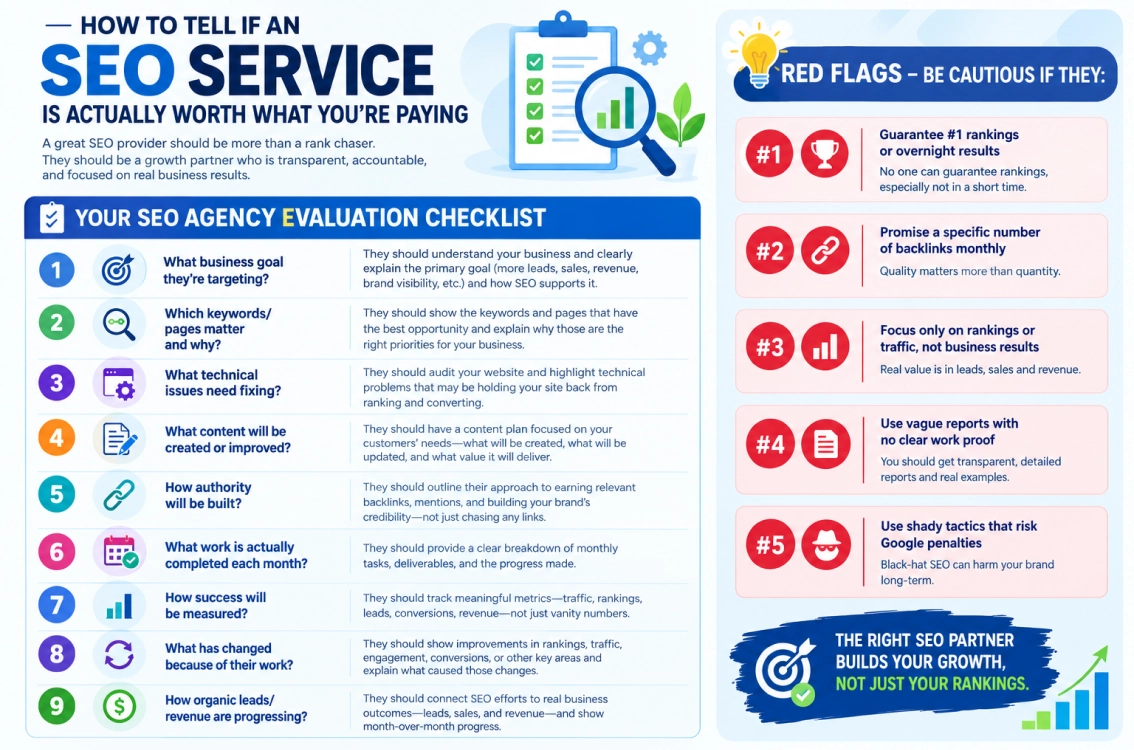
How To Tell If an SEO Service is Actually Worth What You’re Paying?
When you pay for SEO, it shouldn’t feel like paying for a black box. A reliable SEO provider should be able to clearly explain their strategies and roadmap, their significance, and the benefits they will bring for your business.
So before signing (or renewing) a contract, ask:
- What business goals are we targeting?
- Which keywords and pages are priorities, and why?
- What technical issues need fixing?
- What content will you create or improve?
- How will you build relevant authority?
- What work will be completed each month?
- Which metrics will you use to measure progress?
- How are organic leads, sales, or revenue changing?
Also, be wary of providers who promise guaranteed results, like “guaranteed #1 ranking,” or claim their tools have special access to Google’s ranking data.
TL;DR: The simplest test – your service provider should be able to show you the work completed, explain the reasoning behind it, and connect that work to measurable business outcomes.
Which Types of Businesses Benefit Most From SEO?
SEO tends to benefit those businesses whose offerings are being searched often by people online.
- Local Service Businesses like medical practices, mortgage brokers, home service businesses, law firms, and dentists can benefit a lot because customers tend to look for specific services in their region.
- B2B businesses, including SaaS companies, technology providers, manufacturers, and professional service firms, can use SEO to reach decision-makers researching solutions and comparing providers, or looking for answers to industry-specific problems.
- Ecommerce businesses can benefit by optimizing product and category pages while creating useful content that supports product discovery and purchase decisions.
- Besides, SEO can also benefit high-ticket businesses, where gaining even a few additional customers can justify the investment.
TL;DR: The higher the perceived value of each customer and the more frequently those customers look for the solution, the more compelling the business case for SEO.
When Are SEO Services Not Worth It?
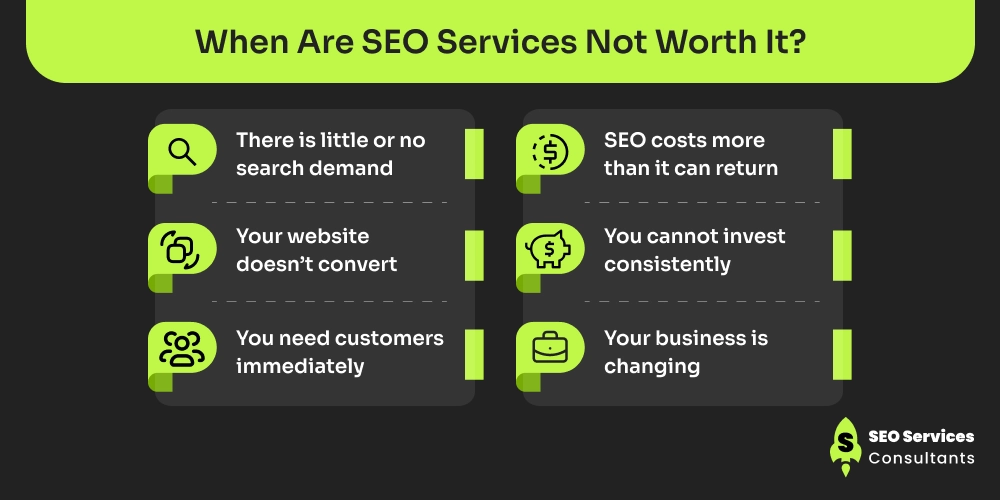
SEO can be a powerful long-term growth channel, but it is not the right investment for every business or industry. Hence, it’s important to know when to hold back, as it can save you time and money.
- There is little or no search demand: SEO may not be for your business if your target customers rarely search for the product or service you offer. For example, a local business selling a completely new type of product may need to create awareness through social media, events, or partnerships before people begin searching for it.
- Your website doesn’t convert: More traffic will not solve problems with your website, offer, pricing, messaging, or sales process. You should focus on improving conversion issues before investing in SEO.
- You need customers immediately: If you need leads or sales within days or weeks, SEO isn’t for you, as it usually takes time to produce results. Instead, you should consider investing in paid ads, referrals, or direct outreach.
- SEO costs more than it can return: Compare your SEO costs with the profit each customer generates. If the potential return is too slow, SEO may not be a financially feasible option for you.
- You cannot invest consistently: SEO requires ongoing work, including content creation, technical improvements, monitoring, and regular updates. A one-month test is rarely enough to assess its potential.
- Your business is changing: Major pivots, market changes, or a planned shutdown may leave too little time to benefit from SEO.
How To Make SEO Worth The Investment?
SEO becomes more valuable when you treat it as a business growth strategy rather than a growth shortcut. Here’s how you can use it to get the most out of it:
- Start by defining clear goals, such as generating quality leads, increasing sales, or reducing customer acquisition costs.
- Before you invest heavily in content, validate search demand. Understand what your potential customers are actually looking for. Focus on keywords with commercial intent instead of chasing traffic that is unlikely to convert.
- Make your website conversion-ready by improving its technical health and fixing issues with content, messaging, user experience, and conversion paths before scaling traffic.
- Build topical authority by creating original, useful content that answers real customer questions and supports their buying journey. Then, measure what matters - leads, sales, revenue, and SEO ROI (return on investment).
- Finally, keep improving. SEO requires regular testing, updating, and refinement as your audience, competitors, and search landscape change.
Conclusion - So, Are SEO Services Worth The Money?
SEO services can be worth it, but there’s no one-size-fits-all answer. It depends on your search demand, business goals, customer values, timeline, and ability to execute consistently.
It’s not about whether SEO works in general, but whether it can bring your business enough qualified customers and revenue to make the investment worthwhile.
If the numbers make sense, SEO can become a reliable source of long-term compounding growth. If they don’t, fixing your website, offer, or customer acquisition strategy, or choosing another marketing channel, may be smarter.
And if you’re still unsure, don’t rush into a long-term contract. Start with an SEO opportunity assessment to understand where the potential returns actually are.
Frequently Asked Questions
1. Are SEO services worth paying for?
Yes, SEO services are worth it, only if it fits your business model. This means you should invest in SEO if your ideal customers are searching for your products or services online. The SEO investment makes more sense when you have strong customer value, realistic competition, and enough time to see results.
2. How much should a business spend on SEO?
There is no fixed SEO budget that works for every business. Your investment depends on your industry, competition, website, size, goals, target market, and the amount of work required. The right budget should support a realistic strategy.
3. How long does SEO take to show results?
SEO takes several months to generate meaningful results. However, improvements can appear earlier. How long SEO takes to show results depends on your site’s current situation in the digital landscape, competition, content, authority, search demand, and how consistently SEO recommendations are implemented.
4. Is SEO still worth it in 2026?
Yes, SEO remains significant in 2026 and beyond because people still use search engines to discover information, products, and services. However, search is changing with AI-powered experiences. So, businesses should focus on useful content, technical foundations, building credibility, and visibility across evolving search experiences.
5. How do you compare SEO cost vs. ROI?
Compare your SEO investment with the revenue or profit generated from organic search, rather than focusing only on rankings and traffic. Consider qualified leads, conversions, customer value, and acquisition costs to determine whether SEO is producing a worthwhile return.