

Generating relevant leads to your website is important, as is getting organic traffic. But in most cases, websites may rank well on Google and attract thousands of visitors but still generate very few qualified leads.
There can be several reasons, such as wrong keyword targeting, search intent, unclear calls to action, a lack of trust signals, etc. Inaccurate conversion tracking can also make it difficult to understand how effectively your organic traffic contributes to lead generation.
Understanding these challenges helps you identify gaps in your SEO strategy and focus on attracting relevant visitors who are more likely to become potential customers.
Continue reading this blog to learn why organic traffic can still produce poor leads and how you can improve lead quality.
Key Takeaways
- Studies show that 53% of visitors leave your website if it takes more than three seconds to load.
- Target commercial and transactional keywords to reach potential customers who are actively looking to buy.
- Complicated forms, technical issues, and poor mobile usability can prevent interested visitors from converting.
- Use Google Analytics 4 and Google Search Console to understand which traffic sources and pages generate qualified leads.
- Measure relevant enquiries, qualified prospects, and conversions to understand the business impact of your SEO efforts.
- Give basic information related to your products or services so that users don't leave your website without exploring.
Common Reasons Your Website Traffic Isn't Converting Into Leads
Understanding common issues can help you identify why visitors leave without taking action and how you can improve to generate more qualified leads.
1. Targeting Keywords With Low Buying Intent
Not every term searched by users on Google has a buying motive. Some users simply browse the internet to get information.
For example, a user searches for “how to polish wooden furniture at home” or “how to polish wood furniture with oil”, etc. These terms are searched with an informational motive rather than to hire a professional or purchase a service.
But if users type queries like “buy furniture online” or “buy furniture on rent”, these terms demonstrate a stronger purchase intent. Users are actively looking for furniture to buy or rent and may be closer to making a transaction.
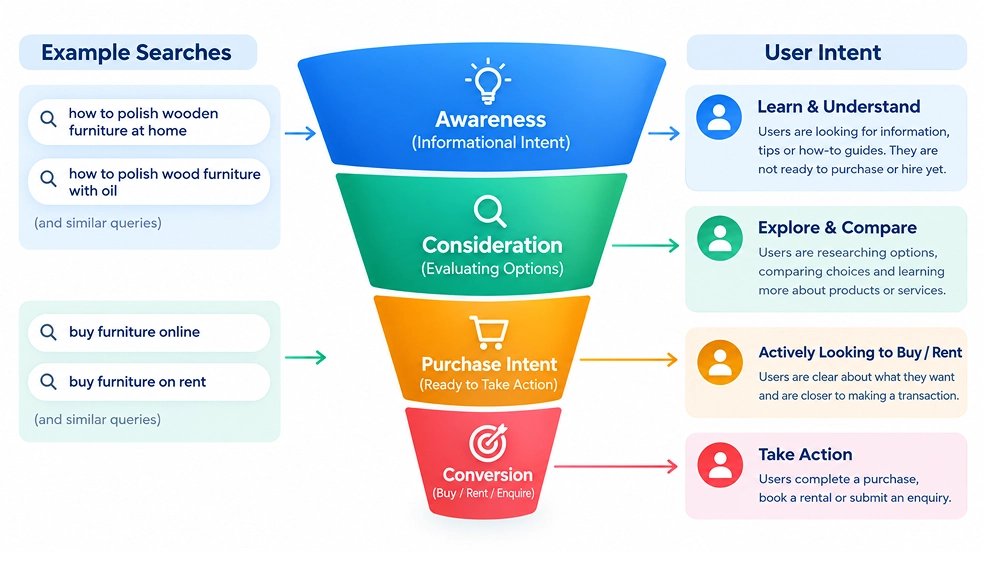
It is very important to understand user query intent. Targeting informational keywords only may increase website traffic without generating enough leads or sales.
To attract potential customers, businesses should also target commercial and transactional keywords that align with their products or services and the audience’s purchasing needs.
How to Increase Qualified Leads
- Focus on keywords that you are targeting; they must be aligned with the target audience’s intent and business goals.
- Do keyword analysis; it will help you understand the terms potential customers use when looking for products or services like yours.
- Include relevant commercial and transactional keywords in your service pages, product pages, and landing pages.
- Also, target informational keywords in blog posts to attract the right audiences who are looking for information only.
2. Attracting the Wrong Audience
Your website may get high traffic, but that doesn’t guarantee you are attracting your target audience.
Sometimes, users visit your website to browse your content, but they aren’t part of your target market.
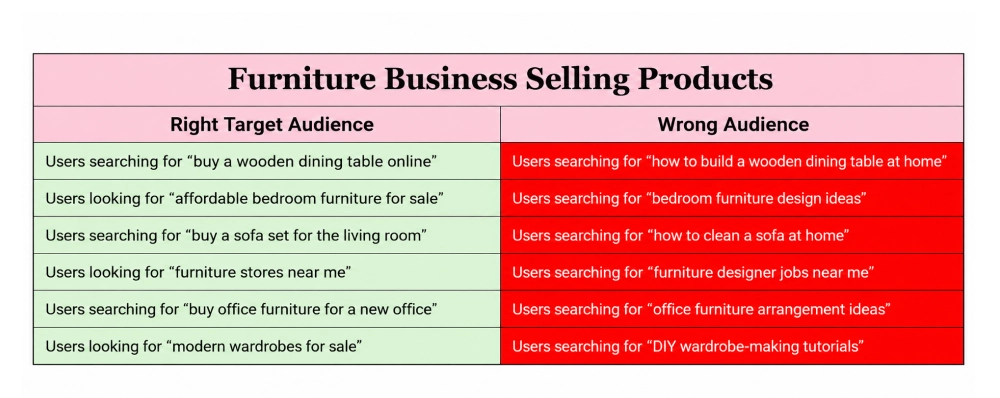
For example, you run a digital marketing agency in the USA providing services like SEO, PPC, Social media, etc. If your website attracts users who are searching for “free SEO tools” or “digital marketing course”, this may increase your organic traffic, but these are not the right audience. They are looking for something else.
Similarly, you may attract the right audience but from different countries where you don’t serve. This may generate irrelevant leads.
Therefore, it is important to understand the audiences that are visiting your website. Focus on creating content and targeting keywords that attract the right audiences and are more likely to become customers.
More examples:
How to Increase Qualified Leads
- Target audiences based on their purchasing behaviour, needs, and location.
- Select relevant keywords based on your business products or services and users who are actually interested in buying them.
- Create content that focuses on solving users’ queries and explains how your products or services can help.
- If your business operates in any particular location, then focus on local keywords and ensure that your business targets location-based content.
- Use tools such as Google Analytics 4 to identify visitors' locations, landing pages, and engagement patterns to identify irrelevant traffic.
3. Search Intent Doesn't Match the Landing Page
Even if you target the right audience, it doesn’t guarantee generating leads. Why?
Because after clicking on a particular web page of a website, users expect to be redirected to the right landing page.
For example, you search for “buy a wooden dining table online”; of course, you expect that after clicking on blue clickable links, you will be redirected to a category page showing products, where you browse products and place an order.
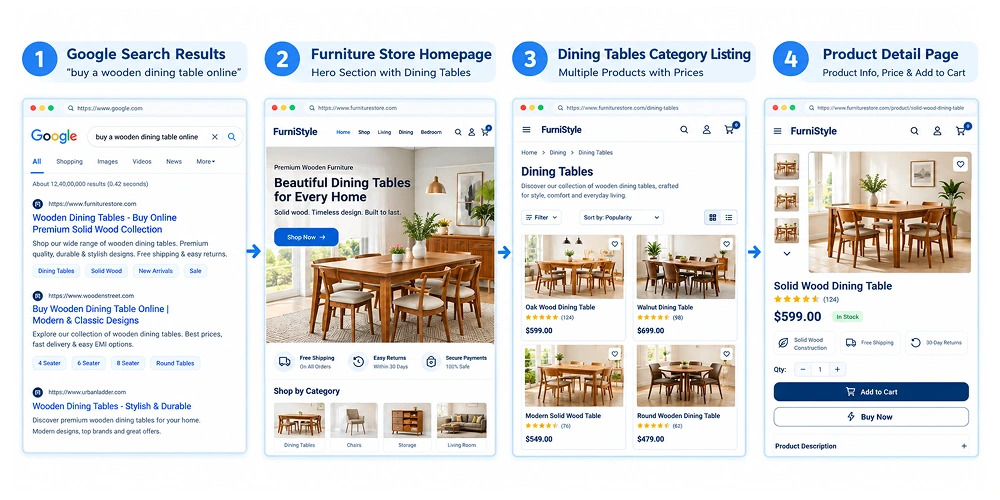
But if, after clicking, it redirects to a blog page providing information regarding different types of wooden dining tables without showing products available for purchase. You may leave the website without exploring further.
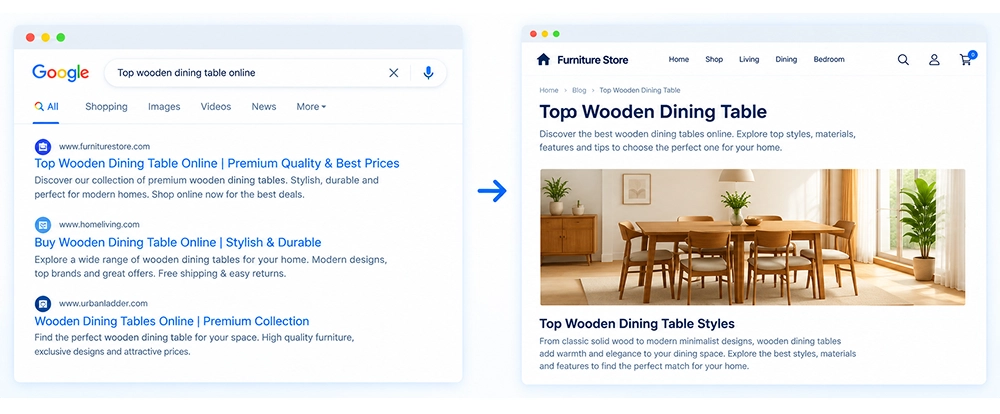
That’s why it is important to check that users are directed to relevant product pages, service pages, or informational content based on what they are looking for.
This helps improve their experience and increases the chances of turning organic visitors into qualified leads or customers.
How to Increase Qualified Leads
- Start by identifying what users are actually looking for. Whether browsing the internet to get specific information or to buy a product/services.
- Must ensure that users are directed to the right page after clicking on blue links in search results.
- Users looking for a product > Product Page
- Users looking for services > Service Page
- Users looking for information > Blog Post
- Use Google Search Console to identify the queries bringing visitors to each page and check whether the page satisfies their needs.
- Add relevant internal links or CTAs.
4. Weak Calls to Action and Unclear Value Propositions
Sometimes, weak CTAs and unclear value propositions confuse visitors, lose interest, or may fail to convert visitors into customers.
Value propositions clearly explain what your business offers, how it benefits customers, and why they should choose your products or services over other options.
Call to Action ( CTA ) is a prompt that tells your audience what step to take next.
To illustrate, your business provides SEO services. Visitors who visit your site may be looking for professional SEO support for their business, but your web page only highlights “We are the best digital marketing agency providing SEO services” or “We provide digital marketing services”.
But your page doesn’t explain anything about how your services can help your business improve search visibility or generate qualified leads.
Similarly, if your website uses a vague CTA such as “Learn More” instead of a clear, relevant option like “Get Your Free SEO Audit,” visitors may not understand what action to take next.
To improve lead generation, it is important to communicate your value proposition clearly by highlighting the benefits customers can expect from your services. Use specific, action-oriented CTAs that tell visitors what to do next and make the process simple.
How to Increase Qualified Leads
- Your website clearly explains business offerings, how it benefits customers, and why they should choose your products or services.
- Whenever a customer visits a particular site, they expect to get what they are looking for. So it is important to focus on customers’ queries and benefits.
- Use clear, action-oriented CTAs.
- Avoid lengthy forms and unnecessary information that may lead to visitors leaving the site without taking any action.
- Track button clicks, form submissions, and qualified leads to determine whether your changes improve conversions.
5. Lack of Trust and Credibility Signals
Before taking any action, visitors check core signals that disclose business reliability, experience, and capability.
Core signals may include customer reviews, testimonials, case studies, certifications, transparent pricing, and clear contact information.
For example, customers visit your website for SEO services. Your website highlights only services without any client testimonials and case studies. The visitor may not invest in your services because your website has no evidence to evaluate credibility.
As a result, your website may attract relevant organic traffic but generate fewer qualified leads.
How to Increase Qualified Leads
- Show genuine customer reviews to help future clients understand their experience working with your business.
- Demonstrate how your products or services have helped customers solve problems or achieve measurable results.
- Mention ratings and reviews on verified platforms like Clutch, Trustpilot, Yelp, Google Business Profile, and MouthShut.
- Highlight relevant qualifications, industry memberships, awards, or certifications that support your expertise.
- Make your contact details, company information, and service terms easy to find.
- Use HTTPS, maintain a consistent design, and ensure your pages and forms work correctly.
6. Poor Conversion Experience and Complicated Forms
Websites with technical issues and complicated form submission processes may generate fewer leads even if you target the right audiences and keywords.
For example, users visit your website to request a quote for SEO services. They find a suitable service but encounter a lengthy form with unnecessary details, such as company size, annual revenue, a full business address, and multiple marketing requirements.
The user may leave because the process takes too long or requires too much information.
As a result, your website may receive substantial organic traffic without generating enough enquiries or qualified leads.
How to Increase Qualified Leads
- Ask only for necessary details like name, business email, and the service required.
- Make navigation easy for visitors to find relevant service pages, pricing information, contact details, and enquiry options.
- Add accurate CTAs such as “Request a Free SEO Audit” or “Get a Quote” to guide visitors toward the next step.
- Solve all technical issues that reduce website speed and may cause potential customers to leave.
- Show relevant testimonials, case studies, and privacy information near forms to help visitors feel confident about sharing their details.
7. Incorrect Lead Tracking and Measurement
Accurate lead tracking helps you understand how effectively your organic traffic contributes to business enquiries. However, incorrect tracking configurations can make it difficult to measure conversions and identify which pages or traffic sources generate valuable leads.
Missing conversion events, duplicate tracking, or incorrectly configured Google Analytics 4 (GA4) reports can lead to misleading performance data.
For example, a user visits your website via Google and submits an enquiry form for SEO services. The enquiry reaches your business, but the form submission event is not configured correctly in GA4, so the conversion is not recorded.
These errors can create a disconnect between reported organic traffic and lead generation.
How to Increase Qualified Leads
- Check GA4 events to track important actions, such as enquiry form submissions, quote requests, phone calls, and consultation bookings.
- Submit test enquiries to confirm that each conversion is recorded accurately and that events are not missing or counted multiple times.
- Use Search Console to understand which search queries and landing pages attract organic visitors, and GA4 to analyze their on-site behavior and conversion activity.
- Connect your website analytics with your CRM to identify which enquiries become genuine prospects and paying customers.
- Compare organic traffic, engagement, conversion rates, and lead quality across different landing pages to identify which pages contribute to business growth.
- Check conversion reports regularly to identify unusual changes, measurement errors, or discrepancies between analytics data and actual enquiries.
8. Poor Mobile Experience
Today, around 5.83 billion people use smartphones globally for activities such as shopping, studying, watching movies, and searching the web.
About 96% of global internet users access websites on mobile phones, and mobile devices generate between 51% and 60% of all global website traffic.
If visitors struggle to navigate your website easily, then they may leave without performing any action.
For example, you are searching for “best running shoes for men” on your mobile.
You visit a website with issues like unreadable text, non-clickable CTA buttons, or the enquiry form not fitting properly on the screen. Most probably, you leave the site, and the business is unable to generate leads.
How to Increase Qualified Leads
- Check that your website is responsive for all screen sizes.
- Optimize images, scripts, and other page elements to reduce loading delays and help visitors access information quickly.
- Ensure CTA buttons are visible, readable, and easy to tap on smaller screens.
- Use clear menus and make important pages, contact details, and service information easy to find.
- Check your website on different devices and screen sizes. Use Google PageSpeed Insights and GA4 to identify performance issues and understand how mobile visitors interact with your website.
9. Lack of Relevant Information
When users search for something via Google or AI, they expect to get fast, accurate, relevant results that directly solve their needs.
If your website does not provide relevant information, then users may leave without wasting more time.
For example, when users search for “affordable sports shoes”, they expect a list of budget-friendly options, clear specifications, key features, and multiple colour options with sizes.
However, if your website content provides basic information without mentioning prices, available sizes, colours, or key features, users may leave the site. As a result, your website may attract organic traffic but fail to convert visitors into customers.
How to Increase Qualified Leads
- Identify what information users expect to find when they search for your products or services.
- Include basic details like pricing, key features, specifications, etc.
- Add relevant headings, bullet points, product details, and comparison tables to help visitors find information quickly.
10. Slow Follow-Up on Incoming Leads
Generating an enquiry does not guarantee that it will become a qualified opportunity. If your business takes longer to respond to incoming leads, potential customers may lose interest or contact a competitor who responds sooner.
For example, a business owner searches for an “SEO agency” and submits an enquiry form to request a consultation. However, your team does not respond for several days. During that time, the business owner may contact other agencies.
In this situation, your website has successfully attracted relevant organic traffic and generated an enquiry, but the delay in follow-up reduces the likelihood of converting that lead into a customer.
How to Increase Qualified Leads
- Respond to users’ enquiries promptly through email, WhatsApp, or other contact methods.
- Use CRMs to organize incoming leads, assign responsibility, and track follow-up activities.
- Prioritize enquiries based on their needs, service requirements, and readiness to purchase.
- Track lead response times and lead-to-customer conversion rates to identify opportunities to improve your sales process.
Frequently Asked Questions
1. What is the difference between organic traffic and qualified leads?
Organic traffic refers to free visitors who arrive naturally to your website via Google.
Qualified leads are potential customers whose needs, interests, or business requirements align with your offerings and who have a realistic chance of becoming customers. A website can receive substantial organic traffic without generating many qualified leads.
2. How to measure organic lead generation performance?
Evaluate organic conversions, qualified leads, or conversion and lead-to-customer rates with the help of the Google Analytics 4 (GA4) tool.
3. Why are my competitors generating more leads with less traffic?
They may target high-intent keywords, attract relevant audiences, and use effective landing pages with clear calls to action.
4. Should I prioritize organic traffic growth or lead generation?
Prioritize qualified lead generation while growing organic traffic to attract relevant visitors and achieve better business results.
5. What is the fastest way to generate leads?
The fastest way to generate leads is through paid online advertising (such as Google Ads and paid social media ads), which places your business in front of active buyers immediately.
Conclusion
High organic traffic is important only when it helps your business reach the right audience and achieve meaningful results. If your website attracts visitors but generates few qualified leads, the problem may lie in targeting the wrong keywords, an irrelevant audience, poor landing-page experience, or conversion tracking.
Start by evaluating which search queries bring visitors to your website and check whether those visitors match your target audience. Then review your landing pages, calls to action, credibility signals, enquiry forms, and mobile experience to identify obstacles that prevent conversions.
Ensure your analytics and CRM data accurately reflect the enquiries your business receives. The goal isn’t to attract more visitors, but to turn relevant organic traffic into qualified leads and potential customers.

Gurpreet Singh is a Marketing Manager at SEO Services Consultants. Over the years, he has worked with businesses from different industries, building strategies and approaches based on their needs.
The everyday challenges he comes across in his work often become the topics he writes about. His articles share what he learns from his work, research, and observations on ongoing market trends. Through his content, he aims to offer practical, clear, and useful insights to readers.